Thanks to Olga and Holly for factchecking a draft of this post. Remaining
errors are my responsibility of course.
The recent 2025 Teammate Hunt just finished, which went really well.
See the link to the wrapup.
I was a minor supporting character in the organizing team,
mostly just taking care of writing a few puzzles here and there.
This post is about the creation stories behind all those puzzles.
(Puzzle links only work if you’re logged in for now;
public access is coming later.)
This was a puzzle that worked because of our hunt structure
(control panel puzzles come in pairs).
Masyu is a common logic puzzle genre, and I was curious if there
was another standard Nikoli genre that also involved a closed loop.
That’s how I …
I remember when I got the central aha, I justified it to my teammates as
“it’d be so cool, so it has to be right”.
— Nathan Pinsker
This is a post meant to explain what makes puzzle hunts appealing
to people who haven’t done them before.
If you do care about the actual mechanical details,
Brian’s introduction is great.
The one-sentence summary is: you’re (usually) trying to get an English
word/phrase as the final answer, there are (usually) no directions or
instructions, and I write “usually” everywhere because puzzle hunts love
breaking rules.
When I first tell people about puzzle hunts, their initial reaction is usually
that the fun must be in the challenge. And it is not untrue that there is a
notion of skill, and it’s satisfying to become a stronger solver. However, I
think this misses the point: it ignores the …
This is a retro-post for the Mystery Hunt 2023,
for which I played a somewhat minor role on the organizing team (teammate).
You can play at interestingthings.museum.
Office décor.
There is an ongoing list of write-ups about the hunt being kept at
puzzles.wiki,
and you may also be interested in the
reddit AMA from teammate.
I worked with a few friends on writing a mini one-round puzzle hunt for this year’s MOP students.
If you want to play, you can do so now at the following URL:
I’m not sure whether or not this is going to become a recurring tradition.
On the one hand, it was loads of fun to make
(including figuring out how to draw art on my iPad);
on the other hand, I definitely didn’t blow a couple hundred hours
of my life putting this together. ;)
Unrelated advertisement: the Carina Initiatives
is currently looking to hire a junior data scientist.
They’re a young philanthropic fund that’s interested in supporting initiatives
that build actual math problem solving (like, the problem-solving you’d see on this blog,
not the mainstream buzzword stuff).
I’ve had a lot of fun talking with them over the …
As a follow-up to the previous post,
I am recording here some details about the (numerous, varied, and deep)
revisions that a bunch of my puzzles went through during the production process.
These puzzles are in chronological order of when I wrote the puzzle.
Spoiler warning:
Unlike the last post, these will completely spoil all of the puzzles below.
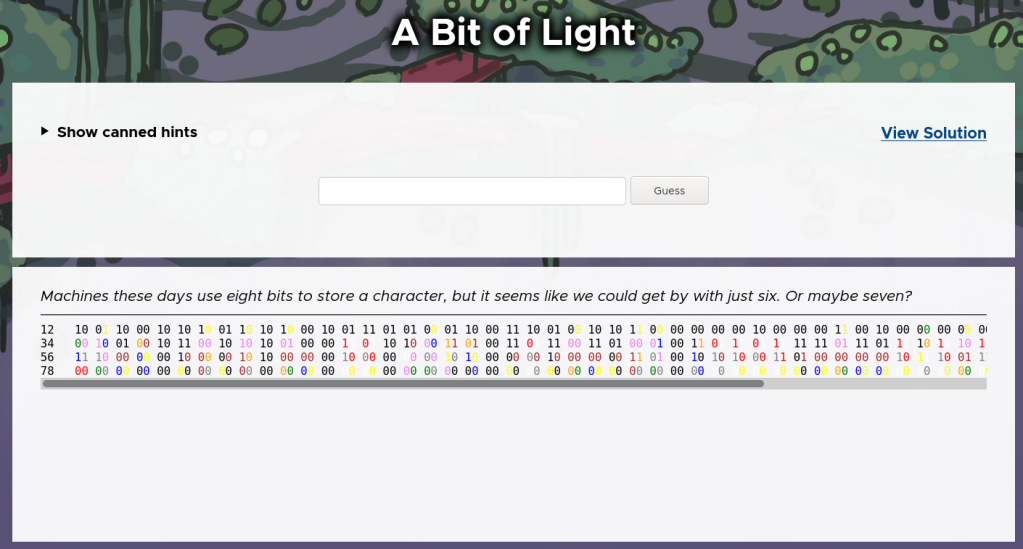
Surprisingly, the gist of the puzzle mostly survived revisions:
the idea of an encoding-based puzzle with the
key step to look at seven-segment displays between the Braille and resistor color encoding.
One issue I ran into while constructing was that
ABCDEF6 is actually too big in base 16 to store in an eight-bit number,
which is part of why I ended up 1337-ing the seven-segment display bits.
The final presentation of the “A Bit of Light” puzzle;
it looked pretty much like this at the start …
The 2021 Mystery Hunt
concluded a while ago, and wow, what an experience.
I was lucky enough to be on the organizing team,
and I am so proud right now to be able to say I am a ✈️✈️✈️ Galactic Trensdetter ✈️✈️✈️.
(If you don’t know what a puzzle hunt is,
betaveros has a great introduction.)
I came in to the MIT Mystery Hunt with no writing experience at all,
and ended up being listed as the author of a few.
It was a trial by fire, to say the least.
In this post I want to say a bit about the parts
of the puzzle-writing process that surprised me the most,
in the hopes that maybe it would be helpful to future authors.
A nice introduction is given by e.g.
David Wilson,
which I read many times before I actually attempted to write my first puzzle.
Most of what …