
🖉 Artin Reciprocity
I will tell you a story about the Reciprocity Law. After my thesis, I had the idea to define -series for non-abelian extensions. But for them to agree with the -series for abelian extensions, a certain isomorphism had to be true. I could show it implied all the standard reciprocity laws. So I called it the General Reciprocity Law and tried to prove it but couldn’t, even after many tries. Then I showed it to the other number theorists, but they all laughed at it, and I remember Hasse in particular telling me it couldn’t possibly be true.
Still, I kept at it, but nothing I tried worked. Not a week went by — for three years! — that I did not try to prove the Reciprocity Law. It was discouraging, and meanwhile I turned to other things. Then one afternoon I had nothing special to do, so I said, `Well, I try to prove the Reciprocity Law again.’ So I went out and sat down in the garden. You see, from the very beginning I had the idea to use the cyclotomic fields, but they never worked, and now I suddenly saw that all this time I had been using them in the wrong way — and in half an hour I had it.
— Emil Artin
Algebraic number theory assumed (e.g. the ANT chapters of Napkin). In this post, I’m going to state some big theorems of global class field theory and use them to deduce the Kronecker-Weber plus Hilbert class fields. For experts: this is global class field theory, without ideles.
Here’s the executive summary: let be a number field. Then all abelian extensions can be understood using solely information intrinsic to : namely, the ray class groups (generalizing ideal class groups).
1. Infinite primes
Let be a number field of degree . We know what a prime ideal of is, but we now allow for the so-called infinite primes, which I’ll describe using embeddings. We know there are embeddings , which consist of
- real embeddings where , and
- pairs of conjugate complex embeddings.
Hence . The first class of embeddings form the real infinite primes, while the complex infinite primes are the second type. We say is totally real (resp totally complex) if all its infinite primes are real (resp complex).
Example 1 (Examples of infinite primes)
- has a single real infinite prime. We often write it as .
- has a single complex infinite prime, and no real infinite primes. Hence totally complex.
- has two real infinite primes, and no complex infinite primes. Hence totally real.
The motivation from this actually comes from the theory of valuations. Every prime corresponds exactly to a valuation; the infinite primes correspond to the Archimedean valuations while the finite primes correspond to the non-Archimedean valuations.
2. Modular arithmetic with infinite primes
A modulus is a formal product where the product runs over all primes, finite and infinite. (Here is a nonnegative integer, of which only finitely many are nonzero.) We also require that
- for any complex infinite prime , and
- for any real infinite prime .
Obviously, every can be written as by separating the finite from the (real) infinite primes.
We say if
- If is a finite prime, then means exactly what you think it should mean: .
- If is a real infinite prime , then means that .
Of course, means modulo each prime power in . With this, we can define a generalization of the class group:
Definition 2. Let be a modulus of a number field .
- Let to be the set of all fractional ideals of which are relatively prime to , which is an abelian group.
Let be the subgroup of generated by
This is sometimes called a “ray” of principal ideals.
Finally define the ray class group of to be .
This group is known to always be finite. Note the usual class group is .
One last definition that we’ll use right after Artin reciprocity:
Definition 3. A congruence subgroup of is a subgroup with Thus is a group which contains a lattice of various quotients , where is a congruence subgroup.
This definition takes a while to get used to, so here are examples.
Example 4 (Ray class groups in )
Consider with infinite prime . Then
- If we take then is all fractional ideals, and is all principal fractional ideals. Their quotient is the usual class group of , which is trivial.
Now take . Thus . Moreover
You might at first glance think that the quotient is thus . But the issue is that we are dealing with ideals: specifically, we have
because . So actually, we get
Now take . As before . Now, by definition we have
At first glance you might think this was , but the same behavior with ideals shows in fact . So in this case, still has all principal fractional ideals. Therefore, is still trivial.
Finally, let . As before . Now in this case:
This time, we really do have : we have and also . So neither of the generators of are in . Thus we finally obtain
with the bijection given by .
Generalizing these examples, we see that
3. Infinite primes in extensions
I want to emphasize that everything above is intrinsic to a particular number field . After this point we are going to consider extensions but it is important to keep in mind the distinction that the concept of modulus and ray class group are objects defined solely from rather than the above .
Now take a Galois extension of degree .
We already know prime ideals of break into a product of prime
ideals of in in a nice way, so we want to do the same thing with infinite primes.
This is straightforward: each of the infinite primes
lifts to infinite primes ,
by which I mean the diagram
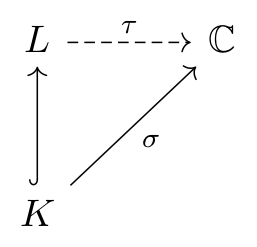 commutes.
Hence like before, each infinite prime of has infinite primes
of which lie above it.
commutes.
Hence like before, each infinite prime of has infinite primes
of which lie above it.
For a real prime of , any of the resulting above it are complex, we say that the prime ramifies in the extension . Otherwise it is unramified in . An infinite prime of is always unramified in . In this way, we can talk about an unramified Galois extension : it is one where all primes (finite or infinite) are unramified.
Example 5 (Ramification of )
Let be the real infinite prime of .
- is ramified in .
- is unramified in .
Note also that if is totally complex then any extension is unramified.
4. Frobenius element and Artin symbol
Recall the following key result:
Theorem 6 (Frobenius element)
Let be a Galois extension. If is a prime unramified in , and a prime above it in . Then there is a unique element of , denoted , obeying
Example 7 (Example of Frobenius elements)
Let , . We have .
If is an odd prime with above it, then is the unique element such that in . In particular,
From this we see that is the identity when and is complex conjugation when .
Example 8 (Cyclotomic Frobenius element)
Generalizing previous example, let and , with an -th root of unity. It’s well-known that is unramified outside and prime factors of . Moreover, the Galois group is : the Galois group consists of elements of the form and .
Then it follows just like before that if is prime and is above
An important property of the Frobenius element is its order is related to the decomposition of in the higher field in the nicest way possible:
Lemma 9 (Order of the Frobenius element)
The Frobenius element of an extension has order equal to the inertial degree of , that is, In particular, if and only if splits completely in .
Proof: We want to understand the order of the map on the field . But the latter is isomorphic to the splitting field of in , by Galois theory of finite fields. Hence the order is .
Exercise 10. Deduce from this that the rational primes which split completely in are exactly those with . Here is an -th root of unity.
The Galois group acts transitively among the set of above a given , so that we have Thus is determined by its underlying up to conjugation.
In class field theory, we are interested in abelian extensions, (which just means that is Galois) in which case the theory becomes extra nice: the conjugacy classes have size one.
Definition 11. Assume is an abelian extension. Then for a given unramified prime in , the element doesn’t depend on the choice of . We denote the resulting by the Artin symbol.
The definition of the Artin symbol is written deliberately to look like the Legendre symbol. To see why:
Example 12 (Legendre symbol subsumed by Artin symbol)
Suppose we want to understand where is prime. Consider the element
It is uniquely determined by where it sends . But in fact we have
where is the usual Legendre symbol, and is above in . Thus the Artin symbol generalizes the quadratic Legendre symbol.
Example 13 (Cubic Legendre symbol subsumed by Artin symbol)
Similarly, it also generalizes the cubic Legendre symbol. To see this, assume is primary in (thus is Eisenstein integers). Then for example
where is above in .
5. Artin reciprocity
Now, we further capitalize on the fact that is abelian. For brevity, in what follows let denote the primes of (either finite or infinite) which ramify in .
Definition 14. Let be an abelian extension and let be divisible by every prime in . Then since is abelian we can extend the Artin symbol multiplicatively to a map This is called the Artin map, and it is surjective (for example by Chebotarev Density).
Since the map above is surjective, we denote its kernel by . Thus we have We can now present the long-awaited Artin reciprocity theorem.
Theorem 15 (Artin reciprocity)
Let be an abelian extension. Then there is a modulus , divisible by exactly the primes of , with the following property: if is divisible by all primes of
We call the conductor of .
So the conductor plays a similar role to the discriminant (divisible by exactly the primes which ramify), and when is divisible by the conductor, is a congruence subgroup.
Note that for example, if we pick such that then Artin reciprocity means that there is an isomorphism More generally, we see that is always a subgroup some subgroup .
Example 16 (Cyclotomic field)
Let be a primitive -th root of unity. We show in this example that
This is the generic example of achieving the lower bound in Artin reciprocity. It also implies that .
It’s well-known is unramified outside finite primes dividing , so that the Artin symbol is defined on . Now the Artin map is given by
So we see that the kernel of this map is trivial, i.e.\ it is given by the identity of the Galois group, corresponding to . Then for a unique abelian extension .
Finally, such subgroups reverse inclusion in the best way possible:
Lemma 17 (Inclusion-reversing congruence subgroups)
Fix a modulus . Let and be abelian extensions and suppose is divisible by the conductors of and . Then Here by we mean that is isomorphic to some subfield of .
Proof: Let us first prove the equivalence with fixed.
In one direction, assume ; one can check from the definitions that the diagram
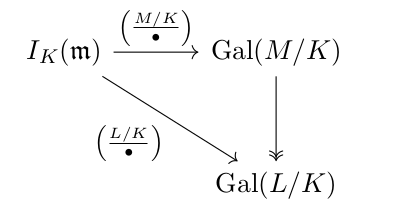 commutes, because it suffices to verify this for prime powers,
which is just saying that Frobenius elements behave well with respect to restriction.
Then the inclusion of kernels follows directly.
The reverse direction is essentially the Takagi existence theorem.
commutes, because it suffices to verify this for prime powers,
which is just saying that Frobenius elements behave well with respect to restriction.
Then the inclusion of kernels follows directly.
The reverse direction is essentially the Takagi existence theorem.
Note that we can always take to be the product of conductors here.
6. Consequences
With all this theory we can deduce the following two results.
Corollary 18 (Kronecker-Weber theorem)
Let be an abelian extension of . Then is contained in a cyclic extension where is an -th root of unity (for some ).
Proof: Suppose for some . Then by the example from earlier we have the chain
So by inclusion reversal we’re done.
Corollary 19 (Hilbert class field)
Let be any number field. Then there exists a unique abelian extension which is unramified at all primes (finite or infinite) and such that
- is the maximal such extension by inclusion.
- is isomorphic to the class group of .
- A prime of splits completely in if and only if it is principal.
We call the Hilbert class field of .
Proof: Apply the Takagi existence theorem with to obtain an unramified extension such that . We claim this works:
- To see it is maximal by inclusion, note that any other extension with this property has conductor (no primes divide the conductor), and then we have , so inclusion reversal gives .
- We have the class group.
- The isomorphism in the previous part is given by the Artin symbol. So splits completely if and only if if and only if is principal (trivial in ).
This completes the proof.
One can also derive quadratic and cubic reciprocity from Artin reciprocity; see this link for QR and this link for CR.