During your turn, part of figuring out the best move involves looking into the
future to see what the next player will do. If they discard, will it be okay?
Is there some obvious clue that they will do? And so on.
As you get better at Hanabi, you will need to do this prediction not just for
the next player, but for an entire go-around of the table. And as you really
get good at Hanabi, you will need to do this for as far in the future as you
can reasonably predict. (Sometimes, this means 15 moves or more in the
future.)
Similar to chess, initiating a move in which you can predict the next sequence
of moves is called initiating a “line”.
In post-game reviews, we will often compare and hypothetically “play through”
two different lines …
In my last semester of MIT I led a recitation (i.e. twice-a-week review) sessionFor those of you that don’t know how the system works, at MIT,
18.02 is a huge class with 400 to 500 students (mostly first-years).
In order to make sure students actually get the individual attention they
need (impossible during lecture), the math department also places each student in a
recitation section
of about 20 students each, meeting twice a week for an hour each.
for multivariable calculus (18.02) at MIT
(although the first few weeks are all linear algebra).
It’s different from many contexts I’ve taught in before;
the emphasis of the class is on doing standard procedures,
but the challenge is that there is a lot of ground covered.
That is, compared to other settings I’ve taught,
there is generally a tradeoff of less depth for more …
I was a coordinator for last year’s IMO 2024 and this year’s IMO 2025.Before, I was a coordinator for some virtual IMO during the pandemic too,
which is much less fun. And from 2017-2019 I was an observer for the USA.
Here’s some thoughts about that, contrasting my IMO 2019 post.
What is coordination?
For those of you that don’t know, coordination is the grading process for IMO.
As I describe it in my FAQ:
Basically, the outline of the idea is: before the exam, a marking scheme
(rubric) is set for each problem, to cover the typical cases of what progress
will be worth what points. Then, the leaders of each country get to see the
solutions of their country’s students, while there is a number of coordinators
from the IMO host country for each problem. Both the coordinators and the
leaders read …
I am always harping on my students to write solutions well rather
than aiming for just mathematically correct, and now I have a
pair of problems to illustrate why.
For any integer d>0,
let f(d) be the smallest positive integer that has exactly d positive divisors
(for example, f(1)=1, f(5)=16, and f(6)=12).
Prove that for every integer k≥0, f(2k) divides f(2k+1).
I like this problem, so try it out if you haven’t.
This is a problem …
During this year’s MOP,
we used the following procedure to divide some of our students into two classes:
Let p=7075374838595186541578161 be prime.
Take the letters in your name as it appears on the roster,
convert them with A1Z26 and take the sum of cubes to get a number s.
For example, EVANCHEN corresponds to s=53+223+⋯+143=16926.
Then you’re in Red 1 (room A155) if s is a quadratic residue modulo p,
and Red 2 (room A133) otherwise.
The students were understandably a bit confused why the prime was chosen.
It turned out to be a prank:
if you ran the calculation on the 30-ish students in this class,
it was …
I recently had a student writing to me asking for advice on problem-solving. The
student gave a few examples of problems they didn’t solve (like I
tell people to). One of the
things that struck me about the message was their description of their work on
USAMO 2021/4, whose statement reads:
A finite set S of positive integers has the property that,
for each s∈S, and each positive integer divisor d of s,
there exists a unique element t∈S satisfying gcd(s,t)=d.
(The elements s and t could be equal.)
Given this information, find all possible values for the
number of elements of S.
Roughly (for privacy reasons, this isn’t exactly what …
This is a short blog post on the FrontierMath benchmark,
a set of lots of difficult math problems with easily verifiable answers.
Just to be clear, everything written here is my own thoughts
and doesn’t necessarily reflect the intention of any collaborators.
When you’re setting a problem for a competition like the IMO or Putnam,
three properties that are often considered desirable are:
It should require creative insight.
Competitions avoid problems that are too similar to existing ones
or too easily solved by simply applying standard textbook techniques.
You want the problems to really feel different
and force the solver to feel like they came up with a new idea to solve it.
This is sort of what the spirit of math olympiads is about.
It should not take a lot of implementation,
i.e. once a set of key ideas has been identified,
actually carrying out the …
There’s this pet peeve I have where people sometimes ask things like what kind
of strategies they should use for, say, collinearity problems in geometry.
Like, I know there are valid answers like Menelaus or something.
But the reason it bugs me is because “the problem says to prove collinearity”
is about as superficial as it gets.
It would be like asking for advice for problems that have “ABC” in them.
To drive my point, consider the following setup:
Let ABC be a triangle with circumcircle Γ
and incenter I and let M be the midpoint of BC.
Denote by D the foot of the perpendicular from I to BC.
The line through I perpendicular to A …
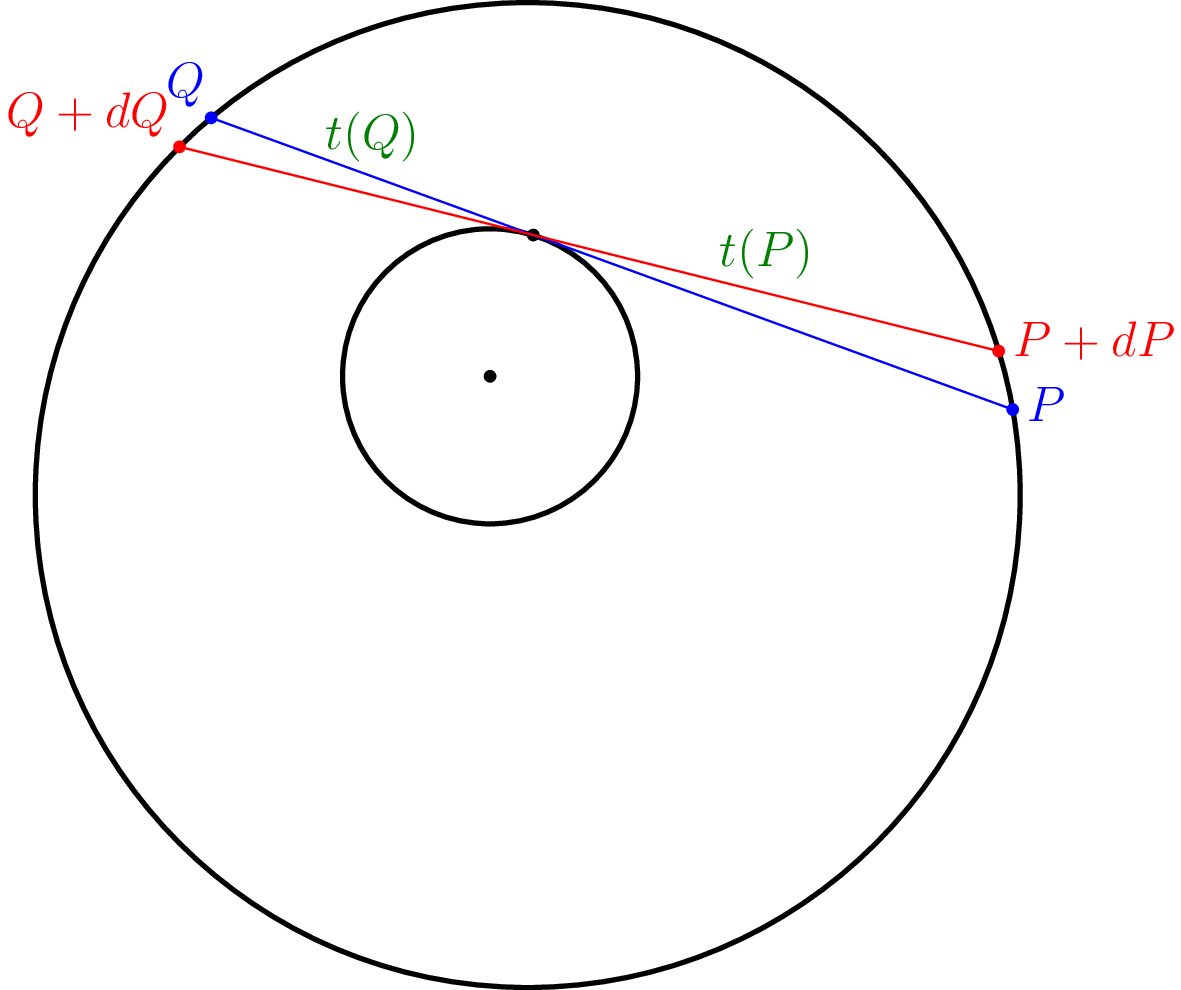
Brian Lawrence showed me the following conceptual proof of Poncelet porism in the case of two circles,
which I thought was neat and wanted to sketch here.
(This is only a sketch, since I’m not really defining the integration.)
Let P be a point on the outer circle,
and let Q be the point you get when you take the counterclockwise tangent from P to the inner circle.
Consider what happens if we nudge the point P by a small increment dP.
Figure for Poncelet porism proof.
The similar triangles in power of a point then give us the approximation
About five years ago I wrote a blog post warning that I thought it
was a bad idea to design math olympiads to be completely untrainable,
because I think math olympiads should be about talent development rather
than just talent identification, yada yada yada.
So now I want to say the other direction: I also don’t want to design
math olympiads so that every problem is 100% required to lie in a
fixed, rigid, and arbitrary boundary prescribed by some
nonexistent syllabus.
From a coach’s perspective, I want to reward “good” studying,
and whatever “good” means, I think it should include more than
zero flexibility and capacity to deal with slight curveballs.
I was reminded of this because there was a recent contest problem
(I won’t say which one to avoid spoilers) that quoted Brianchon’s theorem.
Brianchon’s theorem, for those of you that don’t …