During this year’s MOP,
we used the following procedure to divide some of our students into two classes:
Let p=7075374838595186541578161 be prime.
Take the letters in your name as it appears on the roster,
convert them with A1Z26 and take the sum of cubes to get a number s.
For example, EVANCHEN corresponds to s=53+223+⋯+143=16926.
Then you’re in Red 1 (room A155) if s is a quadratic residue modulo p,
and Red 2 (room A133) otherwise.
The students were understandably a bit confused why the prime was chosen.
It turned out to be a prank:
if you ran the calculation on the 30-ish students in this class,
it was …
There’s this pet peeve I have where people sometimes ask things like what kind
of strategies they should use for, say, collinearity problems in geometry.
Like, I know there are valid answers like Menelaus or something.
But the reason it bugs me is because “the problem says to prove collinearity”
is about as superficial as it gets.
It would be like asking for advice for problems that have “ABC” in them.
To drive my point, consider the following setup:
Let ABC be a triangle with circumcircle Γ
and incenter I and let M be the midpoint of BC.
Denote by D the foot of the perpendicular from I to BC.
The line through I perpendicular to A …
Brian Lawrence showed me the following conceptual proof of Poncelet porism in the case of two circles,
which I thought was neat and wanted to sketch here.
(This is only a sketch, since I’m not really defining the integration.)
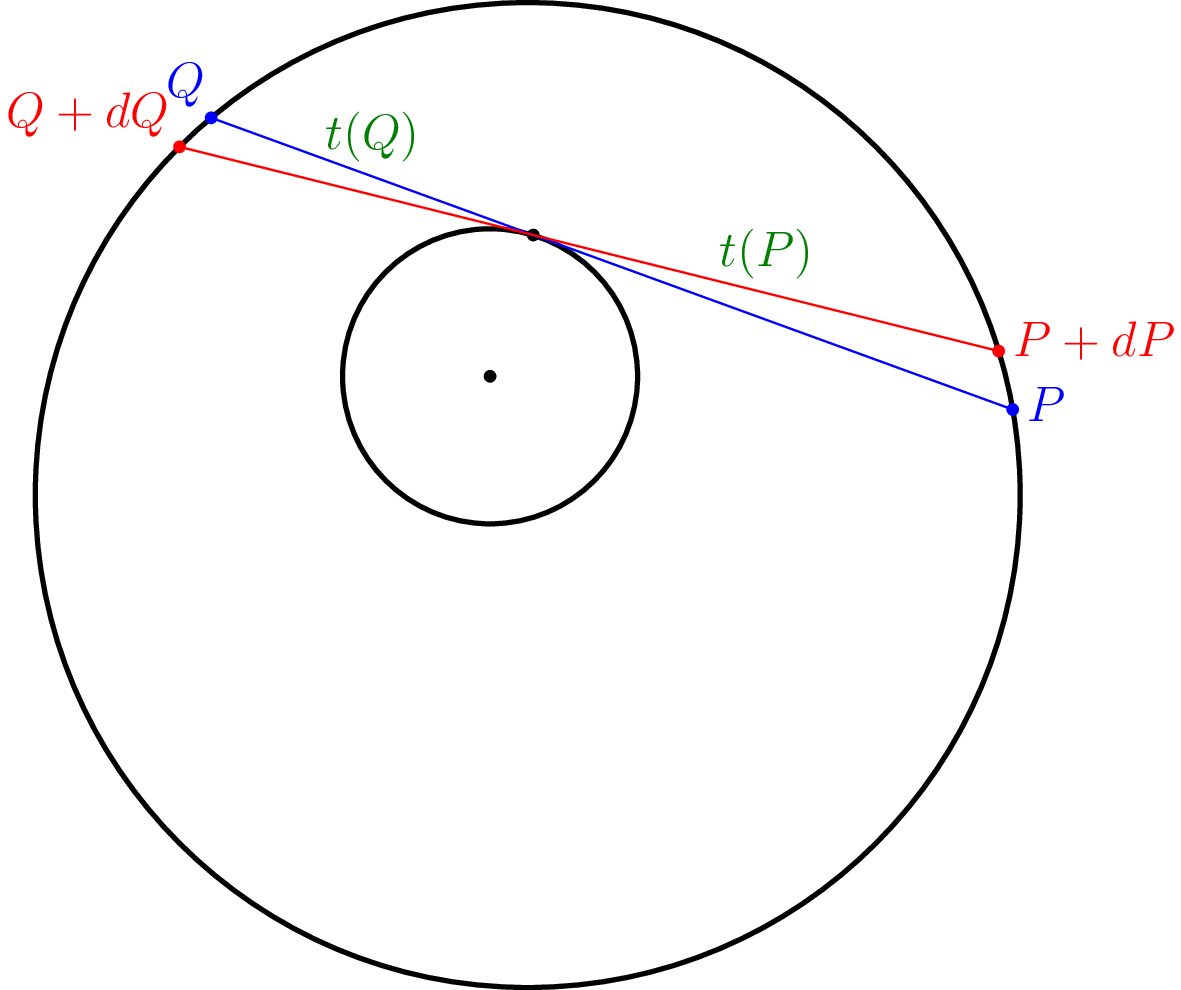
Let P be a point on the outer circle,
and let Q be the point you get when you take the counterclockwise tangent from P to the inner circle.
Consider what happens if we nudge the point P by a small increment dP.
Figure for Poncelet porism proof.
The similar triangles in power of a point then give us the approximation
There’s a common error I keep seeing on OTIS applications, so I’m going to
document the error here in the hopes that I can preemptively dispel it.
To illustrate it more clearly, here is a problem I made up for which the bogus
solution also gets the wrong numerical answer:
Problem: Suppose a2+b2+c2=1 for positive real numbers a, b, c.
Find the minimum possible value of S=a2b+b2c+c2a.
The wrong solution I keep seeing goes like so:
Nonsense solution: By AM-GM, the minimum value of S is
This post will mostly be focused on construction-type problems
in which you’re asked to construct something satisfying property P.
Minor spoilers for USAMO 2011/4, IMO 2014/5.
1. What is a leap of faith?
Usually, a good thing to do whenever you can is to make “safe moves”
which are implied by the property P.
Here’s a simple example.
Example 1(USAMO 2011)
Find an integer n such that the remainder when 2n is divided by n is odd.
It is easy to see, for example, that n itself must be odd for this to be true,
and so we can make our life easier without incurring any worries by restricting our search to odd n.
You might therefore call this an “optimization”:
a kind of move that makes the …
In the previous post we defined p-adic numbers.
This post will state (mostly without proof) some more surprising results about
continuous functions f:Zp→Qp.
Then we give the famous proof of the Skolem-Mahler-Lech theorem using p-adic analysis.
1. Digression on Cp
Before I go on, I want to mention that Qp is not algebraically closed.
So, we can take its algebraic closure Qp — but this
field is now no longer complete (in the topological sense).
However, we can then take the completion of this space to obtain Cp.
In general, completing an algebraically closed field remains algebraically closed,
and so there is a larger space
I think this post is more than two years late in coming, but anywhow…
This post introduces the p-adic integers Zp, and the p-adic numbers Qp.
The one-sentence description is that these are “integers/rationals carrying full
mod pe information” (and only that information).
The first four sections will cover the founding definitions culminating in a
short solution to a USA TST problem.
In this whole post, p is always a prime.
Much of this is based off of Chapter 3A from Straight from the Book.
1. Motivation
Before really telling you what Zp and Qp are,
let me tell you what you might expect them to do.
In elementary/olympiad number theory, we’re already well-familiar …
One of the major headaches of using complex numbers in olympiad geometry
problems is dealing with square roots.
In particular, it is nontrivial to express the incenter of a triangle inscribed
in the unit circle in terms of its vertices.
The following lemma is the standard way to set up the arc midpoints of a triangle.
It appears for example as part (a) of Lemma 6.23.
Theorem 1(Arc midpoint setup for a triangle)
Let ABC be a triangle with circumcircle Γ and let MA, MB, MC
denote the arc midpoints of BC opposite A, CA opposite B,
AB opposite C.
I recently had a combinatorics paper
appear in the EJC.
In this post I want to brag a bit by telling the “story” of this paper:
what motivated it, how I found the conjecture that I originally did,
and the process that eventually led me to the proof, and so on.
This work was part of the Duluth REU 2017,
and I thank Joe Gallian for suggesting the problem.
1. Background
Let me begin by formulating the problem as it was given to me.
First, here is the definition and notation for a “block-ascending” permutation.
Definition 1. For nonnegative integers a1, …,
an an (a1,…,an)-ascending permutation is a permutation on
{1,2,…,a1+⋯+an} whose descent set is …
I wanted to quickly write this proof up, complete with pictures, so that I won’t forget it again.
In this post I’ll give a combinatorial proof (due to Joyal) of the following:
Theorem 1(Cayley’s Formula)
The number of trees on n labeled vertices is nn−2.
Proof: We are going to construct a bijection between
Functions {1,2,…,n}→{1,2,…,n} (of which there are nn) and
Trees on {1,2,…,n} with two distinguished nodes A and B (possibly A=B).
This will imply the answer.
Let’s look at the first piece of data.
We can visualize it as