
🖉 Holomorphic Logarithms and Roots
In this post we’ll make sense of a holomorphic square root and logarithm. Wrote this up because I was surprised how hard it was to find a decent complete explanation.
Let be a holomorphic function. A holomorphic -th root of is a function such that for all . A logarithm of is a function such that for all .
The main question we’ll try to figure out is: when do these exist? In particular, what if ?
1. Motivation: Square Root of a Complex Number
To start us off, can we define for any complex number ?
The first obvious problem that comes up is that there for any , there are two numbers such that . How can we pick one to use? For our ordinary square root function, we had a notion of “positive”, and so we simply took the positive root.
Let’s expand on this: given (here ) we should take the root to be such that ; there are two choices for , differing by .
For complex numbers, we don’t have an obvious way to pick . Nonetheless, perhaps we can also get away with an arbitrary distinction: let’s see what happens if we just choose the with .
Pictured below are some points (in red) and their images (in blue) under this “upper-half” square root. The condition on means we are forcing the blue points to lie on the right-half plane.
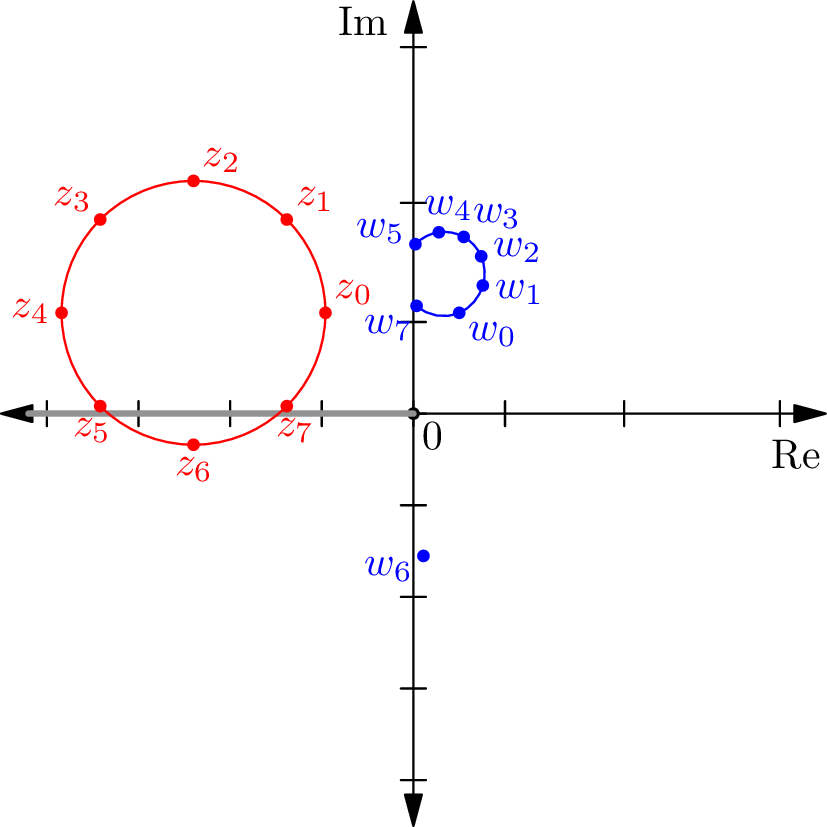
Here, for each , and we are constraining the to lie in the right half of the complex plane. We see there is an obvious issue: there is a big discontinuity near the point and ! The nearby point has been mapped very far away. This discontinuity occurs since the points on the negative real axis are at the “boundary”. For example, given , we send it to , but we have hit the boundary: in our interval , we are at the very left edge.
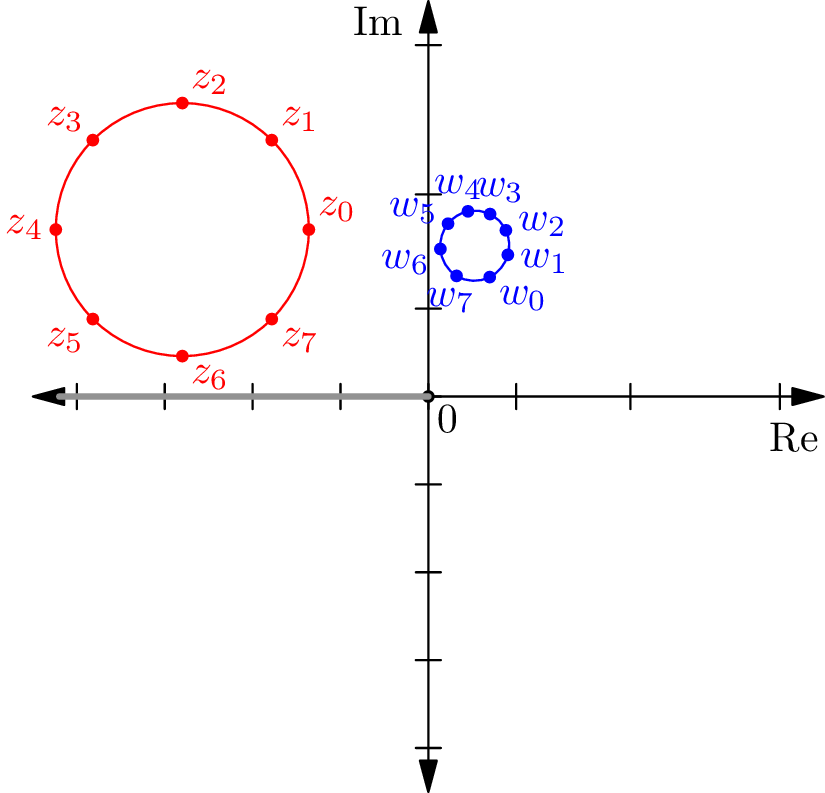
The negative real axis that we must not touch is what we will later call a branch cut, but for now I call it a ray of death. It is a warning to the red points: if you cross this line, you will die! However, if we move the red circle just a little upwards (so that it misses the negative real axis) this issue is avoided entirely, and we get what seems to be a “nice” square root.
In fact, the ray of death is fairly arbitrary: it is the set of “boundary issues” that arose when we picked . Suppose we instead insisted on the interval ; then the ray of death would be the positive real axis instead. The earlier circle we had now works just fine.
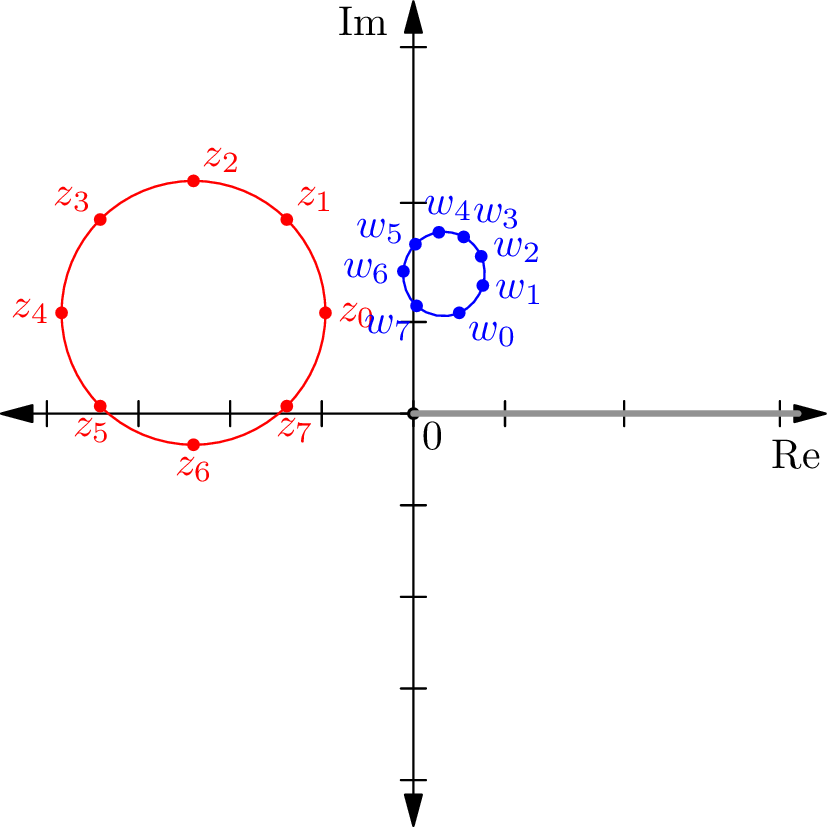
What we see is that picking a particular -interval leads to a different set of edge cases, and hence a different ray of death. The only thing these rays have in common is their starting point of zero. In other words, given a red circle and a restriction of , I can make a nice “square rooted” blue circle as long as the ray of death misses it.
So, what exactly is going on?
2. Square Roots of Holomorphic Functions
To get a picture of what’s happening, we would like to consider a more general problem: let be holomorphic. Then we want to decide whether there is a holomorphic such that Our previous discussion when tells us we cannot hope to achieve this for ; there is a “half-ray” which causes problems. However, there are certainly functions such that a exists. As a simplest example, should definitely have a square root!
Now let’s see if we can fudge together a square root. Earlier, what we did was try to specify a rule to force one of the two choices at each point. This is unnecessarily strict. Perhaps we can do something like the following: start at a point in , pick a square root of , and then try to “fudge” from there the square roots of the other points. What do I mean by fudge? Well, suppose is a point very close to , and we want to pick a square root of . While there are two choices, we also would expect to be close to . Unless we are highly unlucky, this should tell us which choice of to pick. (Stupid concrete example: if I have taken the square root of and then ask you to continue this square root to , which sign should you pick for ?)
There are two possible ways we could get unlucky in the scheme above: first, if , then we’re sunk. But even if we avoid that, we have to worry that we are in a situation, where we run around a full loop in the complex plane, and then find that our continuous perturbation has left us in a different place than we started. For concreteness, consider the following situation, again with :
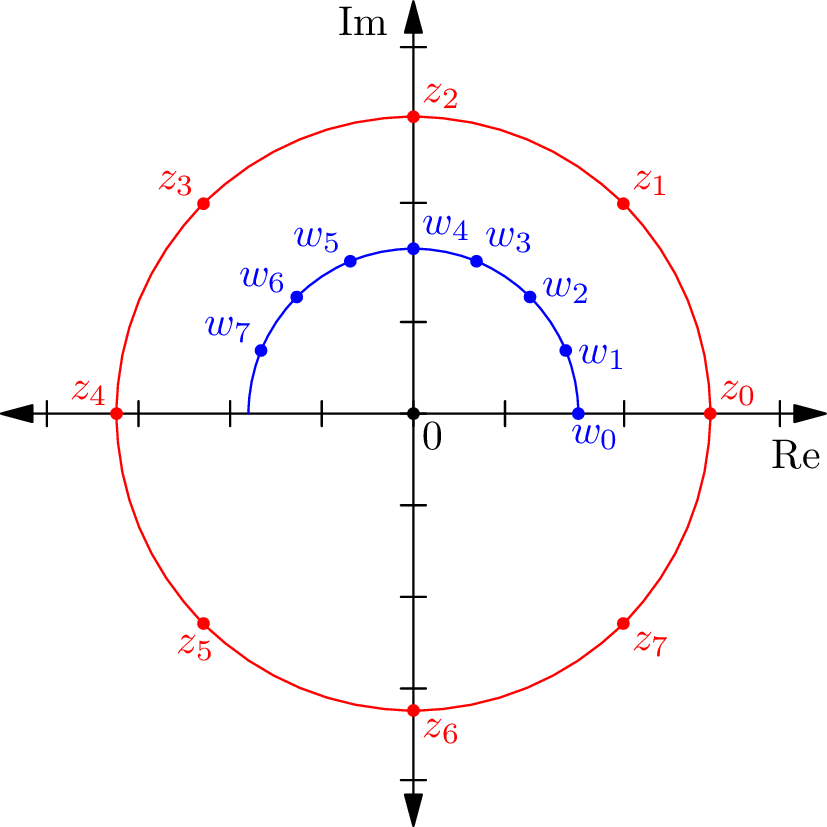
We started at the point , with one of its square roots as . We then wound a full red circle around the origin, only to find that at the end of it, the blue arc is at a different place where it started!
The interval construction from earlier doesn’t work either: no matter how we pick the interval for , any ray of death must hit our red circle. The problem somehow lies with the fact that we have enclosed the very special point .
Nevertheless, we know that if we take , then we don’t run into any problems with our “make it up as you go” procedure. So, what exactly is going on?
3. Covering Projections
By now, if you have read the part of algebraic topology. this should all seem very strangely familiar. The “fudging” procedure exactly describes the idea of a lifting.
More precisely, recall that there is a covering projection Let . For , we already have the square root . So the burden is completing .
Then essentially, what we are trying to do is construct a lifting for the following diagram:
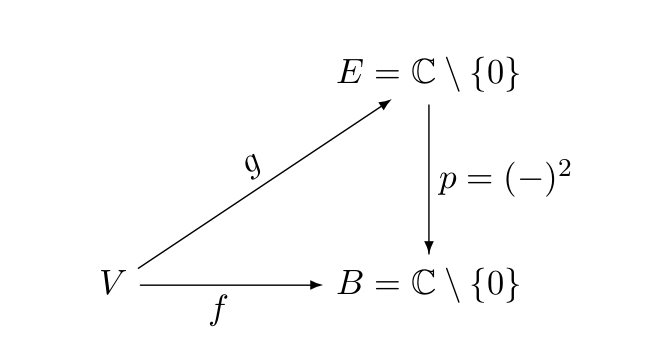
Our map can be described as “winding around twice”. From algebraic topology, we now know that this lifting exists if and only if is a subset of the image of by . Since and are both punctured planes, we can identify them with .
Exercise 1
Show that the image under is exactly once we identify .
That means that for any loop in , we need to have an even winding number around . This amounts to since has no poles.
Replacing with and carrying over the discussion gives the first main result.
Theorem 2 (Existence of Holomorphic -th Roots)
Let be holomorphic. Then has a holomorphic -th root if and only if for every contour in .
4. Complex Logarithms
The multivalued nature of the complex logarithm comes from the fact that So if , then any complex number is also a solution.
We can handle this in the same way as before: it amounts to a lifting of the following diagram.
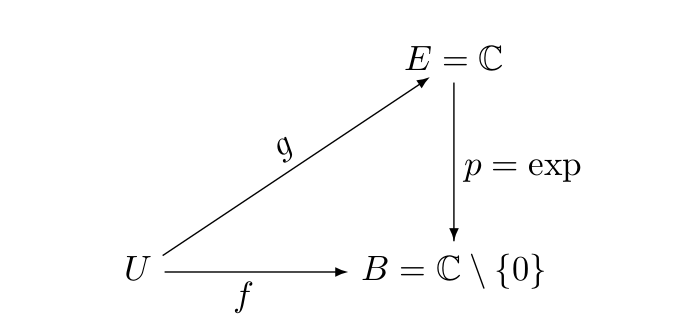
There is no longer a need to work with a separate since:
Exercise 3
Show that if has any zeros then possibly can’t exist.
In fact, the map is a universal cover, since is simply connected. Thus, is trivial. So in addition to being zero-free, cannot have any winding number around at all. In other words:
Theorem 4 (Existence of Logarithms)
Let be holomorphic. Then has a logarithm if and only if for every contour in .
5. Some Special Cases
The most common special case is
Corollary 5 (Nonvanishing Functions from Simply Connected Domains)
Let be continuous, where is simply connected. If for every , then has both a logarithm and holomorphic -th root.
Finally, let’s return to the question of from the very beginning. What’s the best domain such that we can define ? Clearly cannot be made to work, but we can do almost as well. For note that the only zero of is at the origin. Thus, if we want to make a logarithm exist, all we have to do is make an incision in the complex plane that renders it impossible to make a loop around the origin. The usual choice is to delete negative half of the real axis, our very first ray of death; we call this a branch cut, with branch point at (the point which we cannot circle around). This gives
Theorem 6 (Branch Cut Functions)
There exist holomorphic functions
satisfying the obvious properties.
There are many possible choices of such functions ( choices for the -th root and infinitely many for ); a choice of such a function is called a branch. So this is what is meant by a “branch” of a logarithm.
The principal branch is the “canonical” branch, analogous to the way we arbitrarily pick the positive branch to define . For , we take the such that and the imaginary part of lies in (since we can shift by integer multiples of ). Often, authors will write to emphasize this choice.
Example 7. Let be the complex plane minus the real interval . Then the function by has a holomorphic square root.
Corollary 8. A holomorphic function has a holomorphic -th root for all if and only if it has a holomorphic logarithm.