More than six months late, but here are notes from the combinatorial
nullsetllensatz talk I gave at the student colloquium at MIT.
This was also my term paper for 18.434, “Seminar in Theoretical Computer Science”.
1. Introducing the choice number
One of the most fundamental problems in graph theory is that of a graph coloring,
in which one assigns a color to every vertex of a graph so that no two adjacent vertices have the same color.
The most basic invariant related to the graph coloring is the chromatic number:
Definition 1. A simple graph G is k-colorable if it’s possible to
properly color its vertices with k colors. The smallest such k is the chromatic numberχ(G).
In this exposition we study a more general notion in which the set of permitted
colors is different for each vertex, as long as at least k colors are listed at each vertex.
This leads to the notion of a so-called choice number, which was introduced by Erdös, Rubin, and Taylor.
Definition 2. A simple graph G is k-choosable if its possible to
properly color its vertices given a list of k colors at each vertex.
The smallest such k is the choice numberch(G).
Example 3. We have ch(C2n)=χ(C2n)=2 for
any integer n (here C2n is the cycle graph on 2n vertices).
To see this, we only have to show that given a list of two colors at each vertex of C2n,
we can select one of them.
If the list of colors is the same at each vertex, then since C2n is bipartite, we are done.
Otherwise, suppose adjacent vertices v1,
v2n are such that some color at c is not in the list at v2n.
Select c at v1, and then greedily color in v2, …, v2n in that order.
We are thus naturally interested in how the choice number and the chromatic number are related.
Of course we always have
ch(G)≥χ(G).
Näively one might expect that we in fact have an equality,
since allowing the colors at vertices to be different seems like it should make the graph easier to color.
However, the following example shows that this is not the case.
Example 4(Erdös)
Let n≥1 be an integer and define
G=Knn,n.
We claim that for any integer n≥1 we have
ch(G)≥n+1andχ(G)=2.
The latter equality follows from G being partite.
Now to see the first inequality, let G have vertex set U∪V,
where U is the set of functions u:[n]→[n] and V=[n].
Then consider n2 colors Ci,j for 1≤i,j≤n.
On a vertex u∈U, we list colors C1,u(1), C2,u(2), …, Cn,u(n).
On a vertex v∈V, we list colors Cv,1, Cv,2, …, Cv,n.
By construction it is impossible to properly color G with these colors.
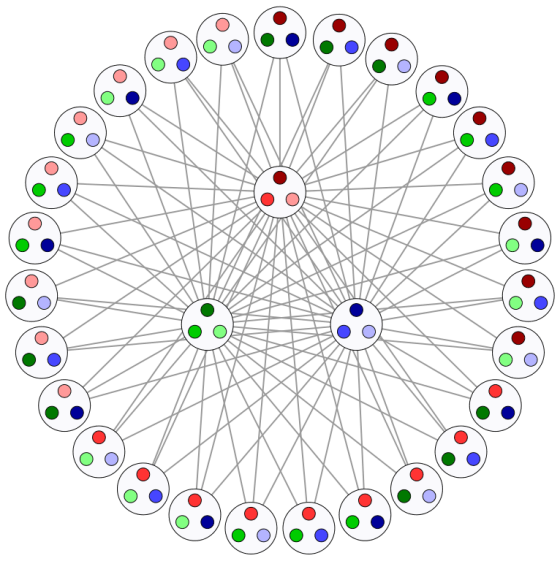
The case n=3 is illustrated in the figure below (image in public
domain).
The n=3 case showing choice numbers and chromatic numbers can differ.
This surprising behavior is the subject of much research:
how can we bound the choice number of a graph as a function of its chromatic
number and other properties of the graph?
We see that the above example requires exponentially many vertices in n.
Theorem 5(Noel, West, Wu, Zhu)
If G is a graph with n vertices then
χ(G)≤ch(G)≤max(χ(G),⌈3χ(G)+n−1⌉).
In particular, if n≤2χ(G)+1 then ch(G)=χ(G).
One of the most major open problems in this direction is the following.
Definition 6. A claw-free graph is a graph with no induced K3,1.
For example, the line graph (also called edge graph) of any simple graph G is claw-free.
If G is a claw-free graph, then it’s conjectured ch(G)=χ(G).
In particular, this conjecture implies that for edge coloring,
the notions of “chromatic number” and “choice number” coincide.
In this exposition, we prove the following result of Alon.
Theorem 7(Alon)
A bipartite graph G is ⌊L(G)⌋+1 choosable, where
L(G)=defH⊆Gmax∣E(H)∣/∣V(H)∣
is half the maximum of the average degree of subgraphs H.
In particular, recall that a planar bipartite graph H with r vertices contains at most 2r−4 edges.
Thus for such graphs we have L(G)≤2 and deduce:
Corollary 8. A planar bipartite graph is 3-choosable.
This corollary is sharp, as it applies to K2,4 which we have seen in
Example 4 has ch(K2,4)=3.
The rest of the paper is divided as follows.
First, we begin in §2 by stating Theorem 9, the famous combinatorial nullstellensatz of Alon.
Then in §3 and §4, we provide descriptions of the so-called graph polynomial,
to which we then apply combinatorial nullstellensatz to deduce Theorem 18.
Finally in §5, we show how to use Theorem 18 to prove Theorem 7.
2. Combinatorial Nullstellensatz
The main tool we use is the Combinatorial Nullestellensatz of Alon.
Theorem 9(Combinatorial Nullstellensatz)
Let F be a field,
and let f∈F[x1,…,xn] be a polynomial of degree t1+⋯+tn.
Let S1,S2,…,Sn⊆F such that ∣Si∣>ti for all i.
Assume the coefficient of x1t1x2t2…xntn of f is not zero.
Then we can pick s1∈S1, …, sn∈Sn such that
f(s1,s2,…,sn)=0.
Example 10. Let us give a second proof that
ch(C2n)=2
for every positive integer n. Our proof will be an application of the Nullstellensatz.
Regard the colors as real numbers, and let Si be the set of colors at vertex i (hence 1≤i≤2n,
and ∣Si∣=2). Consider the polynomial
f=(x1−x2)(x2−x3)…(x2n−1−x2n)(x2n−x1)
The coefficient of x11x21…x2n1 is 2=0.
Therefore, one can select a color from each Si so that f does not vanish.
3. The Graph Polynomial, and Directed Orientations
Motivated by Example 10, we wish to apply a similar technique to general graphs G.
So in what follows, let G be a (simple) graph with vertex set {1,…,n}.
Definition 11. The graph polynomial of G is defined by
fG(x1,…,xn)=(i,j)∈E(G)i<j∏(xi−xj).
We observe that coefficients of fG correspond to differences in directed orientations.
To be precise, we introduce the notation:
Definition 12. Consider orientations on the graph G with vertex set {1,…,n},
meaning we assign a direction v→w to every edge of G to make it into a directed graph G.
An oriented edge is called ascending if v→w and v≤w, i.e.
the edge points from the smaller number to the larger one.
Then we say that an orientation is
even if there are an even number of ascending edges, and
odd if there are an odd number of ascending edges.
Finally, we define
DEG(d1,…,dn) to the be set of all even
orientations of G in which vertex i has indegree di.
DOG(d1,…,dn) to the be set of all odd
orientations of G in which vertex i has indegree di.
Set DG(d1,…,dn)=DEG(d1,…,dn)∪DOG(d1,…,dn).
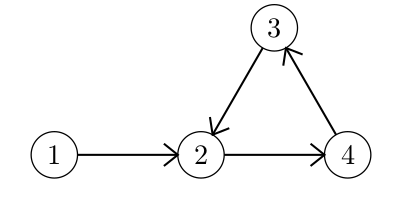
Example 13. Consider the following orientation:
An even orientation.
There are exactly two ascending edges, namely 1→2 and 2→4.
The indegrees of are d1=0, d2=2 and d3=d4=1.
Therefore, this particular orientation is an element of DEG(0,2,1,1).
In terms of fG, this corresponds to the choice of terms
(x1−x2)(x2−x3)(x2−x4)(x3−x4)
which is a +x22x3x4 term.
Lemma 14. In the graph polynomial of G,
the coefficient of x1d1…xndn is
∣DEG(d1,…,dn)∣−∣DOG(d1,…,dn)∣.
Proof: Consider expanding fG.
Then each expanded term corresponds to a choice of xi or xj from each (i,j), as in Example 13.
The term has coefficient +1 is the orientation is even,
and −1 if the orientation is odd, as desired. □
Thus we have an explicit combinatorial description of the coefficients in the graph polynomial fG.
4. Coefficients via Eulerian Suborientations
We now give a second description of the coefficients of fG.
Definition 15. Let D∈DG(d1,…,dn), viewed as a directed graph.
An Eulerian suborientation of D is a subgraph of D (not necessarily
induced) in which every vertex has equal indegree and outdegree. We say that such a suborientation is
even if it has an even number of edges, and
odd if it has an odd number of edges.
Note that the empty suborientation is allowed.
We denote the even and odd Eulerian suborientations of D by
EE(D) and EO(D), respectively.
Eulerian suborientations are brought into the picture by the following lemma.
Lemma 16. Assume D∈DEG(d1,…,dn).
Then there are natural bijections
DEG(d1,…,dn)DOG(d1,…,dn)→EE(D)→EO(D).
Similarly, if D∈DOG(d1,…,dn) then there are bijections
DEG(d1,…,dn)DOG(d1,…,dn)→EO(D)→EE(D).
Proof: Consider any orientation D′∈DG(d1,…,dn).
Then we define a suborietation of D, denoted D⋊D′,
by including exactly the edges of D whose orientation in D′ is in the opposite direction.
It’s easy to see that this induces a bijection
D⋊−:DG(d1,…,dn)→EE(D)∪EO(D)
Moreover, remark that
D⋊D′ is even if D and D′ are either both even or both odd, and
D⋊D′ is odd otherwise.
The lemma follows from this. □
Corollary 17. In the graph polynomial of G,
the coefficient of x1d1…xndn is
Theorem 18. Let G be a graph on {1,…,n},
and let D∈DG(d1,…,dn) be an orientation of G.
If ∣EE(D)∣=∣EO(D)∣,
then given a list of di+1 colors at each vertex of G,
there exists a proper coloring of the vertices of G.
Armed with Theorem 18, we are almost ready to prove Theorem 7.
The last ingredient is that we need to find an orientation on G in which the
maximal degree is not too large. This is accomplished by the following.
Lemma 19. Let
L(G)=defmaxH⊆G∣E(H)∣/∣V(H)∣ as in Theorem 7.
Then G has an orientation in which every indegree is at most ⌈L(G)⌉.
Proof: This is an application of Hall’s marriage theorem.
Let d=⌈L(G)⌉≥L(G). Construct a bipartite graph
E∪XwhereE=E(G) and X=d timesV(G)⊔⋯⊔V(G).
Connect e∈E and v∈X if v is an endpoint of e.
Since d≥L(G) we satisfy Hall’s condition (as L(G) is a condition for all
subgraphs H⊆G) and can match each edge in E to a (copy of some) vertex in X.
Since there are exactly d copies of each vertex in X, the conclusion follows. □
Proof: According to Lemma 19,
pick D∈DG(d1,…,dn) where maxdi≤⌈L(G)⌉.
Since G is bipartite, we obviously have EO(D)=∅,
since G cannot have any odd cycles.
So Theorem 18 applies and we are done. □