I was a coordinator for last year’s IMO 2024 and this year’s IMO 2025.Before, I was a coordinator for some virtual IMO during the pandemic too,
which is much less fun. And from 2017-2019 I was an observer for the USA.
Here’s some thoughts about that, contrasting my IMO 2019 post.
What is coordination?
For those of you that don’t know, coordination is the grading process for IMO.
As I describe it in my FAQ:
Basically, the outline of the idea is: before the exam, a marking scheme
(rubric) is set for each problem, to cover the typical cases of what progress
will be worth what points. Then, the leaders of each country get to see the
solutions of their country’s students, while there is a number of coordinators
from the IMO host country for each problem. Both the coordinators and the
leaders read …
This is a short blog post on the FrontierMath benchmark,
a set of lots of difficult math problems with easily verifiable answers.
Just to be clear, everything written here is my own thoughts
and doesn’t necessarily reflect the intention of any collaborators.
When you’re setting a problem for a competition like the IMO or Putnam,
three properties that are often considered desirable are:
It should require creative insight.
Competitions avoid problems that are too similar to existing ones
or too easily solved by simply applying standard textbook techniques.
You want the problems to really feel different
and force the solver to feel like they came up with a new idea to solve it.
This is sort of what the spirit of math olympiads is about.
It should not take a lot of implementation,
i.e. once a set of key ideas has been identified,
actually carrying out the …
Here’s a mix of several publicity-related things I’d like to broadcast.
AlphaGeometry
A lot of you have already heard the buzz about the
AlphaGeometry news
and Nature paper.
(I’ve known about this paper for a while now,
so I’m glad I can finally talk about it!)
I managed to snag a cameo in the DeepMind post where I wrote
AlphaGeometry’s output is impressive because it’s both verifiable and clean.
Past AI solutions to proof-based competition problems have sometimes been
hit-or-miss (outputs are only correct sometimes and need human checks).
AlphaGeometry doesn’t have this weakness: its solutions have
machine-verifiable structure. Yet despite this, its output is still
human-readable. One could have imagined a computer program that solved
geometry problems by brute-force coordinate systems: think pages and pages of
tedious algebra calculation. AlphaGeometry is not that. It uses classical
geometry rules with angles and similar …
In this post I’m hoping to say a bit about the process that’s used for the
problem selection of the recent USEMO:
how one goes from a pool of problem proposals to a six-problem test.
(How to write problems is an entirely different story, and deserves its own post.)
I choose USEMO for concreteness here,
but I imagine a similar procedure could be used for many other contests.
I hope this might be of interest to students preparing for contests
to see a bit of the behind-the-scenes,
and maybe helpful for other organizers of olympiads.
The overview of the entire timeline is:
Submission period for authors (5-10 weeks)
Creating the packet
Reviewing period where volunteers try out the proposed problems (6-12 weeks)
Here is my commentary for the 2019 International Math Olympiad,
consisting of pictures and some political statements about the problem.
Summary
This year’s USA delegation consisted of leader Po-Shen Loh and deputy leader Yang Liu.
The USA scored 227 points, tying for first place with China.
For context, that is missing a total of four problems across all students, which is actually kind of insane.
All six students got gold medals, and two have perfect scores.
Vincent Huang 7 7 3 7 7 7
Luke Robitaille 7 6 2 7 7 6
Colin Shanmo Tang 7 7 7 7 7 7
Edward Wan 7 6 0 7 7 7
Brandon Wang 7 7 7 7 7 1
Daniel Zhu 7 7 7 7 7 7
Korea was 3rd place with 226 points, just one point shy of first,
but way ahead of the 4th place score (with 187 points …
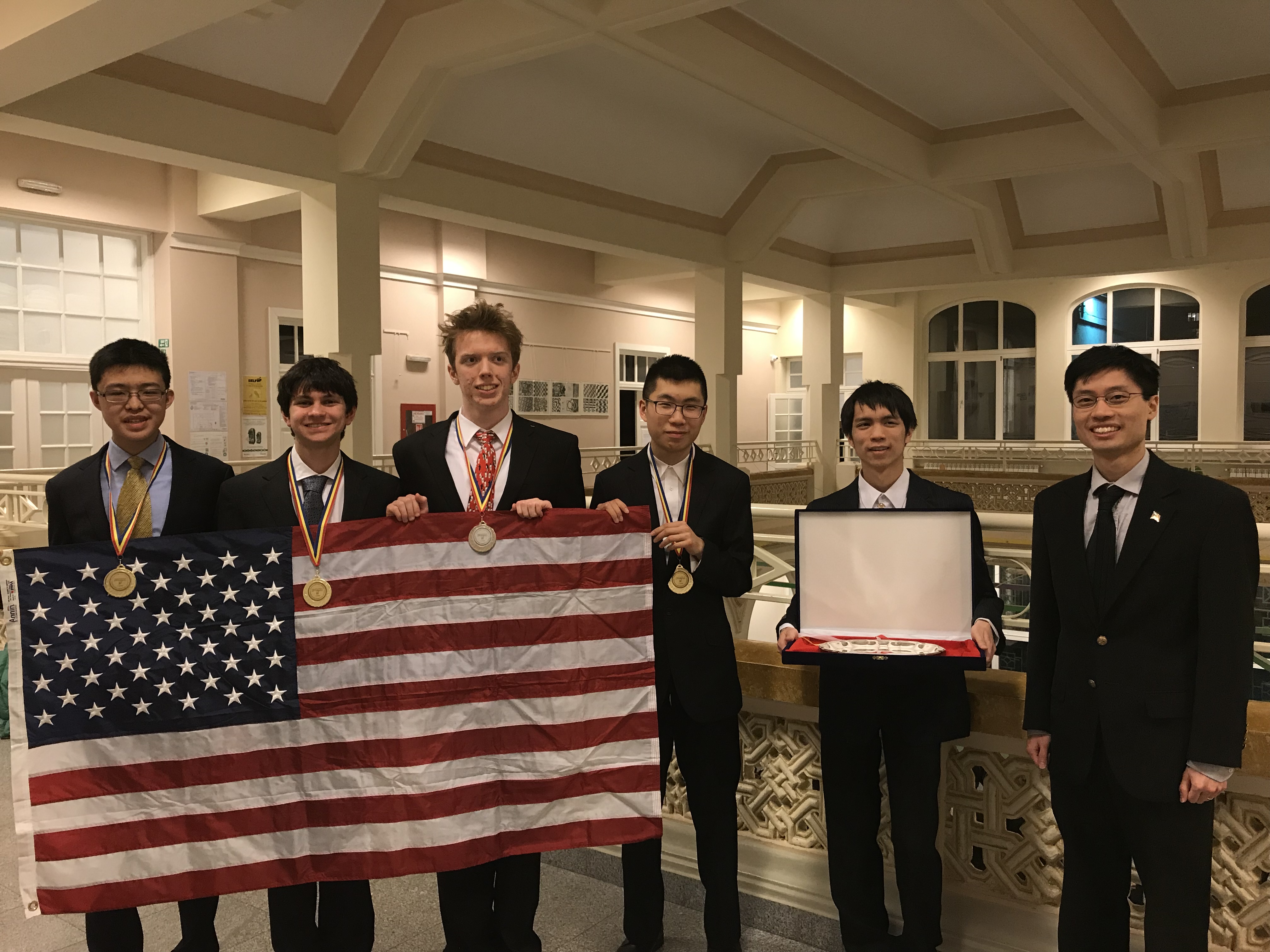
Po-Shen Loh and I spent the last week in Bucharest with the United States team for the 11th RMM.
The USA usually sends four students who have not attended a previous IMO or RMM before.
This year’s four students did breathtakingly well:
Benjamin Qi — gold (rank 2nd)
Luke Robitaille — silver (rank 10th)
Carl Schildkraut — gold (rank 8th)
Daniel Zhu — gold (rank 4th)
(Yes, there are only nine gold medals this year!)
The team score is obtained by summing the three highest scores of the four team members.
The USA won the team component by a lofty margin, making it the first time we’ve won back to back.
I’m very proud of the team.
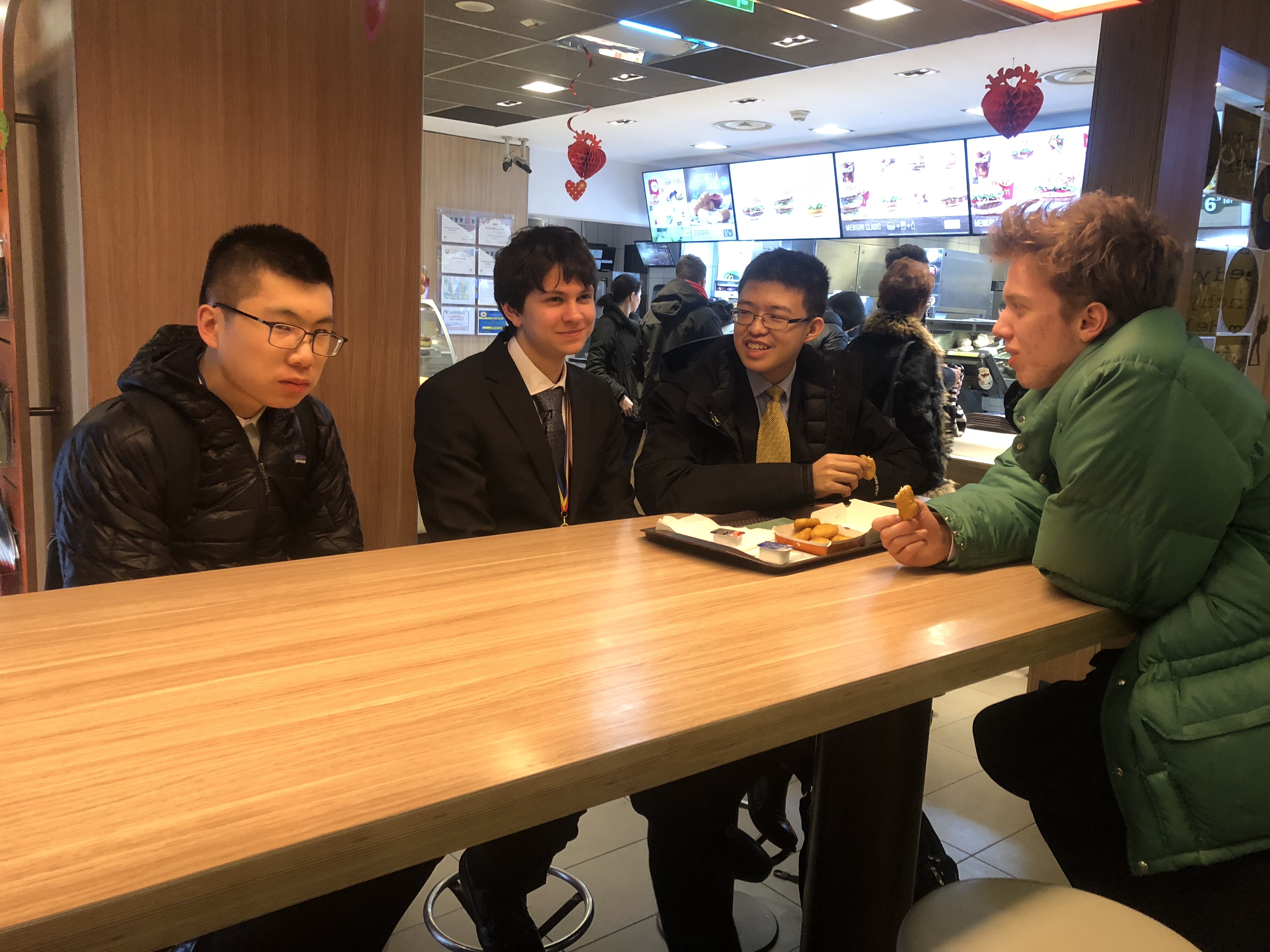
Pictures
RMM 2019 team after the competition (taken by Daniel Zhu’s
dad)McDonald’s …
There’s a recent working paper by economists Ruchir
Agarwal
and Patrick Gaule which
I think would be of much interest to this readership:
a systematic study of IMO performance versus success as a mathematician later on.
Despite the click-baity title and dreamy introduction about the Millennium Prizes,
the rest of the paper is fascinating, and the figures section is a gold mine.
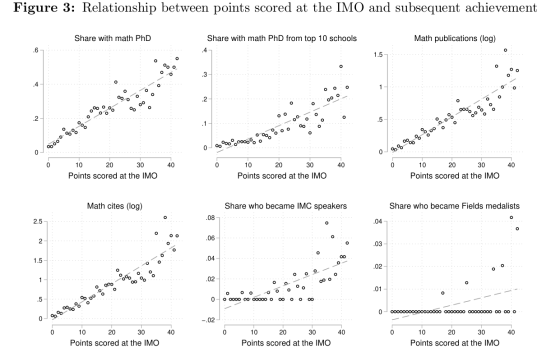
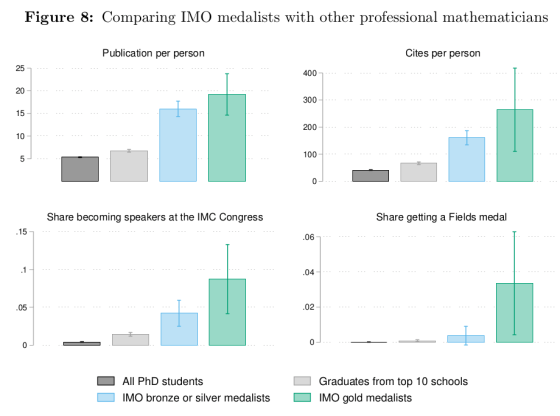
Here are two that stood out to me:
Points scored at IMO vs subsequent achievements.IMO medalist outcomes.
There’s also one really nice idea they had,
which was to investigate the effect of getting one point less than a gold medal,
versus getting exactly a gold medal.
This is a pretty clever way to account for the effect of the prestige of the IMO,
since “IMO gold” sounds so much better on a CV than “IMO silver” even …
Hmm, so hopefully this will be finished within the next 10 years.
— An email of mine at the beginning of this project
My Euclidean geometry book was published last March or so.
I thought I’d take the time to write about what the whole process of publishing this book was like,
but I’ll start with the disclaimer that my process was probably not very typical
and is unlikely to be representative of what everyone else does.
Writing the Book
The Idea
I’m trying to pinpoint exactly when this project changed from “daydream” to “let’s do it”,
but I’m not quite sure; here’s the best I can recount.
It was sometimes in the fall of 2013, towards the start of the school year; I think late September.
I was a senior in high school, and I was only enrolled in two classes.
It was fantastic …