There’s this pet peeve I have where people sometimes ask things like what kind
of strategies they should use for, say, collinearity problems in geometry.
Like, I know there are valid answers like Menelaus or something.
But the reason it bugs me is because “the problem says to prove collinearity”
is about as superficial as it gets.
It would be like asking for advice for problems that have “ABC” in them.
To drive my point, consider the following setup:
Let ABC be a triangle with circumcircle Γ
and incenter I and let M be the midpoint of BC.
Denote by D the foot of the perpendicular from I to BC.
The line through I perpendicular to A …
About five years ago I wrote a blog post warning that I thought it
was a bad idea to design math olympiads to be completely untrainable,
because I think math olympiads should be about talent development rather
than just talent identification, yada yada yada.
So now I want to say the other direction: I also don’t want to design
math olympiads so that every problem is 100% required to lie in a
fixed, rigid, and arbitrary boundary prescribed by some
nonexistent syllabus.
From a coach’s perspective, I want to reward “good” studying,
and whatever “good” means, I think it should include more than
zero flexibility and capacity to deal with slight curveballs.
I was reminded of this because there was a recent contest problem
(I won’t say which one to avoid spoilers) that quoted Brianchon’s theorem.
Brianchon’s theorem, for those of you that don’t …
Editorial note: this post was mostly written in February 2023. Any resemblance
to contests after that date is therefore coincidental.
Background
A long time ago, rubrics for the IMO and USAMO were fairly strict. Out of seven,
the overall meta-rubric looks like:
7: Problem solved
6: Tiny slip (and contestant could repair)
5: Small gap or mistake, but non-central
2: Lots of genuine progress
1: Significant non-trivial progress
0: “Busy work”, special cases, lots of writing
In particular, traditional rubrics were often sublinear.
You’d see problems where you could split it into two parts, and solving
either part would only give 2 points, whereas solving both was worth 7.
Increasingly, I’ve noticed this is less and less common.
Particularly, at the IMOAs far as I know, the IMO rubrics aren’t really available anywhere.
(On the other hand, I’ve never been told that rubrics
explicitly need …
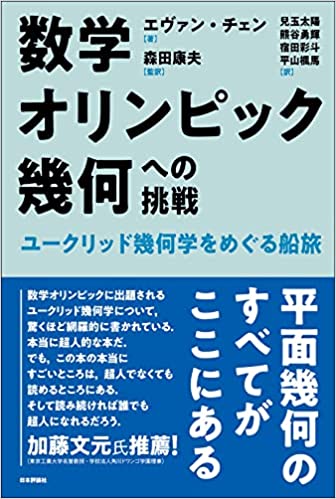
I’m happy to thank 日本評論社 and their team (Fuma Hirayama, Yuki Kumagae, Taiyo Kodama, Ayato Shukuta,
among others) for making the Japanese translation a reality.
As well as tripling the length of the errata PDF :)
This marks the second translation of the EGMO textbook (a Chinese translation
was published a while ago as well by Harbin Institute of Technology). Both linked below:
Japanese translation at nippyo.co.jp and amazon.co.jp.
ISBN-10: 4535789789 / ISBN-13: 978-4535789784.
Chinese translation at abebooks
and amazon.
ISBN-10: 7560395880 / ISBN-13: 978-7560395883.
In this post I’m hoping to say a bit about the process that’s used for the
problem selection of the recent USEMO:
how one goes from a pool of problem proposals to a six-problem test.
(How to write problems is an entirely different story, and deserves its own post.)
I choose USEMO for concreteness here,
but I imagine a similar procedure could be used for many other contests.
I hope this might be of interest to students preparing for contests
to see a bit of the behind-the-scenes,
and maybe helpful for other organizers of olympiads.
The overview of the entire timeline is:
Submission period for authors (5-10 weeks)
Creating the packet
Reviewing period where volunteers try out the proposed problems (6-12 weeks)
A lot of people have been asking me how team selection is going to work for the USA this year.
This information was sent out to the contestants a while ago,
but I understand that there’s a lot of people outside of MOP 2020
who are interested in seeing the TST problems :)
so this is a quick overview of how things are going down this year.
This year there are six tests leading to the IMO 2021 team:
USA TSTST Day 1: November 12, 2020 (3 problems, 4.5 hours)
USA TSTST Day 2: December 10, 2020 (3 problems, 4.5 hours)
USA TSTST Day 3: January 21, 2021 (3 problems, 4.5 hours)
RMM Day 1: February 2021 (3 problems, 4.5 hours)
APMO: March 2021 (5 problems, 4 hours)
USAMO: April 2021 (2 days, each with 3 problems and 4.5 hours)
I’m happy to announce that sign-ups for my new olympiad style contest,
the United States Ersatz Math Olympiad (USEMO), are open now!
The webpage for the USEMO is https://web.evanchen.cc/usemo.html (where sign-ups are posted).
Logo for USEMO.
The US Ersatz Math Olympiad is a proof-based competition open to all US middle and high school students.
Like many competitions, its goals are to develop interest and ability in mathematics (rather than measure it).
However, it is one of few proof-based contests open to all US middle and high school students.
You can see more about the goals of this contest in the
mission statement.
The contest will run over Memorial day weekend:
Day 1 is Saturday May 23 2020, from 12:30pm ET – 5:00pm ET.
Day 2 is Sunday May 24 2020, from 12:30pm ET – 5:00pm ET.
This post will mostly be focused on construction-type problems
in which you’re asked to construct something satisfying property P.
Minor spoilers for USAMO 2011/4, IMO 2014/5.
1. What is a leap of faith?
Usually, a good thing to do whenever you can is to make “safe moves”
which are implied by the property P.
Here’s a simple example.
Example 1(USAMO 2011)
Find an integer n such that the remainder when 2n is divided by n is odd.
It is easy to see, for example, that n itself must be odd for this to be true,
and so we can make our life easier without incurring any worries by restricting our search to odd n.
You might therefore call this an “optimization”:
a kind of move that makes the …
There’s a new addition to my olympiad problems and solutions archive:
I created an index of many past IMO/USAMO/USA TST(ST) problems by what my opinions on their difficulties are.
You can grab the direct link to the file below:
In short, the scale runs from 0M to 50M in increments of 5M,
and every USAMO / IMO problem on my archive now has a rating too.
My hope is that this can be useful in a couple ways.
One is that I hope it’s a nice reference for students,
so that they can better make choices about what practice problems
would be most useful for them to work on.
The other is that the hardness scale contains a very long discussion
about how I judge the difficulty of problems.
While this is my own personal opinion,
obviously, I hope it …
Here is my commentary for the 2019 International Math Olympiad,
consisting of pictures and some political statements about the problem.
Summary
This year’s USA delegation consisted of leader Po-Shen Loh and deputy leader Yang Liu.
The USA scored 227 points, tying for first place with China.
For context, that is missing a total of four problems across all students, which is actually kind of insane.
All six students got gold medals, and two have perfect scores.
Vincent Huang 7 7 3 7 7 7
Luke Robitaille 7 6 2 7 7 6
Colin Shanmo Tang 7 7 7 7 7 7
Edward Wan 7 6 0 7 7 7
Brandon Wang 7 7 7 7 7 1
Daniel Zhu 7 7 7 7 7 7
Korea was 3rd place with 226 points, just one point shy of first,
but way ahead of the 4th place score (with 187 points …