
🖉 Linnik's Theorem for Sato-Tate Laws on CM Elliptic Curves
Here I talk about my first project at the Emory REU. Prerequisites for this post: some familiarity with number fields.
1. Motivation: Arithmetic Progressions
Given a property about primes, there’s two questions we can ask:
- How many primes are there with this property?
- What’s the least prime with this property?
As an example, consider an arithmetic progression , , …, with and . The strong form of Dirichlet’s Theorem tells us that basically, the number of primes is the total number of primes. Moreover, the celebrated Linnik’s Theorem tells us that the first prime is for a fixed , with record .
As I talked about last time on my blog, the key ingredients were:
- Introducing Dirichlet characters , which are periodic functions modulo . One uses this to get the mod into the problem.
- Introducing an -function attached to .
- Using complex analysis (Cauchy’s Residue Theorem) to boil the proof down to properties of the zeros of .
With that said, we now move to the object of interest: elliptic curves.
2. Counting Primes
Let be an elliptic curve over , which for our purposes we can think of concretely as a curve in Weirestrass form where the right-hand side has three distinct complex roots (viewed as a polynomial in ). If we are unlucky enough that the right-hand side has a double root, then the curve ceases to bear the name “elliptic curve” and instead becomes singular.
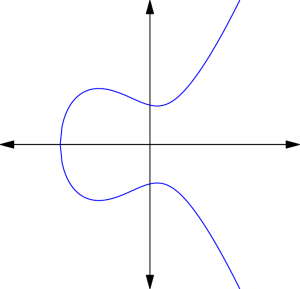
Here’s a natural number theoretic question: for any rational prime , how many solutions does have modulo ?
To answer this it’s helpful to be able to think over an arbitrary field . While we’ve written our elliptic curve as a curve over , we could just as well regard it as a curve over , or as a curve over . Even better, since we’re interested in counting solutions modulo , we can regard this as a curve over . To make this clear, we will use the notation to signal that we are thinking of our elliptic curve over the field . Also, we write to denote the number of points of the elliptic curve over (usually when is a finite field). Thus, the question boils down to computing .
Anyways, the question above is given by the famous Hasse bound, and in fact it works over any number field!
Theorem 1 (Hasse Bound)
Let be a number field, and let be an elliptic curve. Consider any prime ideal which is not ramified. Then we have where .
Here is the field of elements. The extra “” comes from a point at infinity when you complete the elliptic curve in the projective plane.
Here, the ramification means what you might guess. Associated to every elliptic curve over is a conductor , and a prime is ramified if it divides . The finitely many ramified primes are the “bad” primes for which something breaks down when we take modulo (for example, perhaps the curve becomes singular).
In other words, for the case, except for finitely many bad primes , the number of solutions is , and we even know the implied -constant to be .
Now, how do we predict the error term?
3. The Sato-Tate Conjecture
For elliptic curves over , we the Sato-Tate conjecture (which recently got upgraded to a theorem) more or less answers the question. But to state it, I have to introduce a new term: an elliptic curve , when regarded over , can have complex multiplication (abbreviated CM). I’ll define this in just a moment, but for now, the two things to know are
- CM curves are “special cases”, in the sense that a randomly selected elliptic curve won’t have CM.
- It’s not easy in general to tell whether a given elliptic curve has CM.
Now I can state the Sato-Tate result. It is most elegantly stated in terms of the following notation: if we define as above, then there is a unique which obeys
Theorem 2 (Sato-Tate)
Fix an elliptic curve which does not have CM (when regarded over ). Then as varies across unramified primes, the asymptotic probability that is In other words, is distributed according to the measure .
Now, what about the CM case?
4. CM Elliptic Curves
Consider an elliptic curve but regard it as a curve over . It’s well known that elliptic curves happen to have a group law: given two points on an elliptic curve, you can add them to get a third point. (If you’re not familiar with this, Wikipedia has a nice explanation). So elliptic curves have more structure than just their set of points: they form an abelian group; when written in Weirerstrass form, the identity is the point at infinity.
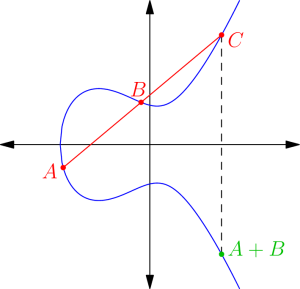
Letting be the associated abelian group, we can look at the endomorphisms of (that is, homomorphisms ). These form a ring, which we denote . An example of such an endomorphism is for an integer (meaning , times). In this way, we see that .
Most of the time we in fact have . But on occasion, we will find that is congruent to , the ring of integers of a number field . This is called complex multiplication by .
Intuitively, this CM is special (despite being rare), because it means that the group structure associated to has a richer set of symmetry. For CM curves over any number field, for example, the Sato-Tate result becomes very clean, and is considerably more straightforward to prove.
Here’s an example. The elliptic curve of conductor turns out to have i.e. it has complex multiplication has . Throwing out the bad primes and , we compute the first several values of , and something bizarre happens. For the mod primes we get
and for the mod primes we have
Astonishingly, the vanishing of is controlled by the splitting of in ! In fact, this holds more generally. It’s a theorem that for elliptic curves with CM, we have where is some quadratic imaginary number field which is also a PID, like . Then governs how the behave:
Theorem 3 (Sato-Tate Over CM)
Let be a fixed elliptic curve with CM by . Let be a unramified prime of .
- If is inert, then (i.e. ).
- If is split, then is uniform across .
I’m told this is much easier to prove than the usual Sato-Tate.
But there’s even more going on in the background. If I look again at where , I might recall that can be written as the sum of squares, and construct the following table:
Each is double one of the terms! There is no mistake: the are also tied to the decomposition of . And this works for any number field.
What’s happening? The main idea is that looking at a prime ideal , is related to the argument of the complex number in some way. Of course, there are lots of questions unanswered (how to pick the sign, and which of and to choose) but there’s a nice way to package all this information, as I’ll explain momentarily.
(Aside: I think the choice of having be the odd or even number depends precisely on whether is a quadratic residue modulo , but I’ll have to check on that.)
5. -Functions
I’ll just briefly explain where all this is coming from, and omit lots of details (in part because I don’t know all of them). Let be an elliptic curve with CM by . We can define an associated -function
(actually this isn’t quite true actually, some terms change for ramified primes ).
At the same time there’s a notion of a Hecke Grössencharakter on a number field – a higher dimensional analog of the Dirichlet characters we used on to filter modulo . For our purposes, think of it as a multiplicative function which takes in ideals of and returns complex numbers of norm . Like Dirichlet characters, each gets a Hecke -function which again extends to a meromorphic function on the entire complex plane.
Now the great theorem is:
Theorem 4 (Deuring)
Let have CM by . Then for some Hecke Grössencharakter .
Using the definitions given above and equating the Euler products at an unramified gives
Upon recalling that , we derive This is enough to determine the entire since is multiplicative.
So this is the result: let be an elliptic curve of conductor . Given our quadratic number field , we define a map from prime ideals of to the unit circle in by
Thus is a Hecke Grössencharakter for some choice of at each .
It turns out furthermore that has frequency , which roughly means that the argument of is related to times the argument of itself. This fact is what explains the mysterious connection between the and the solutions above.
6. Linnik-Type Result
With this in mind, I can now frame the main question: suppose we have an interval . What’s the first prime such that ? We’d love to have some analog of Linnik’s Theorem here.
This was our project and the REU, and Ashvin, Peter and I proved that
Theorem 5. If a rational has CM then the least prime with is
I might blog later about what else goes into the proof of this… but Deuring’s result is one key ingredient, and a proof of an analogous theorem for non-CM curves would have to be very different.