This was originally a diary entry, but I showed it to some students
who told me I should put it in my blog instead.
Imagine you’ve moved to a new town, and want to explore the local offerings,
because there’s a lot to do and see, and you’re expecting to live here a while.
The first few days, it’s really overwhelming. Everything is unfamiliar. You get
lost just trying to buy groceries. You constantly have to consult maps to get
anywhere. It takes a while to adjust.
But after the first week, you notice you don’t need a map as much. You can walk
to the grocery store yourself; you remember which turn to take each crossing.
You know the names of the biggest streets and a few landmarks, and you can get
around with familiar roads as anchors. Though you’ve only been inside …
So I have an FAQ now for contest-studying advice, but there’s a “frequently used
answer” that I want to document now that doesn’t fit in the FAQ format because
the question looks different to everyone that asks it.
The questions generally have the same shape: “would it be better to do X or Y
when studying?”. Like:
Is it better to use GeoGebra when practicing geometry?
Should I work on some new OTIS units or go back through some old ones that I
didn’t finish?
Should I work on hard problems in my strongest subject or medium problems in
my weaker subjects?
Would it be better if I learned this or that first?
and things like this.
And the answer is, for a lot of pairs (X,Y), if you’re so unsure that you’re
asking me about it, then you should just do whatever you …
Here’s a snapshot of what running OTIS looks like these days.
Starts from last Sunday afternoon until Monday lunch.
Timestamps indicate when the action was completed (rather than started).
Sunday 13:04: Process a late financial aid request from someone who forgot
to request it earlier.
Sunday 13:14: Edit OTIS website
to clarify that if you haven’t had your registration approved within 48 hours,
then you should email Evan to ask.
Sunday 13:15: Process a student who wants to drop the fall semester and
come back to re-join in the spring.
Sunday 13:55: Answer a question from a student on Discord on applying
AM-GM on the inequality that I was trying to do in my head when I failed my
driving test 11 years ago.
Sunday 14:04: Fix a reported typo in the problem statement of
China TST 2015/2/3
in the OTIS …
Sometimes my OTIS students suggest features or things for the OTIS website, and
I reply “submit a pull request”.
I’m usually half-joking when I say this, because I acknowledge that I’m
essentially saying “please do the work for me”.
But part of me isn’t joking. Because, one of the things I’ve grown to most
value in gifted education is developing self-agency for my students.
If you’re reading this blog post, you’re likely to have good thinking abilities.
You have the capacity to go from point A to point B, to teach yourself geometry
from online resources (or a certain print textbook, I suppose), to put two and
two together unsupervised, and so on. This gift is rarer than you think.
So let me tell you a secret:
if you don’t know how to submit a pull request, you can teach yourself.
I often gripe about how standard K-12 education is overly
focused on specific knowledge (how to solve a quadratic,
memorizing dates for history, etc.)
rather than general skills (e.g. “how to figure out how to solve a quadratic”).
On the other hand, I understand why;
teaching general skills is much more difficult than preparing a cookbook.
So now I will instead gripe about specific things that should be taught
and aren’t.
Any amount of programming or computing literacy
To me the following are all comparable:
Refusing to learn how to use Google Docs,
and shrugging it off by saying “I’m not planning to be a writer”.
Refusing to learn how to use a spreadsheet,
and shrugging it off by saying “I’m not planning to be an accountant”.
Refusing to learn how to use a shell or git,
and shrugging it off by saying “I’m not …
Sometimes people ask me how many of my students made the IMO, and if I’m in a
bad mood I often give the super snarky reply, “I lost track”.The good-mood answer is “a lot”.
That’s actually a white lie. The real answer is “I deliberately don’t keep
track”. And in this post I want to explain why.
It’s definitely human nature to be happy when your students succeed, the same
way it’s human nature to be happy when your selfies get hearts.
In moderation, that seems fine.
I think it’s unlikely I ever reach a point where I never brag about OTIS at all.
But there is a fine line between the following two implications:
“I’m super proud of my kids, look what they did.”
“I’m super proud of myself, look what my kids did.”
I don’t know why I thought to write this,
but it’s been bugging me for a year or two now that I’ve never seen the answer
to “what is a proof” written out quite this way. So here you go.
It’s a bit weird for me to be writing an article that contains “you can stop
reading here” as the second sentence, but first time for everything, I guess.
A while ago someone asked me how COVID had affected the students I worked with.
I replied that, on average, the pandemic had tripled my students’ productivity.
And I’m gonna brag about it like the proud teacher I am.
I get a lot of questions that are so general
that there is no useful answer I can give, e.g.,
“how do I get better at geometry?”.
What do you want from me? Go do more problems, sheesh.
These days, in my instructions for contacting me,
I tell people to be as specific as possible
e.g. including specific problems they recently tried and couldn’t solve.
Unsurpisingly the same kind of people who ask me a question like that
are also not the kind of people who read instructions,
so it hasn’t helped much. 😛
But it’s occurred to me it’s possible to take this too far.
Or maybe more accurately, it’s always better to ask a specific question,
but sometimes the best answer will still be “go do more problems, sheesh”.
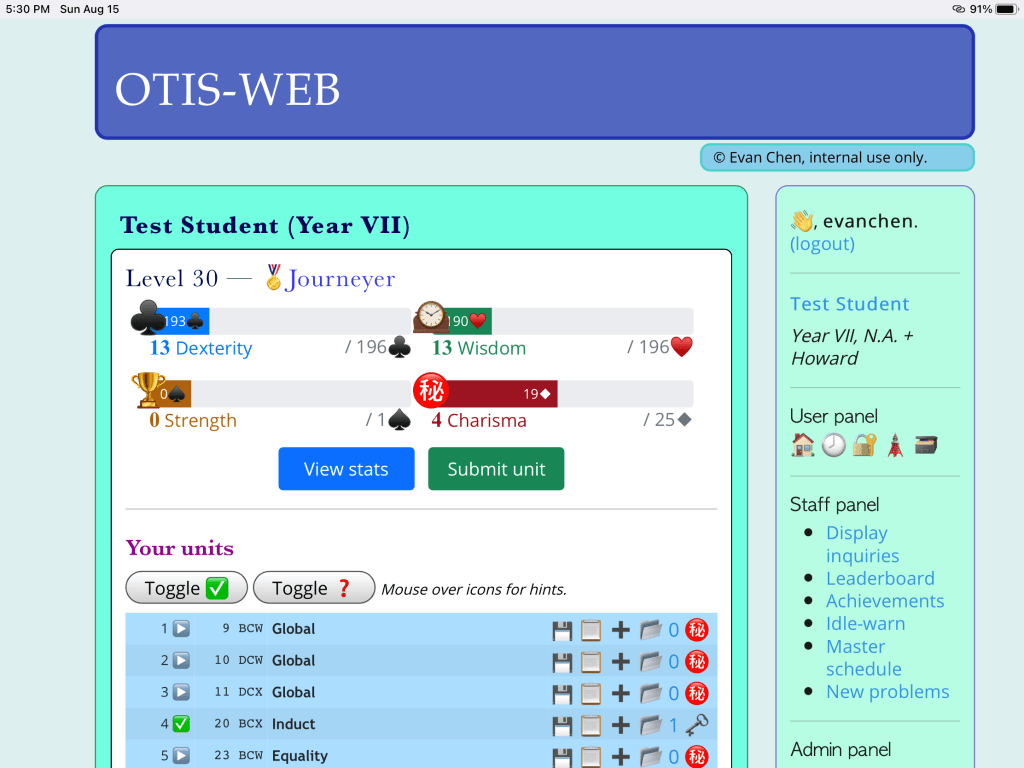
Makes it feel a bit more rewarding to complete problem sets, I think.
Also gives me the chance to plant Easter eggs everywhere,
which is always a lot of fun ;)