Where do all the smart, curious, earnest kids go these days?
One of my friends asked me this recently, and I wasn’t sure what to say.
In the last ten years, something has changed.
If I had to summarize my concerns in one sentence, I would say this:
kids these days no longer feel they’re allowed to work on what they’re
interested in or excited about.
Instead, they feel obligated to work on whatever happens to be considered
the most “important” (or “prestigious”) thing possible.It’s for this reason I consider ambition as a double-edged sword.
When ambition isn’t accompanied by excitement, earnestness, curiosity,
or interest, it doesn’t usually end well.
But let me do a bit of story-telling.
Hobbies
When I was kid, math contests were seen as a hobby, or sport, or game.
Those were the good old days.
Some years ago I published a chart of my ratings of problem difficulty,
using a scale called MOHS.
When I wrote this I had two goals in mind.
One was that I thought the name “MOHS” for a Math Olympiad Hardness Scale
was the best pun of all time,
because there’s a geological scale of mineral hardness that
coincidentally has the same name.
The other was that I thought it would be useful for beginner students,
and coaches, to help find problems that are suitable for practice.
I think it did accomplish those goals.
The problem is that I also inadvertently helped catalyze an endless,
incessant stream of students constantly arguing …
Sometimes people ask me how many of my students made the IMO, and if I’m in a
bad mood I often give the super snarky reply, “I lost track”.The good-mood answer is “a lot”.
That’s actually a white lie. The real answer is “I deliberately don’t keep
track”. And in this post I want to explain why.
It’s definitely human nature to be happy when your students succeed, the same
way it’s human nature to be happy when your selfies get hearts.
In moderation, that seems fine.
I think it’s unlikely I ever reach a point where I never brag about OTIS at all.
But there is a fine line between the following two implications:
“I’m super proud of my kids, look what they did.”
“I’m super proud of myself, look what my kids did.”
Math must be presented for System 1 to absorb and only incidentally for System 2 to verify.
I finally have a sort-of formalizable guideline for teaching and writing math,
and what it means to “understand” math.
I’ve been unconsciously following this for years
and only now managed to write down explicitly what it is that I’ve been doing.
(This post is written from a math-centric perspective,
because that’s the domain where my concrete object-level examples from.
But I suspect much of it applies to communicating hard ideas in general.)
S1 is the part of the brain characterized by fast, intuitive, automatic,
instinctive, emotional responses, For example, when you read the text “2+2=?”,
S1 tells you (without …
While making preparations for this year’s MOP,
I imagined to myself what I would say on orientation night if I was director of the camp,
and came up with the following speech.
I thought it might be nice to share on this blog.
Of course, it represents my own views, not the actual views of MOP or MAA.
And since I am not actually director of MOP, the speech was never given.
People sometimes ask me, why do we have international students at MOP?
Doesn’t that mean we’re training teams from other countries?
So I want to make this clear now: the purpose of MOP is not to train and select future IMO teams.
I know it might seem that way, because we invite by score and grade.
But I really think the purpose of MOP is to give each one of you
the experience of working …
Some thoughts about some modern trends in mathematical olympiads that may be concerning.
I. The story of the barycentric coordinates
I worry about my geometry book. To explain why, let me tell you a story.
When I was in high school about six years ago,
barycentric coordinates were nearly unknown as an olympiad technique.
I only heard about it from whispers in the wind from friends who had heard of
the technique and thought it might be usable.
But at the time, there were nowhere where everything was written down explicitly.
I had a handful of formulas online, a few helpful friends I can reach out to,
and a couple example posts littered across some forums.
Seduced by the possibility of arcane power, I didn’t let this stop me.
Over the spring of 2012, spring break settled in,
and I spent that entire week developing the entire theory of …
It’s not uncommon for technical books to include an admonition from the author
that readers must do the exercises and problems. I always feel a little peculiar when I read such warnings.
Will something bad happen to me if I don’t do the exercises and problems? Of course not.
I’ll gain some time, but at the expense of depth of understanding. Sometimes that’s worth it.
Sometimes it’s not.
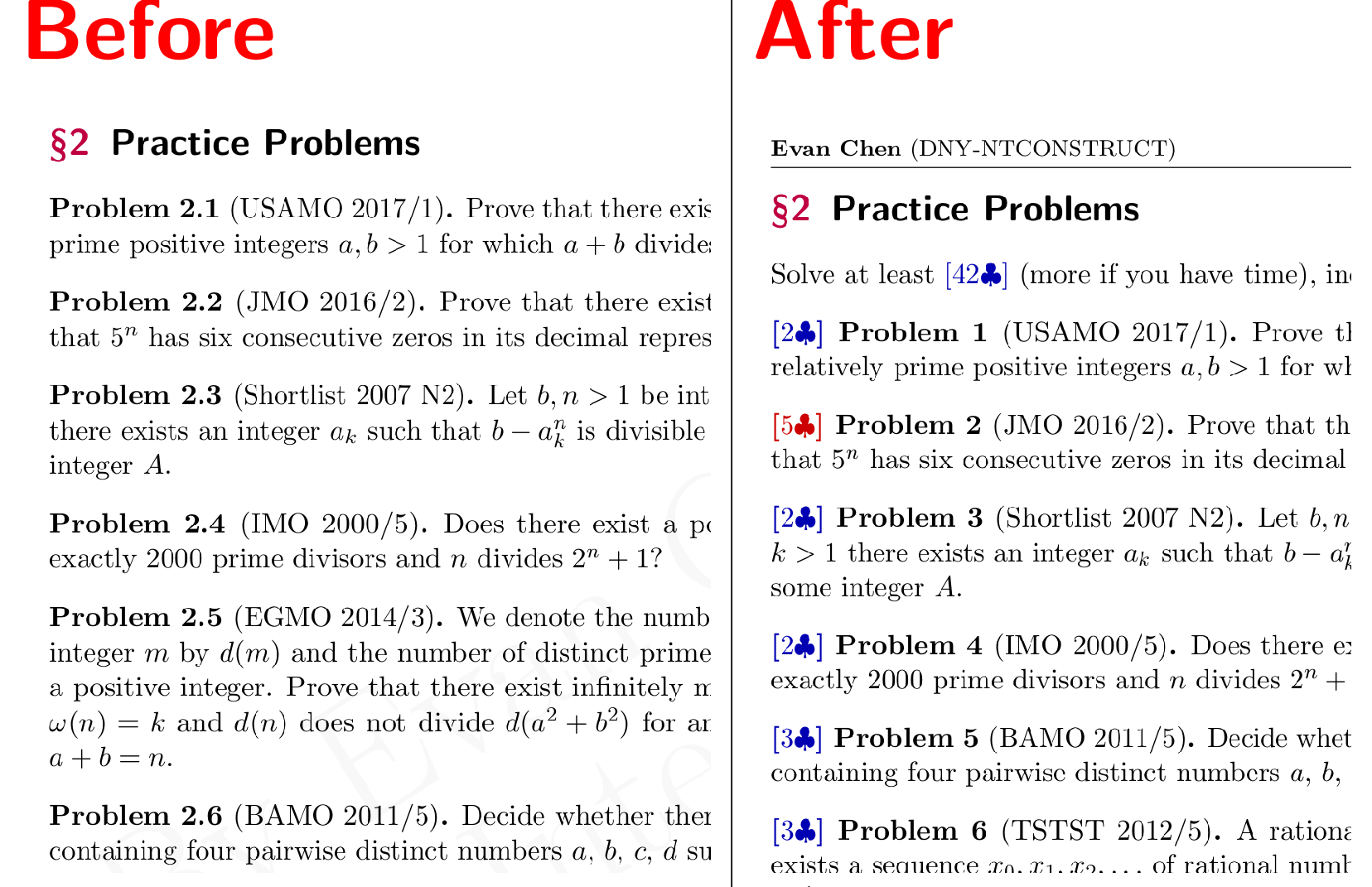
I spent the first few days of my recent winter vacation transitioning all the
problem sets for my students from a
“traditional” format to a “point-based” format. Here’s a before and after.
OTIS problem sets: before and after.
Technical specification:
The traditional problem sets used to consist of a list of 6-9 olympiad problems of varying difficulty,
for which you were expected to solve all problems over …
In a previous post I tried to
make the point that math olympiads should not be judged by their relevance to research mathematics.
In doing so I failed to actually explain why I think math olympiads are a
valuable experience for high schoolers, so I want to make amends here.
1. Summary
In high school I used to think that math contests were primarily meant to
encourage contestants to study some math that is (much) more interesting than
what’s typically shown in high school.
While I still think this is one goal, and maybe it still is the primary goal in some people’s minds,
I no longer believe this is the primary benefit.
My current belief is that there are two major benefits from math competitions:
To build a social network for gifted high school students with similar interests.
To provide a challenging experience that lets gifted students …
(This is a bit of a follow-up to the solution reading post last month.
Spoiler warnings: USAMO 2014/6, USAMO 2012/2, TSTST 2016/4, and hints for ELMO 2013/1, IMO 2016/2.)
I want to say a little about the process which I use to design my olympiad
handouts and classes these days (and thus by extension the way I personally think about problems).
The short summary is that my teaching style is centered around
showing connections and recurring themes between problems.
Now let me explain this in more detail.
1. Main ideas
Solutions to olympiad problems can look quite different from one another at a surface level,
but typically they center around one or two main ideas,
as I describe in my post on reading solutions.
Because details are easy to work out once you have the main idea,
as far as learning is concerned you can …
(Ed Note: This was earlier posted under the incorrect title “On Designing Olympiad Training”.
How I managed to mess that up is a long story involving some incompetence with Python scripts,
but this is fixed now.)
Spoiler warnings: USAMO 2014/1, and hints for Putnam 2014 A4 and B2.
You may want to work on these problems yourself before reading this post.
1. An Apology
At last year’s USA IMO training camp, I prepared a handout on writing/style for the students at MOP.
One of the things I talked about was the “ocean-crossing point”,
which for our purposes you can think of as the discrete jump from a problem
being “essentially not solved” (0+) to “essentially solved” (7−).
The name comes from a Scott Aaronson post:
Suppose your friend in Boston blindfolded you, drove you around for twenty minutes,
then took the blindfold off …