In my last semester of MIT I led a recitation (i.e. twice-a-week review) sessionFor those of you that don’t know how the system works, at MIT,
18.02 is a huge class with 400 to 500 students (mostly first-years).
In order to make sure students actually get the individual attention they
need (impossible during lecture), the math department also places each student in a
recitation section
of about 20 students each, meeting twice a week for an hour each.
for multivariable calculus (18.02) at MIT
(although the first few weeks are all linear algebra).
It’s different from many contexts I’ve taught in before;
the emphasis of the class is on doing standard procedures,
but the challenge is that there is a lot of ground covered.
That is, compared to other settings I’ve taught,
there is generally a tradeoff of less depth for more …
Editorial note: this post was mostly written in February 2023. Any resemblance
to contests after that date is therefore coincidental.
Background
A long time ago, rubrics for the IMO and USAMO were fairly strict. Out of seven,
the overall meta-rubric looks like:
7: Problem solved
6: Tiny slip (and contestant could repair)
5: Small gap or mistake, but non-central
2: Lots of genuine progress
1: Significant non-trivial progress
0: “Busy work”, special cases, lots of writing
In particular, traditional rubrics were often sublinear.
You’d see problems where you could split it into two parts, and solving
either part would only give 2 points, whereas solving both was worth 7.
Increasingly, I’ve noticed this is less and less common.
Particularly, at the IMOAs far as I know, the IMO rubrics aren’t really available anywhere.
(On the other hand, I’ve never been told that rubrics
explicitly need …
Some years ago I published a chart of my ratings of problem difficulty,
using a scale called MOHS.
When I wrote this I had two goals in mind.
One was that I thought the name “MOHS” for a Math Olympiad Hardness Scale
was the best pun of all time,
because there’s a geological scale of mineral hardness that
coincidentally has the same name.
The other was that I thought it would be useful for beginner students,
and coaches, to help find problems that are suitable for practice.
I think it did accomplish those goals.
The problem is that I also inadvertently helped catalyze an endless,
incessant stream of students constantly arguing …
Note: if you are a prospective OTIS student,
read the syllabus instead. More useful, less bragging.
In the unlikely event that I’m a social gathering like a party or family
gathering, people will sometimes ask me about my teaching.
Invariably they ask, “so do you do like 1:1 meetings or group lessons?”.
Then I have to explain, no, I have 400 students, there are no synchronous meetings at all.
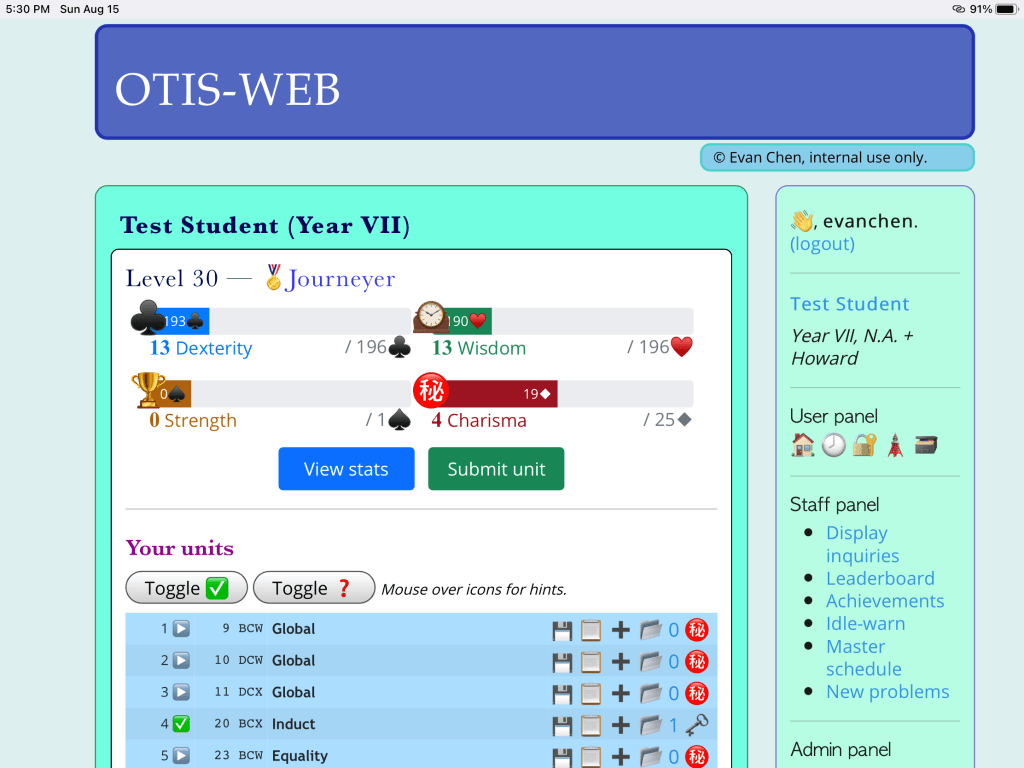
The core of the program is literally a
Python web server that serves PDF files.
Then it sounds less impressive.
I guess when people hear I’m a teacher, they expect me to teach classes,
and it’s a bit embarrassing to explain that I’m not a teacher in that sense anymore.
But the purpose of OTIS isn’t to make Evan sound cool at parties;
the purpose of OTIS to be effective for the students.
So this …
I often gripe about how standard K-12 education is overly
focused on specific knowledge (how to solve a quadratic,
memorizing dates for history, etc.)
rather than general skills (e.g. “how to figure out how to solve a quadratic”).
On the other hand, I understand why;
teaching general skills is much more difficult than preparing a cookbook.
So now I will instead gripe about specific things that should be taught
and aren’t.
Any amount of programming or computing literacy
To me the following are all comparable:
Refusing to learn how to use Google Docs,
and shrugging it off by saying “I’m not planning to be a writer”.
Refusing to learn how to use a spreadsheet,
and shrugging it off by saying “I’m not planning to be an accountant”.
Refusing to learn how to use a shell or git,
and shrugging it off by saying “I’m not …
Makes it feel a bit more rewarding to complete problem sets, I think.
Also gives me the chance to plant Easter eggs everywhere,
which is always a lot of fun ;)
Some thoughts about some modern trends in mathematical olympiads that may be concerning.
I. The story of the barycentric coordinates
I worry about my geometry book. To explain why, let me tell you a story.
When I was in high school about six years ago,
barycentric coordinates were nearly unknown as an olympiad technique.
I only heard about it from whispers in the wind from friends who had heard of
the technique and thought it might be usable.
But at the time, there were nowhere where everything was written down explicitly.
I had a handful of formulas online, a few helpful friends I can reach out to,
and a couple example posts littered across some forums.
Seduced by the possibility of arcane power, I didn’t let this stop me.
Over the spring of 2012, spring break settled in,
and I spent that entire week developing the entire theory of …
It’s not uncommon for technical books to include an admonition from the author
that readers must do the exercises and problems. I always feel a little peculiar when I read such warnings.
Will something bad happen to me if I don’t do the exercises and problems? Of course not.
I’ll gain some time, but at the expense of depth of understanding. Sometimes that’s worth it.
Sometimes it’s not.
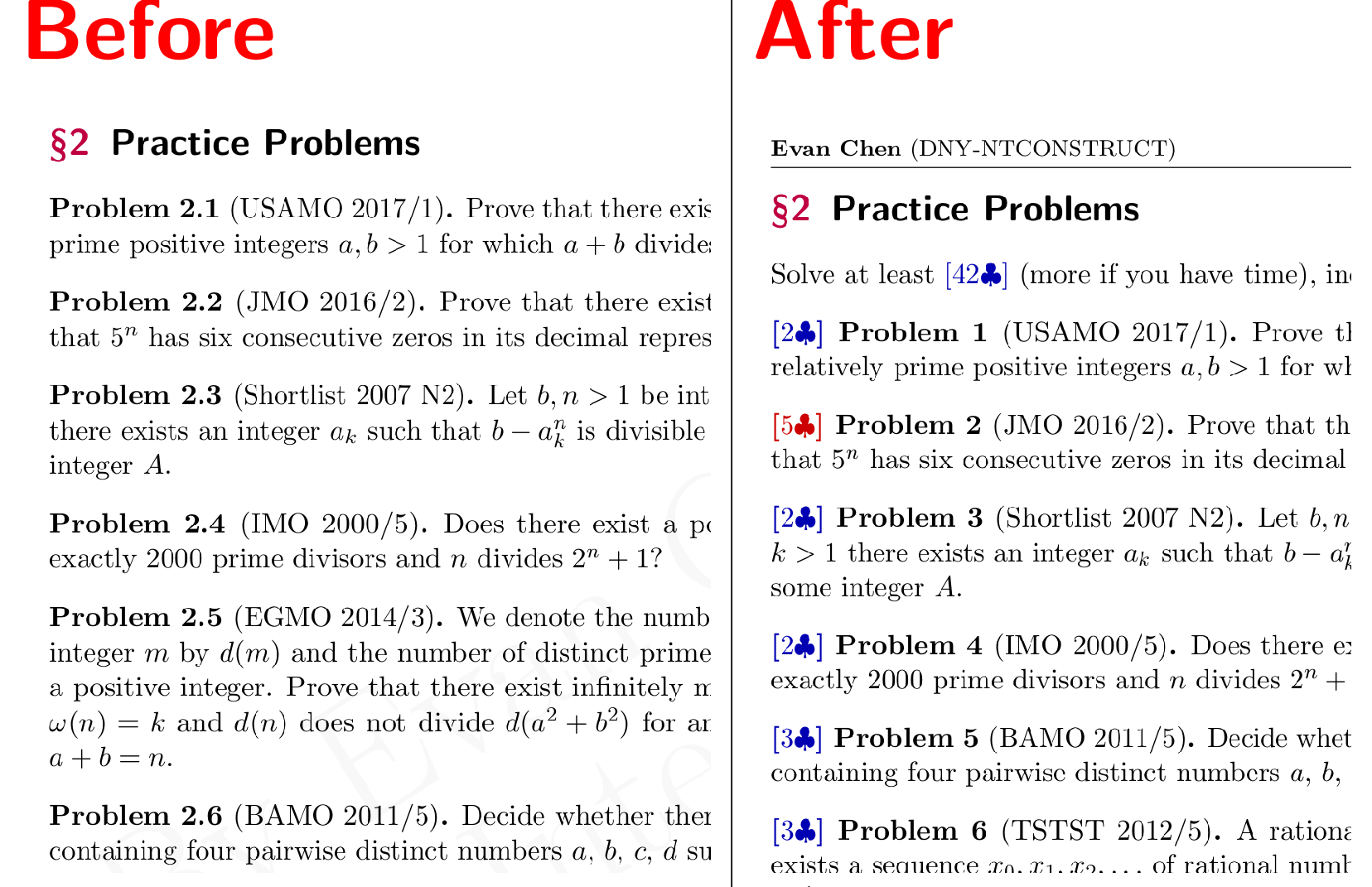
I spent the first few days of my recent winter vacation transitioning all the
problem sets for my students from a
“traditional” format to a “point-based” format. Here’s a before and after.
OTIS problem sets: before and after.
Technical specification:
The traditional problem sets used to consist of a list of 6-9 olympiad problems of varying difficulty,
for which you were expected to solve all problems over …
Median Putnam contestants, willing to devote one of the last Saturdays before final exams to a math test,
are likely to receive an advanced degree in the sciences.
It is counterproductive on many levels to leave them feeling like total idiots.
Last February I made a big public apology
for having caused one of the biggest scoring errors in HMMT history,
causing a lot of changes to the list of top individual students.
Pleasantly, I got some nice emails from coaches who reminded me that most
students and teams do not place highly in the tournament,
and at the end of the day the most important thing is that the contestants enjoyed the tournament.
So now I decided I have to apologize for 2016, too.
The story this time is that I inadvertently sent over 100 students home having
solved two …
In a previous post I tried to
make the point that math olympiads should not be judged by their relevance to research mathematics.
In doing so I failed to actually explain why I think math olympiads are a
valuable experience for high schoolers, so I want to make amends here.
1. Summary
In high school I used to think that math contests were primarily meant to
encourage contestants to study some math that is (much) more interesting than
what’s typically shown in high school.
While I still think this is one goal, and maybe it still is the primary goal in some people’s minds,
I no longer believe this is the primary benefit.
My current belief is that there are two major benefits from math competitions:
To build a social network for gifted high school students with similar interests.
To provide a challenging experience that lets gifted students …