This is a pitch for a new text that I’m thinking of writing.
I want to post it here to solicit opinions from the general community before
investing a lot of time into the actual writing.
Summary
There are a lot of students who ask me a question isomorphic to:
How do I learn to write proofs?
I’ve got this on my Q&A. For the contest kiddos out there,
it basically amounts to saying “read the official solutions to any competition”.
But I think I can do better.
Requirements
Calling into question the obvious, by insisting that it be “rigorously proved”, is to say to a student,
“Your feelings and ideas are suspect. You need to think and speak our way.”
Now there is a place for formal proof in mathematics, no question.
But that place is not a student’s first introduction to mathematical argument.
At …
Finally, if you attempt to read this without working through a significant
number of exercises (see §0.0.1), I will come to your house and pummel you
with [Gr-EGA] until you beg for mercy. It is important to not just have a
vague sense of what is true, but to be able to actually get your hands dirty.
As Mark Kisin has said, “You can wave your hands all you want, but it still
won’t make you fly.”
When people learn new areas in higher math,
they are usually required to do some exercises.
I think no one really disputes this: you have to actually do math to make any progress.
However, from the teacher’s side,
I want to make the case that there is some art to picking exercises, too.
In the process of writing my Napkin …
I’m now going to say something explicitly that I
hinted at in June:
I don’t think a student deserves to make MOP more because they had a higher score than another student.
I think it’s easy to get this impression because the selection for MOP is done
by score cutoffs. So it sure looks that way.
But I don’t think MOP admissions (or contests in general) are meant to be a form
of judgment. My primary agenda is to run a summer program that is good for its
participants, and we get funding for N of them. For that, it’s not important
which N students make it, as long as they are enthusiastic and adequately
prepared. (Admittedly, for a camp like MOP, “adequately prepared” is a tall
order). If anything, what I would hope to select for is the people who would get
the most …
Math must be presented for System 1 to absorb and only incidentally for System 2 to verify.
I finally have a sort-of formalizable guideline for teaching and writing math,
and what it means to “understand” math.
I’ve been unconsciously following this for years
and only now managed to write down explicitly what it is that I’ve been doing.
(This post is written from a math-centric perspective,
because that’s the domain where my concrete object-level examples from.
But I suspect much of it applies to communicating hard ideas in general.)
S1 is the part of the brain characterized by fast, intuitive, automatic,
instinctive, emotional responses, For example, when you read the text “2+2=?”,
S1 tells you (without …
Up to now I always felt a little saddened when I see people drop out of the IMO or EGMO team selection.
But actually, really I should be asking myself what I (as a coach) could do better
to make sure the students know we value their effort,
even if they ultimately don’t make the team.
Because we sure do an awful job of being supportive of the students,
or, well, really doing anything at all.
There’s no practice material, no encouragement,
or actually no form of contact whatsoever.
Just three unreasonably hard problems each month,
followed by a score report about a week later,
starting in December and dragging in to April.
One of a teacher’s important jobs is to encourage their students.
And even though we get the best students in the USA,
probably we shouldn’t skip that step entirely,
especially given the level …
People often complain to me about how olympiad geometry
is just about knowing a bunch of configurations or theorems.
But it recently occurred to me that when you actually get down to its core,
the amount of specific knowledge that you need to do well in olympiad geometry is very little.
In fact I’m going to come out and say:
I think all the theory of mainstream IMO geometry would not last even a one-semester college course.
So to stake my claim, and celebrate April Fool’s Day,
I decided to actually do it.
What would olympiad geometry look like if it was taught at a typical college?
To find out, I present to you the course notes for:
I think it would be nice if every few years I updated my generic answer to “how
do I get better at math contests?”. So here is the 2019 version.
Unlike previous instances, I’m going to be a little less olympiad-focused than I usually am,
since these days I get a lot of people asking for help on the AMC and AIME too.
Some thoughts about some modern trends in mathematical olympiads that may be concerning.
I. The story of the barycentric coordinates
I worry about my geometry book. To explain why, let me tell you a story.
When I was in high school about six years ago,
barycentric coordinates were nearly unknown as an olympiad technique.
I only heard about it from whispers in the wind from friends who had heard of
the technique and thought it might be usable.
But at the time, there were nowhere where everything was written down explicitly.
I had a handful of formulas online, a few helpful friends I can reach out to,
and a couple example posts littered across some forums.
Seduced by the possibility of arcane power, I didn’t let this stop me.
Over the spring of 2012, spring break settled in,
and I spent that entire week developing the entire theory of …
It’s not uncommon for technical books to include an admonition from the author
that readers must do the exercises and problems. I always feel a little peculiar when I read such warnings.
Will something bad happen to me if I don’t do the exercises and problems? Of course not.
I’ll gain some time, but at the expense of depth of understanding. Sometimes that’s worth it.
Sometimes it’s not.
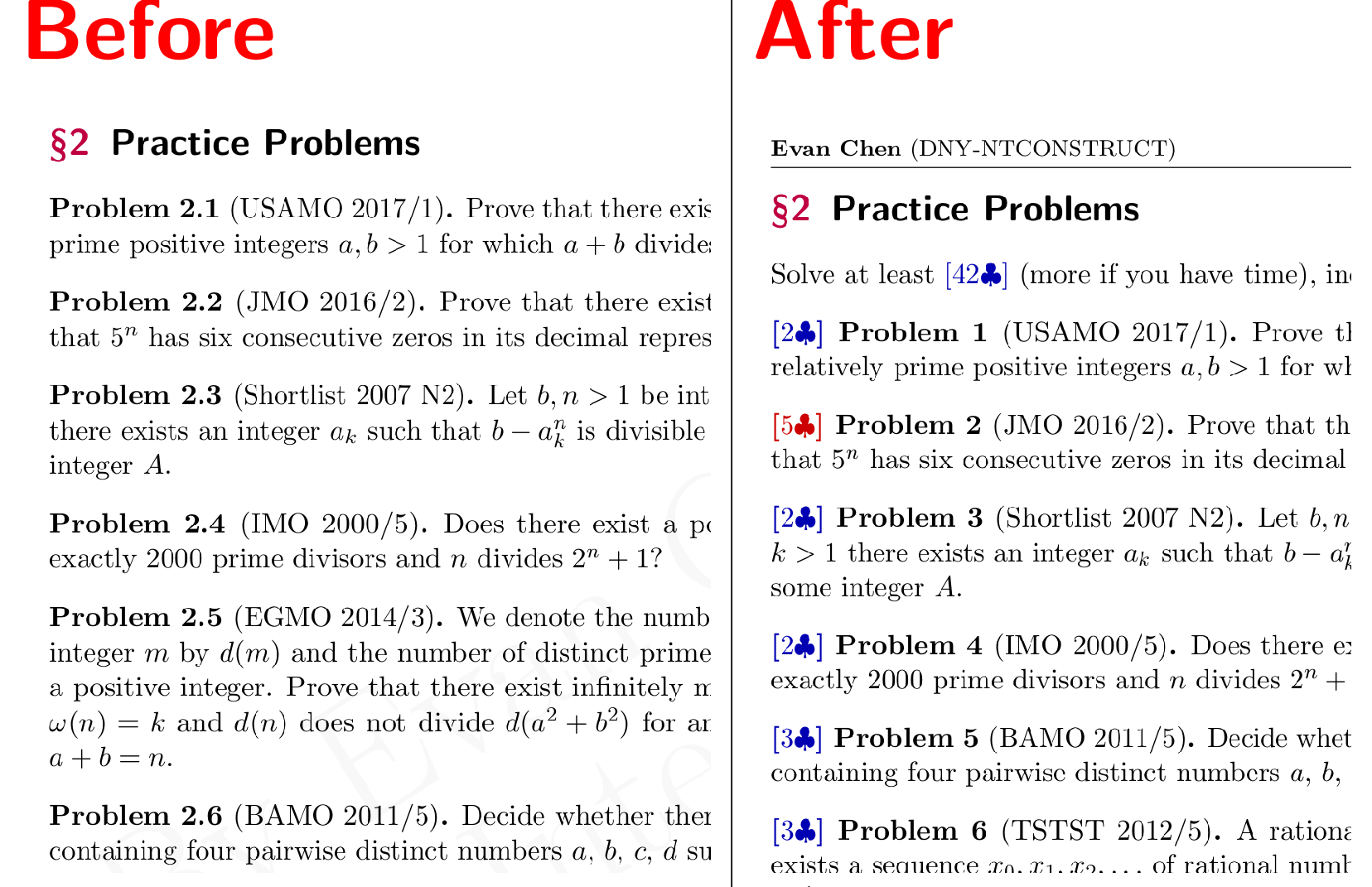
I spent the first few days of my recent winter vacation transitioning all the
problem sets for my students from a
“traditional” format to a “point-based” format. Here’s a before and after.
OTIS problem sets: before and after.
Technical specification:
The traditional problem sets used to consist of a list of 6-9 olympiad problems of varying difficulty,
for which you were expected to solve all problems over …
Median Putnam contestants, willing to devote one of the last Saturdays before final exams to a math test,
are likely to receive an advanced degree in the sciences.
It is counterproductive on many levels to leave them feeling like total idiots.
Last February I made a big public apology
for having caused one of the biggest scoring errors in HMMT history,
causing a lot of changes to the list of top individual students.
Pleasantly, I got some nice emails from coaches who reminded me that most
students and teams do not place highly in the tournament,
and at the end of the day the most important thing is that the contestants enjoyed the tournament.
So now I decided I have to apologize for 2016, too.
The story this time is that I inadvertently sent over 100 students home having
solved two …