
🖉 Revisiting arc midpoints in complex numbers
1. Synopsis
One of the major headaches of using complex numbers in olympiad geometry problems is dealing with square roots. In particular, it is nontrivial to express the incenter of a triangle inscribed in the unit circle in terms of its vertices.
The following lemma is the standard way to set up the arc midpoints of a triangle. It appears for example as part (a) of Lemma 6.23.
Theorem 1 (Arc midpoint setup for a triangle)
Let be a triangle with circumcircle and let , , denote the arc midpoints of opposite , opposite , opposite .
Suppose we view as the unit circle in the complex plane. Then there exist complex numbers , , such that , , , and
Theorem 1 is often used in combination with the following lemma, which lets one assign the incenter the coordinates in the above notation.
Lemma 2 (The incenter is the orthocenter of opposite arc midpoints)
Let be a triangle with circumcircle and let , , denote the arc midpoints of opposite , opposite , opposite . Then the incenter of coincides with the orthocenter of .
Unfortunately, the proof of Theorem 1 in my textbook is wrong, and I cannot find a proof online (though I hear that Lemmas in Olympiad Geometry has a proof). So in this post I will give a correct proof of Theorem 1, which will hopefully also explain the mysterious introduction of the minus signs in the theorem statement. In addition I will give a version of the theorem valid for quadrilaterals.
2. A Word of Warning
I should at once warn the reader that Theorem 1 is an existence result, and thus must be applied carefully.
To see why this matters, consider the following problem, which appeared as problem 1 of the 2016 JMO.
Example 3 (JMO 2016, by Zuming feng)
The isosceles triangle , with , is inscribed in the circle . Let be a variable point on the arc that does not contain , and let and denote the incenters of triangles and , respectively. Prove that as varies, the circumcircle of triangle passes through a fixed point.
By experimenting with the diagram, it is not hard to guess that the correct fixed point is the midpoint of arc , as seen in the figure below. One might be tempted to write , , , and assert the two incenters are and , and that the fixed point is .
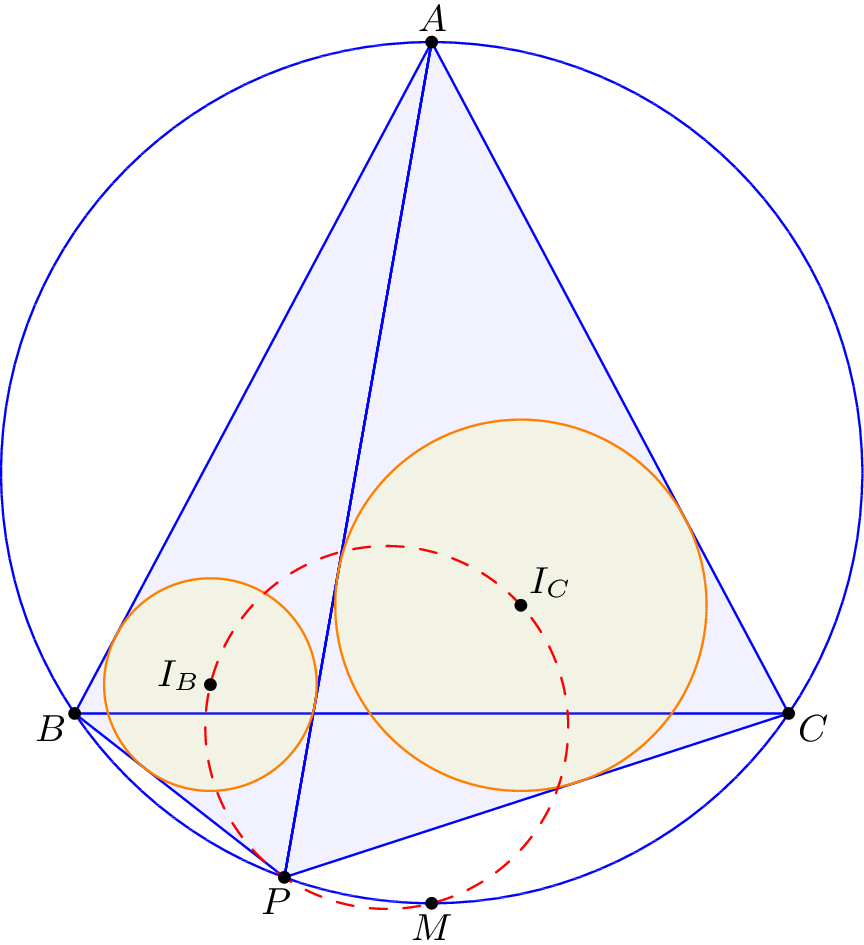
This is a mistake! If one applies Theorem 1 twice, then the choices of “square roots” of the common vertices and may not be compatible. In fact, they cannot be compatible, because the arc midpoint of opposite is different from the arc midpoint of opposite .
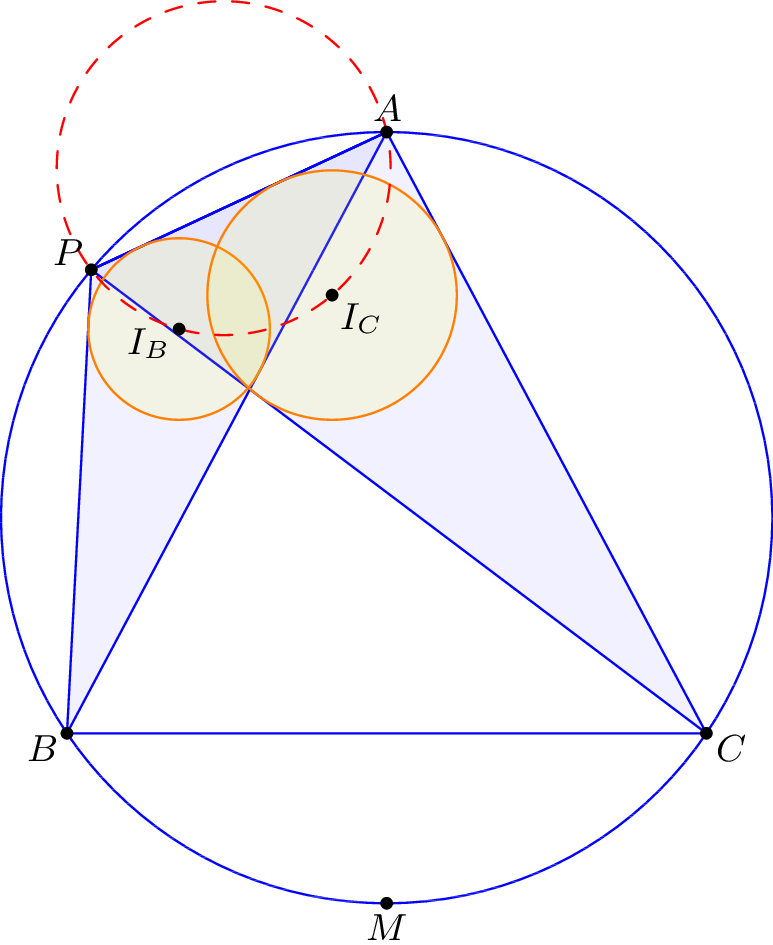
In fact, I claim this is not a minor issue that one can work around. This is because the claim that the circumcircle of passes through the midpoint of arc is false if lies on the arc on the same side as ! In that case it actually passes through instead. Thus the truth of the problem really depends on the fact that the quadrilateral is convex, and any attempt with complex numbers must take this into account to have a chance of working.
3. Proof of the theorem for triangles
Fix now, so we require , , . There are choices of square roots , , we can take (differing by a sign); we wish to show one of them works.
We pick an arbitrary choice for first. Then, of the two choices of , we pick the one such that . Similarly, for the two choices of , we pick the one such that . Our goal is to show that under these conditions, we have again.
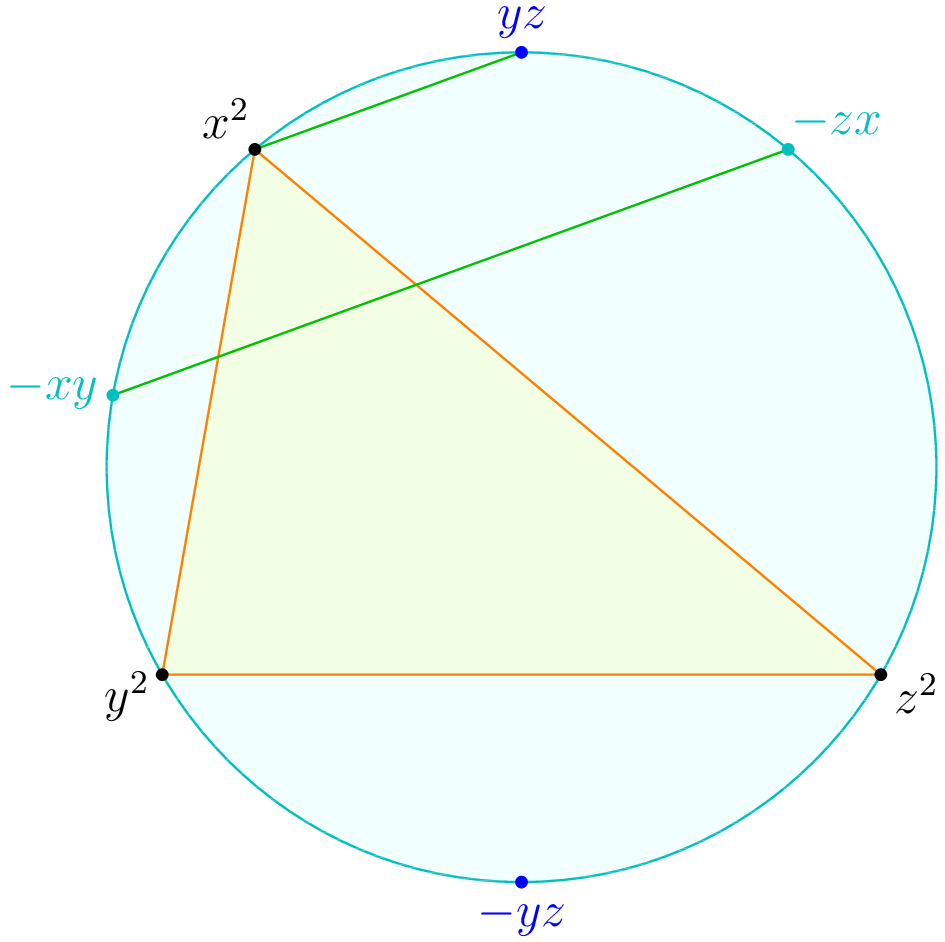
The main trick is to now consider the arc midpoint , which we denote by . It is easy to see that:
Lemma 4 (The isosceles trapezoid trick)
We have (both are perpendicular to the bisector). Thus is an isosceles trapezoid, and so $ A \cdot L = M_B \cdot M_C $.
Thus, we have Thus as desired.
From this we can see why the minus signs are necessary.
Exercise 5. Show that Theorem 1 becomes false if we try to use , , instead of , , .
4. A version for quadrilaterals
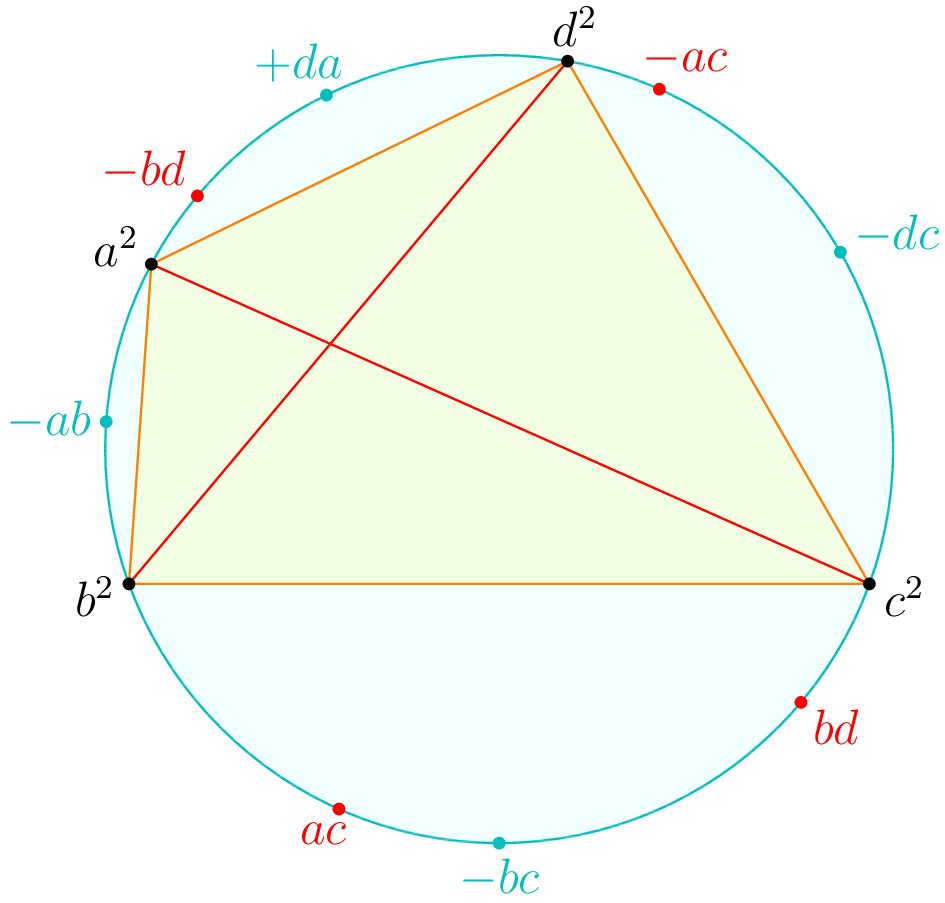
We now return to the setting of a convex quadrilateral that we encountered in Example 3. Suppose we preserve the variables , , that we were given from Theorem 1, but now add a fourth complex number with . How are the new arc midpoints determined? The following theorem answers this question.
Theorem 6 ( setup)
Let be a convex quadrilateral inscribed in the unit circle of the complex plane. Then we can choose complex numbers , , , such that , , , and:
- The opposite arc midpoints , , of triangle are given by , , , as before.
- The midpoint of arc not including or is given by .
- The midpoint of arc not including or is given by .
- The midpoint of arc is and the midpoint of arc is .
This setup is summarized in the following figure.
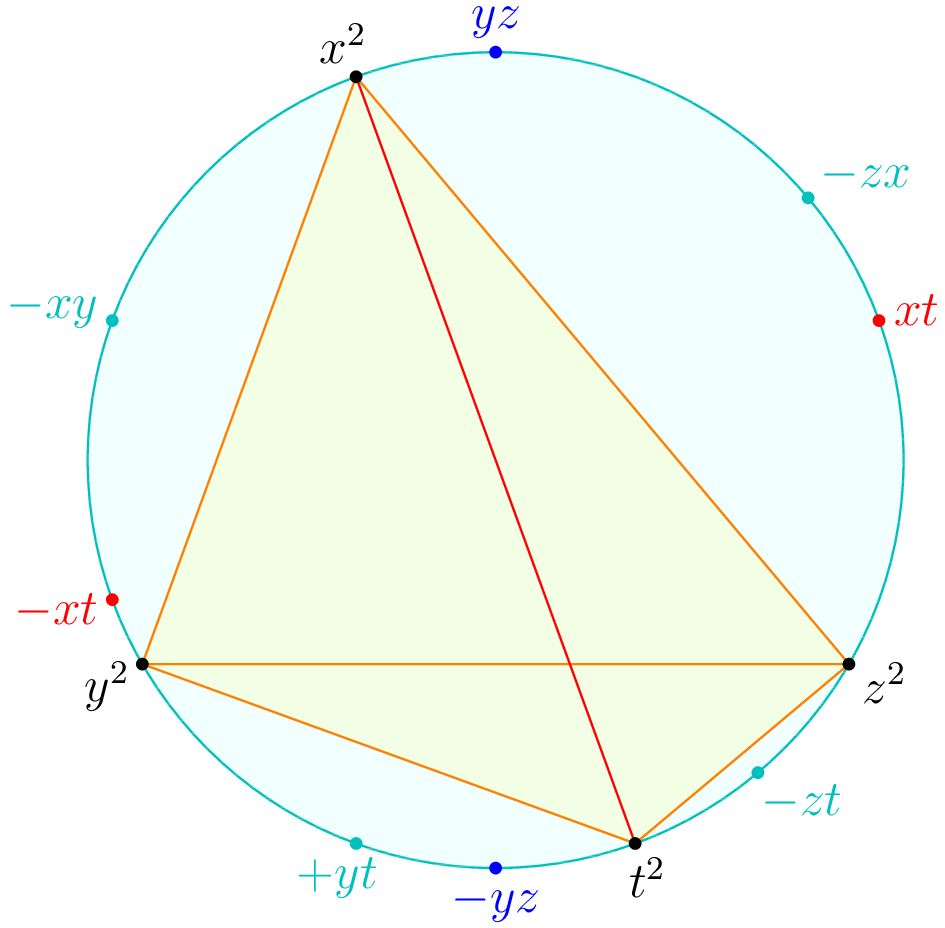
Note that unlike Theorem 1, the four arcs cut out by the sides of do not all have the same sign (I chose to have coordinates ). This asymmetry is inevitable (see if you can understand why from the proof below).
Proof: We select , , with Theorem 1. Now, pick a choice of such that is the arc midpoint of not containing and . Then the arc midpoint of not containing or is given by On the other hand, the calculation of for the midpoint of follows by applying Lemma 4 again (applied to triangle ). The midpoint of is computed similarly.
In other problems, the four vertices of the quadrilateral may play more symmetric roles and in that case it may be desirable to pick a setup in which the four vertices are labeled in order. By relabeling the letters in Theorem 6 one can prove the following alternate formulation.
Corollary 7. Let be a convex quadrilateral inscribed in the unit circle of the complex plane. Then we can choose complex numbers , , , such that , , , and:
- The midpoints of , , , cut out by the sides of are , , , .
- The midpoints of and are and .
- The midpoints of and are and .
To test the newfound theorem, here is a cute easy application.
Example 8 (Japanese theorem for cyclic quadrilaterals)
In a cyclic quadrilateral , the incenters of , , , are the vertices of a rectangle.