Brian Lawrence showed me the following conceptual proof of Poncelet porism in the case of two circles,
which I thought was neat and wanted to sketch here.
(This is only a sketch, since I’m not really defining the integration.)
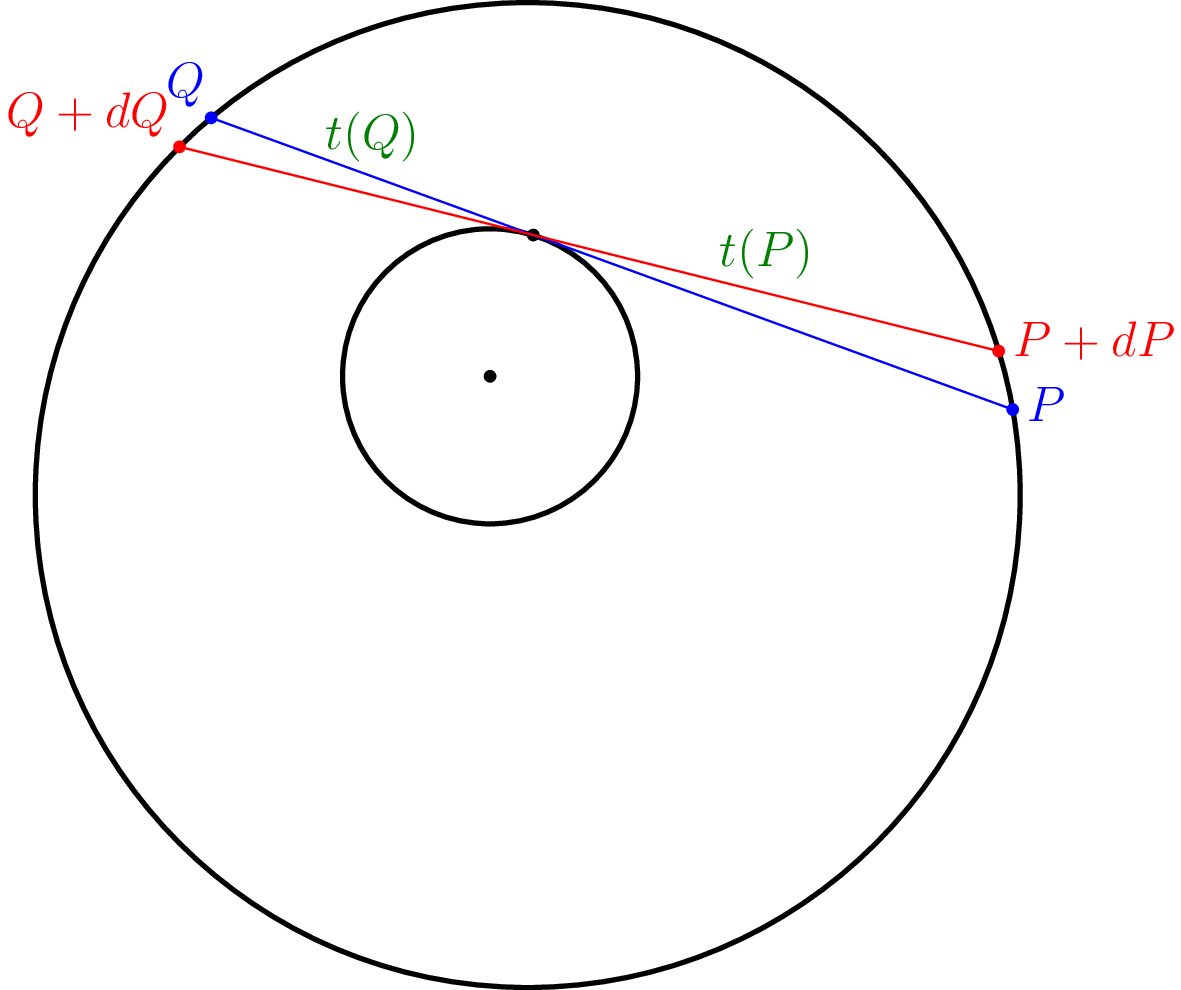
Let P be a point on the outer circle,
and let Q be the point you get when you take the counterclockwise tangent from P to the inner circle.
Consider what happens if we nudge the point P by a small increment dP.
Figure for Poncelet porism proof.
The similar triangles in power of a point then give us the approximation
I’m happy to thank 日本評論社 and their team (Fuma Hirayama, Yuki Kumagae, Taiyo Kodama, Ayato Shukuta,
among others) for making the Japanese translation a reality.
As well as tripling the length of the errata PDF :)
This marks the second translation of the EGMO textbook (a Chinese translation
was published a while ago as well by Harbin Institute of Technology). Both linked below:
Japanese translation at nippyo.co.jp and amazon.co.jp.
ISBN-10: 4535789789 / ISBN-13: 978-4535789784.
Chinese translation at abebooks
and amazon.
ISBN-10: 7560395880 / ISBN-13: 978-7560395883.
The list of errata is now version controlled on GitHub:
vEnhance/egmo-book-errata.
So now you can actually see a changelog of the ocean of typos as they come in.
Shout-out to the crew working on the Japanese translation of the book for
finding way more errors than I will ever care to admit (I didn’t count,
but it’s probably in the 200-300 ballpark).
I took a snapshot my database entries for sourced problems in EGMO.
It turns out that I have many written up already,
so we now have something of a solutions manual for about half the problems or so.
Since I like idiotic names, I dubbed it the Automatically Generated EGMO Solutions Treasury.
People often complain to me about how olympiad geometry
is just about knowing a bunch of configurations or theorems.
But it recently occurred to me that when you actually get down to its core,
the amount of specific knowledge that you need to do well in olympiad geometry is very little.
In fact I’m going to come out and say:
I think all the theory of mainstream IMO geometry would not last even a one-semester college course.
So to stake my claim, and celebrate April Fool’s Day,
I decided to actually do it.
What would olympiad geometry look like if it was taught at a typical college?
To find out, I present to you the course notes for:
One of the major headaches of using complex numbers in olympiad geometry
problems is dealing with square roots.
In particular, it is nontrivial to express the incenter of a triangle inscribed
in the unit circle in terms of its vertices.
The following lemma is the standard way to set up the arc midpoints of a triangle.
It appears for example as part (a) of Lemma 6.23.
Theorem 1(Arc midpoint setup for a triangle)
Let ABC be a triangle with circumcircle Γ and let MA, MB, MC
denote the arc midpoints of BC opposite A, CA opposite B,
AB opposite C.
I know some friends who are fantastic at synthetic geometry.
I can give them any problem and they’ll come up with an incredibly impressive synthetic solution.
I also have some friends who are very bad at synthetic geometry,
but have such good fortitude at computations that they can get away with using
Cartesian coordinates for everything.
I don’t consider myself either of these types; I don’t have much ingenuity when it comes to my solutions,
and I’m actually quite clumsy when it comes to long calculations.
But nonetheless I have a high success rate with olympiad geometry problems.
Not only that, but my solutions are often very algorithmic,
in the sense that any well-trained student should be able to come up with this solution.
In this article I try to describe how I come up which such solutions.
My favorite circle associated to a triangle is the A-mixtilinear incircle.
While it rarely shows up on olympiads, it is one of the richest configurations I have seen,
with many unexpected coincidences showing up,
and I would be overjoyed if they become fashionable within the coming years.
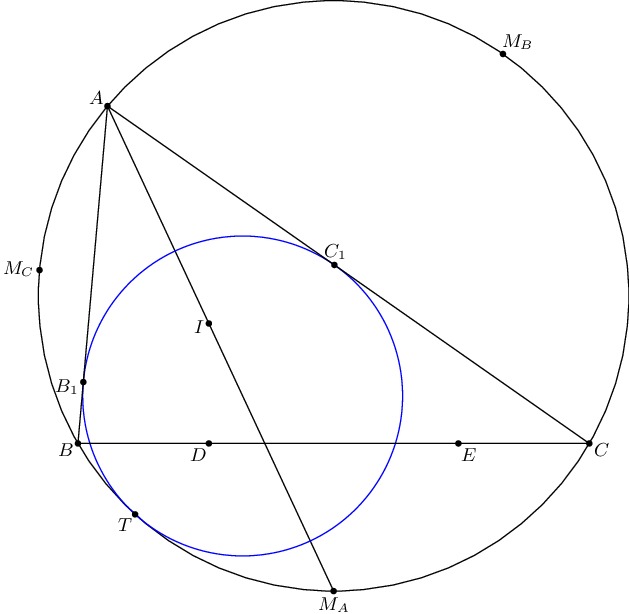
Here’s the picture:
The A-mixtilinear incircle.
The points D and E are the contact points of the incircle and A-excircle on the side BC.
Points MA, MB, MC are the midpoints of the arcs.
As a challenge to my recent USAMO class
(I taught at A* Summer Camp this year),
I asked them to find as many “coincidences” in the picture as I could …
In this post I’ll cover three properties of isogonal conjugates which were only recently made known to me.
These properties are generalization of some well-known lemmas,
such as the incenter/excenter lemma and the nine-point circle.
1. Definitions
Let ABC be a triangle with incenterI,
and let P be any point in the interior of ABC. Then we obtain three lines AP, BP, CP.
Then the reflections of these lines across lines AI, BI,
CI always concur at a point Q which is called the isogonal conjugate of P.
(The proof of this concurrence follows from readily from Trig
Ceva.) When P …