Life isn’t a straight line.
Finding your dream career involves a lot of twists and turns, like a river.
In my search for the perfect job, I find myself constantly changing course,
because even though planning is helpful, the plans themselves are useless.
A lot of you have been asking me what comes after my PhD.
Continuing my post-OTIS entrepreneurial adventures
(see BOATIS in 2023 and (EC)⁵ in 2024),
I’m happy to announce the next chapter:
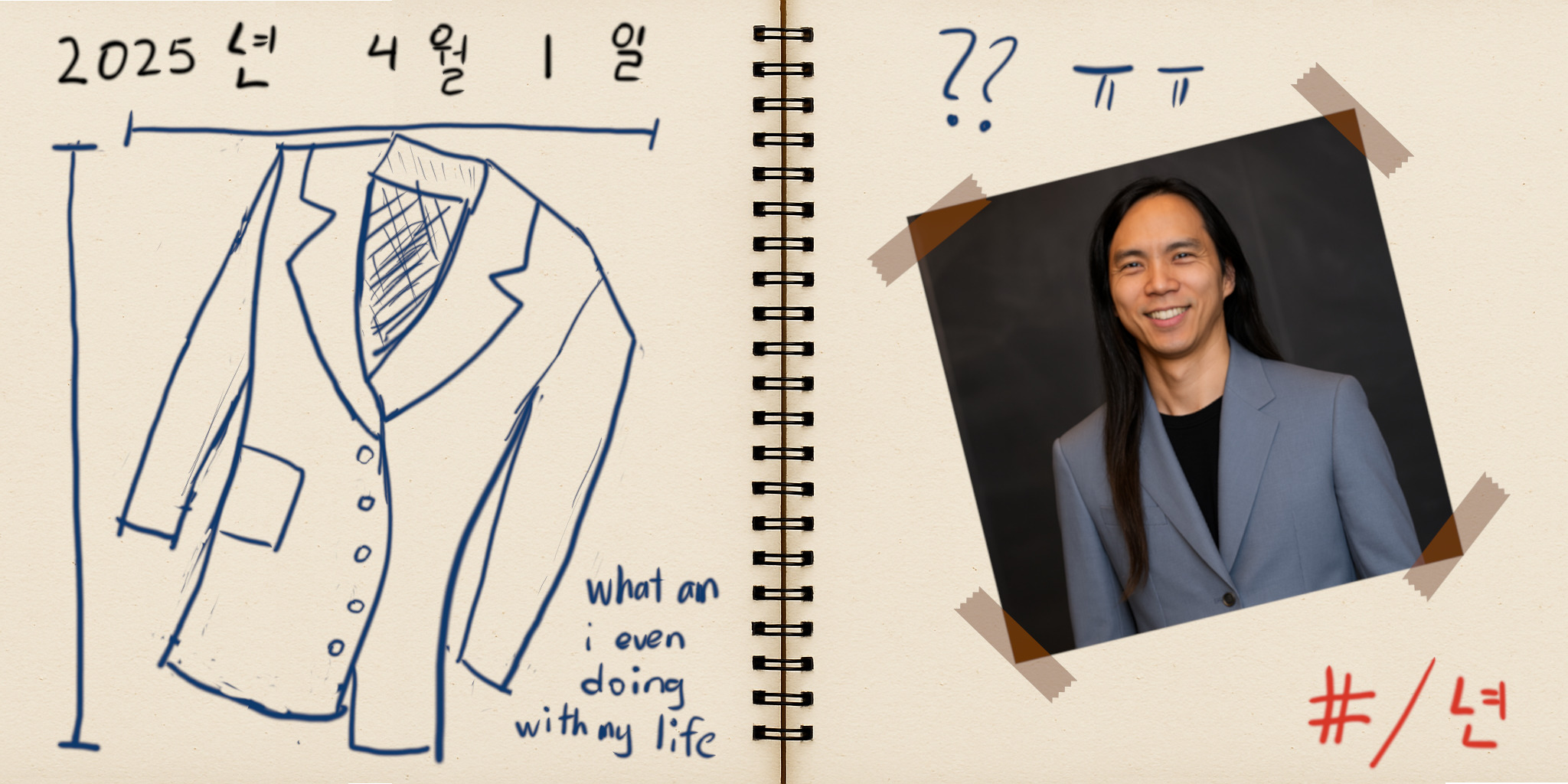
I will be moving to Seoul later this year to start a career in fashion design!
New York would have been the obvious choice,
except I hate New York,
and I thought it might be good to spend some time out of the country.
I’ll be chilling in the fashionable 한남동, sketching ideas for blazers
(and calling it “gender-neutral epistemology” or whatever gets clicks).
I haven’t decided on a name yet for my future brand, suggestions welcome.
Calling all high school juniors!
We’re proud to announce a new educational service to
accompany last year’s ⛵IS:
Evan’s Chen’s Elite Cutting-Edge College Essay Consulting & Editing Center!
Abbreviated (EC)⁵.
Why trust Evan?
Evan Chen is one of the leading names in admissions to elite American colleges.
Students that Evan has mentored have gone on to prestigious institutions
such as Harvard, Princeton, Stanford — and of course,
MIT, the home of the illuMInaTi.
Evan is so successful at securing spots at selective universities
that nearly 1 in e^pi incoming MIT first-years are
alums of Evan’s programs [[citation needed]][[original research?]].
This is a figure unrivaled in the college prep industry.
Now, for the first time, you can join the ranks of Evan’s superstar students:
(EC)⁵ is the first endeavor led by Evan that doesn’t require any
sort of application or past achievements …
It’s with a sense of both sadness and excitement that I am writing to announce
that year IX of my math olympiad training program, OTIS, is cancelled.
Instead, it will be replaced by a new program that I am starting, named
Boat Operations: A Tutorial In Sailing, or ⛵IS for short.
This was a hard decision for me to make, but it’s been with me forever.
I’ve been staring at the edge of the water long as I can remember,
never really knowing why, and now it’s time to answer that calling.
Why sailing instead of math?
Sailing is a more active and physical experience: Sailing involves being out on
the water, feeling the wind and the waves, and physically maneuvering the boat.
This can be a more engaging and immersive experience compared to sitting at a
desk and working on math …
People often complain to me about how olympiad geometry
is just about knowing a bunch of configurations or theorems.
But it recently occurred to me that when you actually get down to its core,
the amount of specific knowledge that you need to do well in olympiad geometry is very little.
In fact I’m going to come out and say:
I think all the theory of mainstream IMO geometry would not last even a one-semester college course.
So to stake my claim, and celebrate April Fool’s Day,
I decided to actually do it.
What would olympiad geometry look like if it was taught at a typical college?
To find out, I present to you the course notes for: