For me the biggest difference between undergraduate math and PhD life
has been something I’ve never seen anyone else talk about:
it’s the feeling like I could no longer see the ground.
To explain what this means, imagine that mathematics is this wide tower,
where you start with certain axioms as a foundation,
and then you build upwards on it.
At first learning math felt like slowly climbing up this tower.
When I reached a landmark, it felt like I was on the balcony
of the 30th or 50th or 100th floor, enjoying the view,
with an appreciation of the floors I had ascended to get here.
In theory, proofs in math can be formalized as a
long sequence of logical steps from the axioms that could be
computer-verified.
This turns out to way too cumbersome to actually do in practice given
the current state of technology (though …
There’s a common error I keep seeing on OTIS applications, so I’m going to
document the error here in the hopes that I can preemptively dispel it.
To illustrate it more clearly, here is a problem I made up for which the bogus
solution also gets the wrong numerical answer:
Problem: Suppose a2+b2+c2=1 for positive real numbers a, b, c.
Find the minimum possible value of S=a2b+b2c+c2a.
The wrong solution I keep seeing goes like so:
Nonsense solution: By AM-GM, the minimum value of S is
This is a pitch for a new text that I’m thinking of writing.
I want to post it here to solicit opinions from the general community before
investing a lot of time into the actual writing.
Summary
There are a lot of students who ask me a question isomorphic to:
How do I learn to write proofs?
I’ve got this on my Q&A. For the contest kiddos out there,
it basically amounts to saying “read the official solutions to any competition”.
But I think I can do better.
Requirements
Calling into question the obvious, by insisting that it be “rigorously proved”, is to say to a student,
“Your feelings and ideas are suspect. You need to think and speak our way.”
Now there is a place for formal proof in mathematics, no question.
But that place is not a student’s first introduction to mathematical argument.
At …
Finally, if you attempt to read this without working through a significant
number of exercises (see §0.0.1), I will come to your house and pummel you
with [Gr-EGA] until you beg for mercy. It is important to not just have a
vague sense of what is true, but to be able to actually get your hands dirty.
As Mark Kisin has said, “You can wave your hands all you want, but it still
won’t make you fly.”
When people learn new areas in higher math,
they are usually required to do some exercises.
I think no one really disputes this: you have to actually do math to make any progress.
However, from the teacher’s side,
I want to make the case that there is some art to picking exercises, too.
In the process of writing my Napkin …
This post will mostly be focused on construction-type problems
in which you’re asked to construct something satisfying property P.
Minor spoilers for USAMO 2011/4, IMO 2014/5.
1. What is a leap of faith?
Usually, a good thing to do whenever you can is to make “safe moves”
which are implied by the property P.
Here’s a simple example.
Example 1(USAMO 2011)
Find an integer n such that the remainder when 2n is divided by n is odd.
It is easy to see, for example, that n itself must be odd for this to be true,
and so we can make our life easier without incurring any worries by restricting our search to odd n.
You might therefore call this an “optimization”:
a kind of move that makes the …
Here is my commentary for the 2019 International Math Olympiad,
consisting of pictures and some political statements about the problem.
Summary
This year’s USA delegation consisted of leader Po-Shen Loh and deputy leader Yang Liu.
The USA scored 227 points, tying for first place with China.
For context, that is missing a total of four problems across all students, which is actually kind of insane.
All six students got gold medals, and two have perfect scores.
Vincent Huang 7 7 3 7 7 7
Luke Robitaille 7 6 2 7 7 6
Colin Shanmo Tang 7 7 7 7 7 7
Edward Wan 7 6 0 7 7 7
Brandon Wang 7 7 7 7 7 1
Daniel Zhu 7 7 7 7 7 7
Korea was 3rd place with 226 points, just one point shy of first,
but way ahead of the 4th place score (with 187 points …
In yet another contest-based post,
I want to distinguish between two types of thinking:
things that could help you solve a problem,
and things that could help you understand the problem better.
Then I’ll talk a little about how you can use the latter.
(I’ve talked about this in my own classes for a while by now,
but only recently realized I’ve never gotten the whole thing in writing. So here goes.)
1. More silly terminology
As usual, to make these things easier to talk about, I’m going to introduce some words to describe these two.
Taking a page from martial arts, I’m going to run with hard and soft techniques.
A hard technique is something you try in the hopes it will prove something
— ideally, solve the problem, but at least give you some intermediate lemma.
Perhaps a better definition is “things that will …
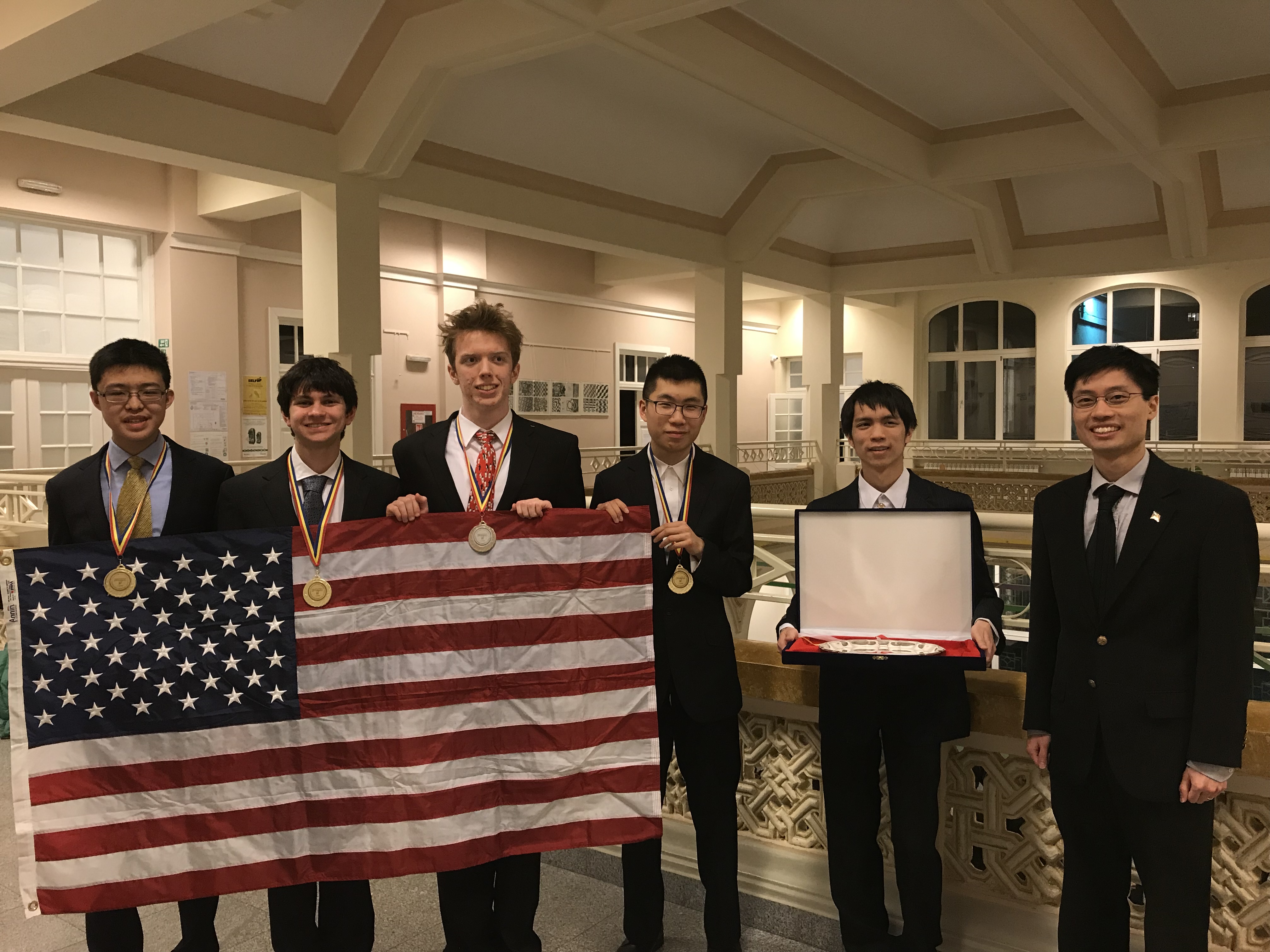
Po-Shen Loh and I spent the last week in Bucharest with the United States team for the 11th RMM.
The USA usually sends four students who have not attended a previous IMO or RMM before.
This year’s four students did breathtakingly well:
Benjamin Qi — gold (rank 2nd)
Luke Robitaille — silver (rank 10th)
Carl Schildkraut — gold (rank 8th)
Daniel Zhu — gold (rank 4th)
(Yes, there are only nine gold medals this year!)
The team score is obtained by summing the three highest scores of the four team members.
The USA won the team component by a lofty margin, making it the first time we’ve won back to back.
I’m very proud of the team.
Pictures
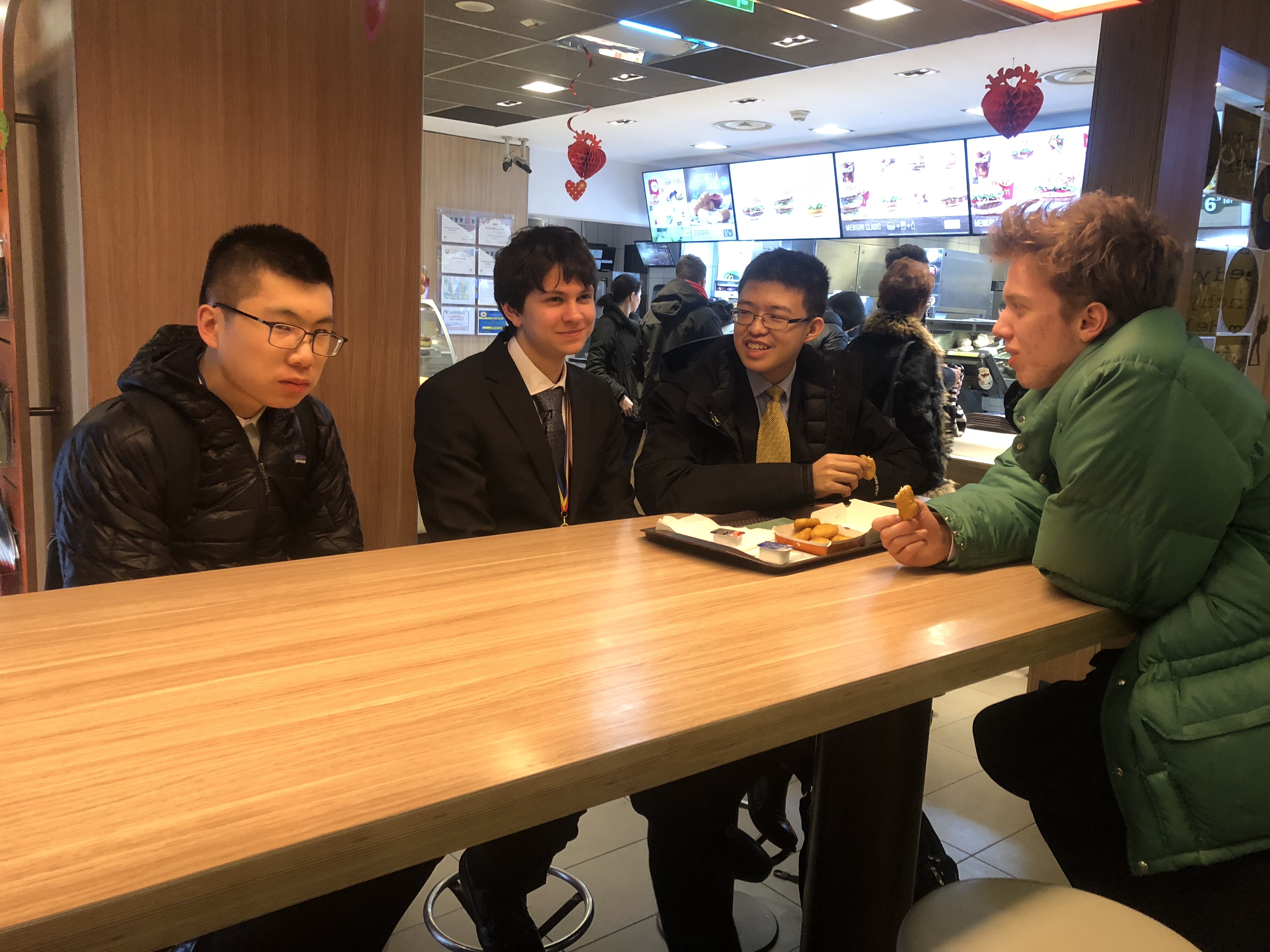
RMM 2019 team after the competition (taken by Daniel Zhu’s
dad)McDonald’s …
Careful readers of my blog might have heard about plans to
have a second edition of Napkin out by the end of February.
As it turns out I was overly ambitious, and
(seeing that I am spending the next week in
Romania)
I am not going to make my self-imposed goal.
Nonetheless, since I did finish a decent chunk of what I hoped to do,
I decided the perfect is the enemy of the good and that I should at least put up what I have so far.
So since this is someplace between version 1 and the (hopefully eventually) version 2,
it seems appropriate to call it version 1.5.
The biggest changes include a complete rewrite of the algebraic geometry chapters,
new parts on real analysis and measure theory,
and a reorganization of many of the earlier chapters
like group theory and topology, with more examples and problems …
There’s a recent working paper by economists Ruchir
Agarwal
and Patrick Gaule which
I think would be of much interest to this readership:
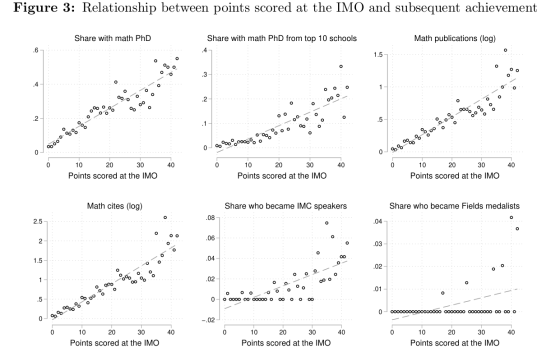
a systematic study of IMO performance versus success as a mathematician later on.
Despite the click-baity title and dreamy introduction about the Millennium Prizes,
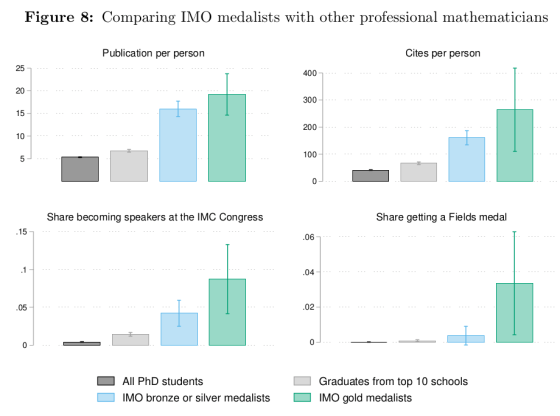
the rest of the paper is fascinating, and the figures section is a gold mine.
Here are two that stood out to me:
Points scored at IMO vs subsequent achievements.IMO medalist outcomes.
There’s also one really nice idea they had,
which was to investigate the effect of getting one point less than a gold medal,
versus getting exactly a gold medal.
This is a pretty clever way to account for the effect of the prestige of the IMO,
since “IMO gold” sounds so much better on a CV than “IMO silver” even …