(EDIT: These solutions earned me a slot in N1, top 16.)
I solved eight problems on the Putnam last Saturday.
Here were the solutions I found during the exam,
plus my repaired solution to B3 (the solution to B3 I submitted originally had a mistake).
Some comments about the test.
I thought that the A test had easy problems: problems A1, A3, A4 were all routine,
and problem A5 is a little long-winded but nothing magical.
Problem A2 was tricky, and took me well over half the A session.
I don’t know anything about A6, but it seems to be very hard.
The B session, on the other hand, was completely bizarre.
In my opinion, the difficulty of the problems I did attempt was
B4≪B1≪B5<B3 …
Model theory is really meta, so you will have to pay attention here.
Roughly, a “model of ZFC” is a set with a binary relation that
satisfies the ZFC axioms,
just as a group is a set with a binary operation that satisfies the group axioms.
Unfortunately, unlike with groups, it is very hard for me to give interesting examples of models,
for the simple reason that we are literally trying to model the entire universe.
1. Models
(Prototypical example for this section: (ω,∈) obeys PowerSet,
Vκ is a model for κ inaccessible (later).)
Definition 1. A modelM consists of a set M and a binary
relation
(Standard post on cardinals, as a prerequisite for forthcoming theory model post.)
An ordinal measures a total ordering. However, it does not do a fantastic job at measuring size.
For example, there is a bijection between the elements of ω and ω+1:
ω+1=ω={{ω0011223……}}.
In fact, as you likely already know, there is even a bijection between ω and ω2:
This one confused me for a long time, so I figured I should write this down before I forgot again.
Let M be an abstract smooth manifold.
We want to define the notion of a tangent vector to M at a point p∈M.
With that, we can define the tangent spaceTp(M),
which will just be the (real) vector space of tangent vectors at p.
Geometrically, we know what this should look like for our usual examples.
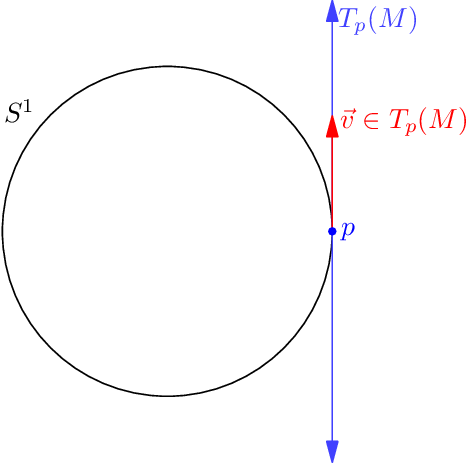
For example, if M=S1 is a circle embedded in R2,
then the tangent vector at a point p should just look like a vector running off tangent to the circle.
My favorite circle associated to a triangle is the A-mixtilinear incircle.
While it rarely shows up on olympiads, it is one of the richest configurations I have seen,
with many unexpected coincidences showing up,
and I would be overjoyed if they become fashionable within the coming years.
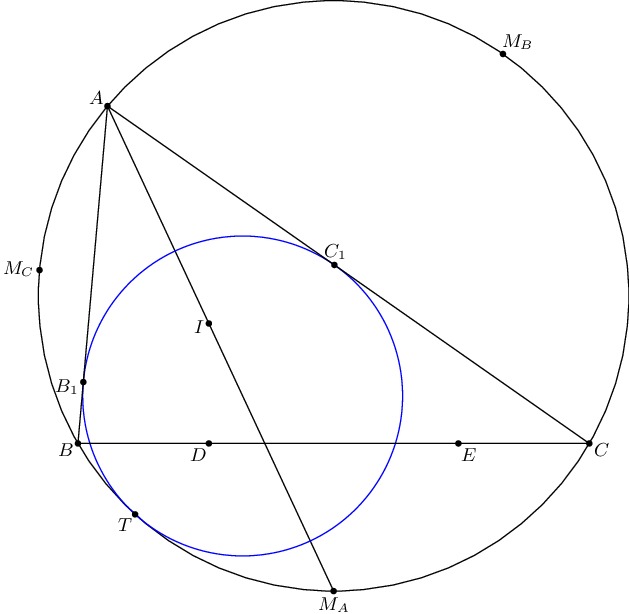
Here’s the picture:
The A-mixtilinear incircle.
The points D and E are the contact points of the incircle and A-excircle on the side BC.
Points MA, MB, MC are the midpoints of the arcs.
As a challenge to my recent USAMO class
(I taught at A* Summer Camp this year),
I asked them to find as many “coincidences” in the picture as I could …
Given a property P about primes, there’s two questions we can ask:
How many primes ≤x are there with this property?
What’s the least prime with this property?
As an example, consider an arithmetic progression a, a+d, …, with a<d and gcd(a,d)=1.
The strong form of Dirichlet’s Theorem tells us that basically,
the number of primes ≡a(modd) is d1 the total number of primes.
Moreover, the celebrated Linnik’s
Theorem tells us that the
first prime is
In this post I will sketch a proof Dirichlet Theorem’s in the following form:
Theorem 1(Dirichlet’s Theorem on Arithmetic Progression)
Let
ψ(x;q,a)=n≤xn≡amodq∑Λ(n).
Let N be a positive constant.
Then for some constant C(N)>0 depending on N, we have for any q such that q≤(logx)N we have
Prerequisites for this post: previous post,
and complex analysis. For this entire post, s is a complex variable with s=σ+it.
1. The Γ function
So there’s this thing called the Gamma function.
Denoted Γ(s), it is defined by
Γ(s)=∫0∞xs−1e−xdx
as long as σ>0. Here are its values at the first few integers:
Normally I don’t like to blog about something until I’m pretty confident that I
have a reasonably good understanding of what’s happening, but I desperately need to sort out my thoughts,
so here I go…
1. Primes
One day, an alien explorer lands on Earth in a 3rd grade classroom.
He hears the teacher talk about these things called primes.
So he goes up to the teacher and asks “how many primes are there less than x?”.
Answer: “uh. . .”.
Maybe that’s too hard, so the alien instead asks “about how many primes are there less than x?”.
This is again greeted with silence.
Confused, the alien asks a bunch of the teachers, who all respond similarly,
but then someone mentions that in the last couple hundred years,
someone …