🖉 The Mixtilinear Incircle
This blog post corresponds to my newest olympiad handout on mixtilinear incircles.
My favorite circle associated to a triangle is the -mixtilinear incircle. While it rarely shows up on olympiads, it is one of the richest configurations I have seen, with many unexpected coincidences showing up, and I would be overjoyed if they become fashionable within the coming years.
Here’s the picture:
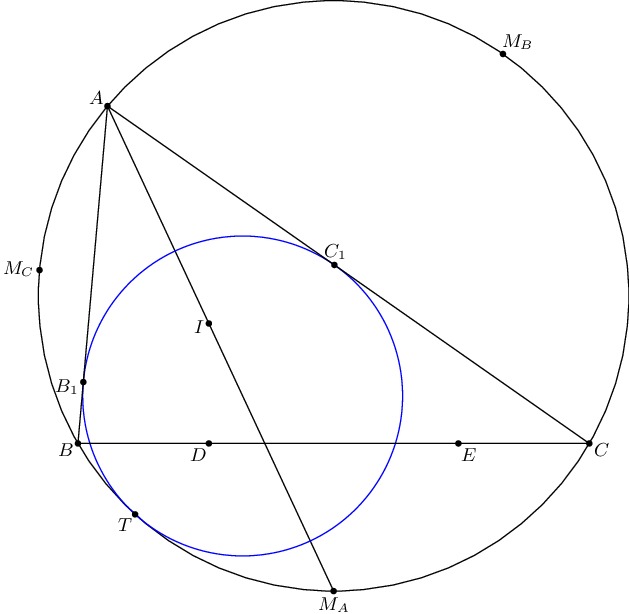
The points and are the contact points of the incircle and -excircle on the side . Points , , are the midpoints of the arcs.
As a challenge to my recent USAMO class (I taught at A* Summer Camp this year), I asked them to find as many “coincidences” in the picture as I could (just to illustrate the richness of the configuration). I invite you to do the same with the picture above.
The results of this exercise were somewhat surprising. Firstly, I found out that students without significant olympiad experience can’t “see” cyclic quadrilaterals in a picture. Through lots of training I’ve gained the ability to notice, with some accuracy, when four points in a diagram are concyclic. This has taken me a long way both in setting problems and solving them. (Aside: I wonder if it might be possible to train this skill by e.g. designing an “eyeballing” game with real olympiad problems. I would totally like to make this happen.)
The other two things that happened: one, I discovered one new property while preparing the handout, and two, a student found yet another property which I hadn’t known to be true before. In any case, I ended up covering the board in plenty of ink.
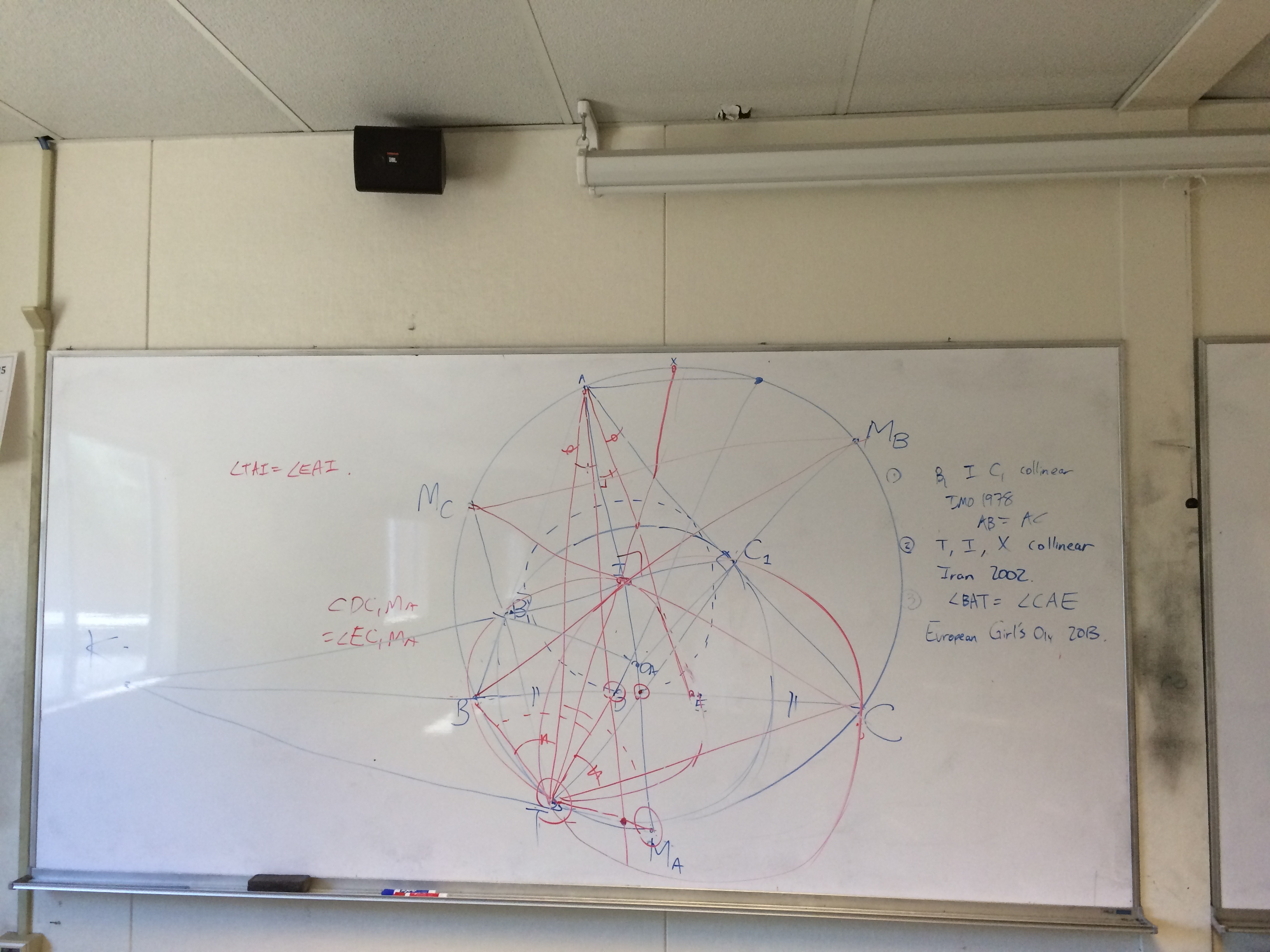
Here’s the list of properties I have.
-
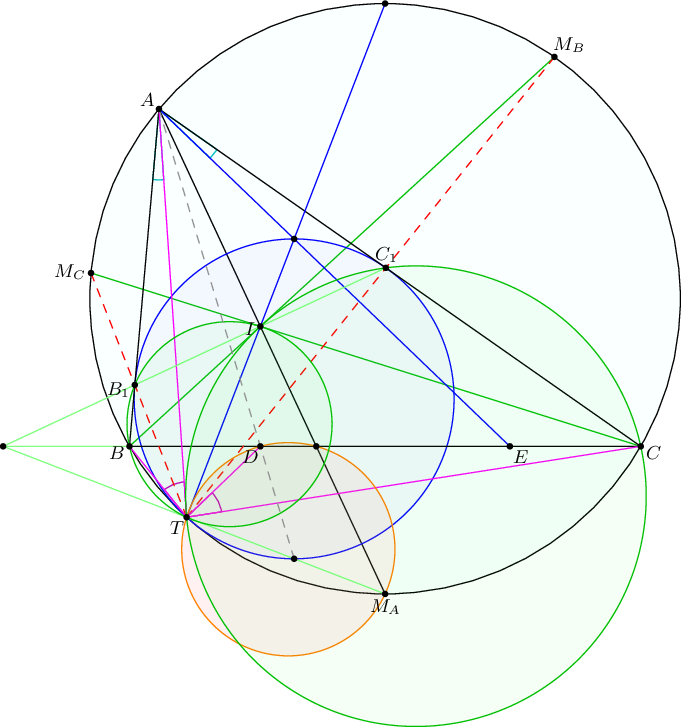
First, the classic: by Pascal’s Theorem on , we find that points , , are collinear; hence the contact chord of the -mixtilinear incircle passes through the incenter. The special case of this problem with appeared in IMO 1978. - Then, by Pascal on , we discover that lines , , and are also concurrent. - This also lets us establish (by angle chasing) that and are concyclic.
In addition, lines and are tangents to these circumcircles at (again by angle chasing).
-
An Iran 2002 problem asks to show that ray passes through the point diametrically opposite on the circumcircle. This is solved by noticing that is a symmedian of the triangle and (by the previous fact) that is a median. This is the key lemma in Taiwan TST 2014, Problem 3, which is one of my favorite problems (a nice result by Cosmin Pohoatza).
- Lines and are isogonal. This was essentially EGMO 2012, Problem 5, and the “morally correct” solution is to do an inversion at followed by a reflection along the -bisector (sometimes we call this a “ inversion”). - As a consequence of this, one can also show that lines and are isogonal (with respect to ). - One can also deduce from this that the circumcircle of passes through the intersection of and .
- Lines and meet on the mixtilinear incircle. (Homothety!)
- Moreover, line passes through the exsimilicenter of the incircle and circumcircle, by, say Monge d’Alembert. Said another way, the mentioned exsimilicenter is the isogonal conjugate of the Nagel point.
To put that all into one picture: