(Standard post on cardinals, as a prerequisite for forthcoming theory model post.)
An ordinal measures a total ordering. However, it does not do a fantastic job at measuring size.
For example, there is a bijection between the elements of ω and ω+1:
ω+1=ω={{ω0011223……}}.
In fact, as you likely already know, there is even a bijection between ω and ω2:
I’ve recently discovered the joy that is git aliases,
courtesy of this blog post.
To return to the favor, I thought I’d share the ones that I came up with.
For those of you that don’t already know, Git allows you to make aliases – shortcuts for commands.
Specifically, if you add the following lines to your .gitconfig:
[alias]cm=commitco=checkoutbr=branch
Then running git cm will expand as git commit, git co master is git checkout master, and so on.
You can see how this might make you happy because it could save a few keystrokes.
But I think it’s more useful than that – let me share what I did.
The first thing I did was add
pu = pull origin
psh = push origin
and permanently save myself the frustration of forgetting to type origin. Not bad.
Even more helpful was …
This one confused me for a long time, so I figured I should write this down before I forgot again.
Let M be an abstract smooth manifold.
We want to define the notion of a tangent vector to M at a point p∈M.
With that, we can define the tangent spaceTp(M),
which will just be the (real) vector space of tangent vectors at p.
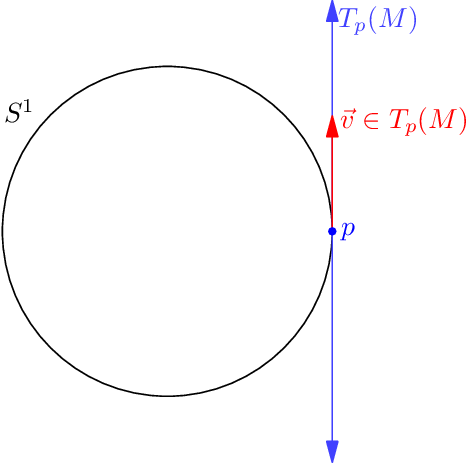
Geometrically, we know what this should look like for our usual examples.
For example, if M=S1 is a circle embedded in R2,
then the tangent vector at a point p should just look like a vector running off tangent to the circle.
My favorite circle associated to a triangle is the A-mixtilinear incircle.
While it rarely shows up on olympiads, it is one of the richest configurations I have seen,
with many unexpected coincidences showing up,
and I would be overjoyed if they become fashionable within the coming years.
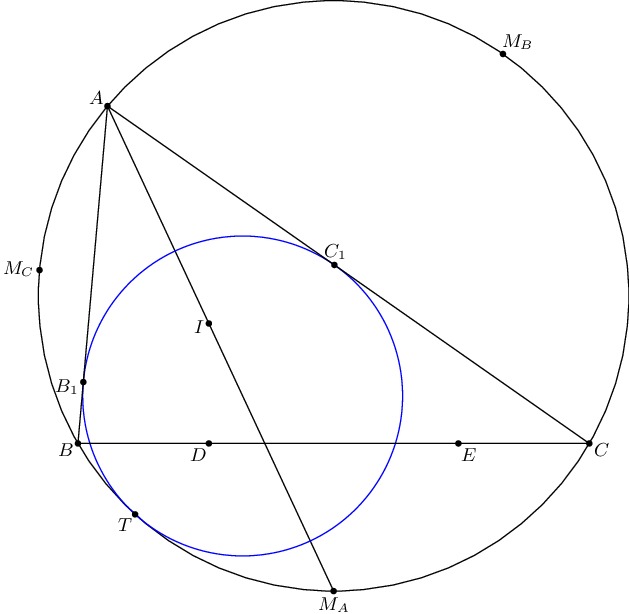
Here’s the picture:
The A-mixtilinear incircle.
The points D and E are the contact points of the incircle and A-excircle on the side BC.
Points MA, MB, MC are the midpoints of the arcs.
As a challenge to my recent USAMO class
(I taught at A* Summer Camp this year),
I asked them to find as many “coincidences” in the picture as I could …
A man that a woman that a child that a bird that I heard saw knows loves
This is a well-formed English phrase. And yet parsing it is difficult, because you need a stack of size four.
Four is a pretty big number.
And that’s after I’ve written the sentence down for you,
so your eyes could scan it two or three times to try and parse it.
Imagine if I instead said this sentence aloud.
Other examples include any object with some moderately complex structure:
Let ABC be a triangle and let AD, BE, CF be altitudes concurrent at the orthocenter H.
This is not a very complicated diagram,
but it’s also very difficult to capture in your …
Given a property P about primes, there’s two questions we can ask:
How many primes ≤x are there with this property?
What’s the least prime with this property?
As an example, consider an arithmetic progression a, a+d, …, with a<d and gcd(a,d)=1.
The strong form of Dirichlet’s Theorem tells us that basically,
the number of primes ≡a(modd) is d1 the total number of primes.
Moreover, the celebrated Linnik’s
Theorem tells us that the
first prime is
Apparently even people on Quora want to
know why I transferred from Harvard to MIT.
Since I’ve been asked this question way too many times, I guess I should give an answer, once and for all.
There were plenty of reasons (and anti-reasons).
I should say some anti-reasons first to give due credit – the Harvard math department is fantastic,
and Harvard gives you significantly more freedom than MIT to take whatever you want.
These were the main reasons why transferring was a difficult decision,
and in fact I’m only ~70% sure I might the right choice.
Ultimately, the main reason I transferred was due to the housing.
At MIT, you basically get to choose where you live.
All the dorms, and even floors within dorms, are different:
living on 3rd West versus living on 5th East might as well be going to different colleges.
Even if for some …
In this post I will sketch a proof Dirichlet Theorem’s in the following form:
Theorem 1(Dirichlet’s Theorem on Arithmetic Progression)
Let
ψ(x;q,a)=n≤xn≡amodq∑Λ(n).
Let N be a positive constant.
Then for some constant C(N)>0 depending on N, we have for any q such that q≤(logx)N we have
Prerequisites for this post: previous post,
and complex analysis. For this entire post, s is a complex variable with s=σ+it.
1. The Γ function
So there’s this thing called the Gamma function.
Denoted Γ(s), it is defined by
Γ(s)=∫0∞xs−1e−xdx
as long as σ>0. Here are its values at the first few integers: