One of my favorite Djikstra programming quotes is about
thinking via “lines of code spent”
rather than “lines of code produced”.
I started using this as a philosophy in my writing too: words spent.
Background
One of the things that’s surprised me about student writing
is how poorly words are spent.
You’ll have a solution where the trivial boilerplate steps are
painfully verbose, and then the actually important parts
are missing all the critical details.
I wonder how much of this is because of crummy writing advice.
In school essays, even when you have nothing meaningful to say,
teachers often impose a minimum word countIn ninth grade, my English teacher preferred the euphemism
“develop your ideas” for “write more words”.
It wasn’t until halfway through the year I realized why
she kept writing that on all my essays. as a “proof of work”.
The implied conclusion …
Thanks to Olga and Holly for factchecking a draft of this post. Remaining
errors are my responsibility of course.
The recent 2025 Teammate Hunt just finished, which went really well.
See the link to the wrapup.
I was a minor supporting character in the organizing team,
mostly just taking care of writing a few puzzles here and there.
This post is about the creation stories behind all those puzzles.
(Puzzle links only work if you’re logged in for now;
public access is coming later.)
This was a puzzle that worked because of our hunt structure
(control panel puzzles come in pairs).
Masyu is a common logic puzzle genre, and I was curious if there
was another standard Nikoli genre that also involved a closed loop.
That’s how I …
A lot of you have been asking me what comes after my PhD.
Continuing my post-OTIS entrepreneurial adventures
(see BOATIS in 2023 and (EC)⁵ in 2024),
I’m happy to announce the next chapter:
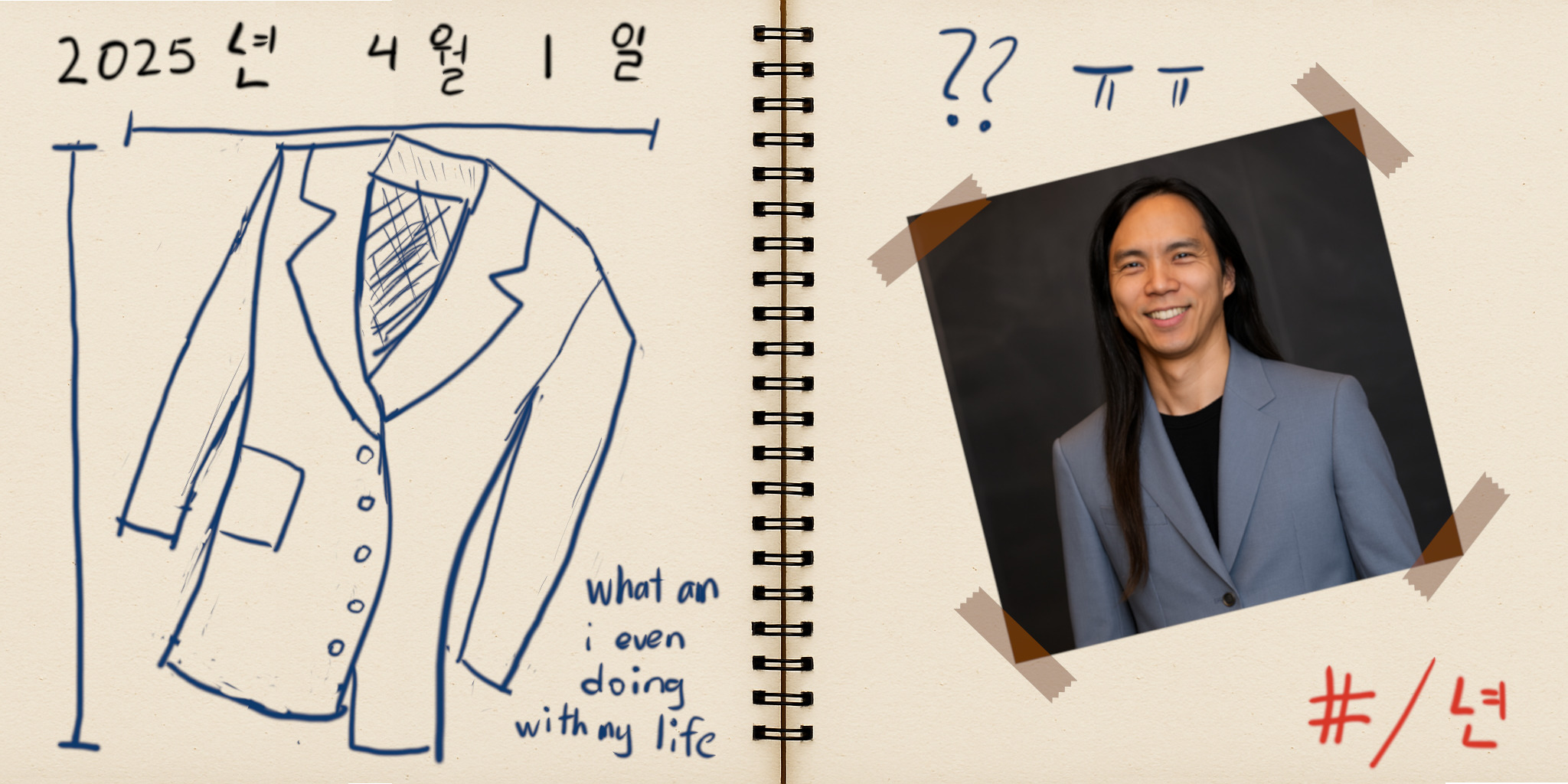
I will be moving to Seoul later this year to start a career in fashion design!
New York would have been the obvious choice,
except I hate New York,
and I thought it might be good to spend some time out of the country.
I’ll be chilling in the fashionable 한남동, sketching ideas for blazers
(and calling it “gender-neutral epistemology” or whatever gets clicks).
I haven’t decided on a name yet for my future brand, suggestions welcome.
The 2025 Teammate Hunt
runs from March 28 to April 6. Please check it out!
(Yes, I’m on the organizing team.)
USEMO 2025 is open to all middle and high school students now
(the US requirement has finally been dropped).
Problem proposals are open now and are due on May 10, 2025;
see the USEMO page for submission instructions.
After being in development hell for 10 years,
the silly weekend project I put together in 2015 is finally up:
Olympiad GeoGuessr,
a dumb game where you can try to guess collinear and concyclic points
from real MO diagrams.
Thanks to Abdullahil Kafi for contributing a lot of the recent levels.
I recently had a student writing to me asking for advice on problem-solving. The
student gave a few examples of problems they didn’t solve (like I
tell people to). One of the
things that struck me about the message was their description of their work on
USAMO 2021/4, whose statement reads:
A finite set S of positive integers has the property that,
for each s∈S, and each positive integer divisor d of s,
there exists a unique element t∈S satisfying gcd(s,t)=d.
(The elements s and t could be equal.)
Given this information, find all possible values for the
number of elements of S.
Roughly (for privacy reasons, this isn’t exactly what …
There are a lot of different kinds of math enrichment activities now,
ranging from olympiads to math circles to tons of summer programs and so on.
I work in the competition sphere, and I used to spend a lot of time worrying
about whether I took the right side.
Now that I’m a bit older, I came to the realization that maybe I don’t
need to be so intent on comparing my work to others
(even though I realize comparing yourself to others is human nature, haha).
I eventually told myself: there are lots of people who don’t like olympiad exams;
there are also lots of people who do, and it’s just okay for them to co-exist.
We don’t need to decide which of the N systems is the best and kill the other
N-1, because “best” is so different from person to person anyway …
Two pieces of news for high school math contest enthusiasts:
OTIS Mock AIME 2025
We’re running the OTIS Mock AIME again this year! It’ll go from December 19, 2024 to January 20, 2025.
New this year is that we’re offering two tests, I and II, and you can try either or both.
However, unlike the real AIME, the two versions are intentionally different:
The OTIS Mock AIME I is going to be tough.
It will definitely be harder than the actual AIME, by perhaps 2 to 4 problems.
But more tangibly, it will also have significant artistic license.
Problems will freely assume IMO-style background throughout the test,
and intentionally stretch the boundary of what constitutes an “AIME problem”.
The OTIS Mock AIME II is meant to be more practically useful.
It will adhere more closely to the difficulty and style of the real AIME.
There will inevitably …
This is a short blog post on the FrontierMath benchmark,
a set of lots of difficult math problems with easily verifiable answers.
Just to be clear, everything written here is my own thoughts
and doesn’t necessarily reflect the intention of any collaborators.
When you’re setting a problem for a competition like the IMO or Putnam,
three properties that are often considered desirable are:
It should require creative insight.
Competitions avoid problems that are too similar to existing ones
or too easily solved by simply applying standard textbook techniques.
You want the problems to really feel different
and force the solver to feel like they came up with a new idea to solve it.
This is sort of what the spirit of math olympiads is about.
It should not take a lot of implementation,
i.e. once a set of key ideas has been identified,
actually carrying out the …
There’s got to be a better way to do this. Someone please enlighten me.
Modern Korean is written in 한글 (Hangul), which uses a syllabic alphabet. It
includes spaces between words, unlike Chinese or Japanese, which means that it’s
possible to have meaningful spellchecking.
So of course one day I decided I wanted to configure Vim to support
spellchecking Hangul. Unfortunately, there’s no file ko.utf-8.spl at
ftp.vim.org, and in a cursory search I
couldn’t find an.
Twitch Solves ISL will resume on September 13, 2024 and September 20,
2024 at the usual time. Then a two-week break (because I’m traveling on both September 27 and October 4),
and then continuing on Fridays for some to-be-determined number of weeks. Check the calendar.
In addition, this Sunday (September 8) at 7PM EDT [EDIT: meant Sunday!
agh], by popular request from the otters,
I’ll be streaming a session where I work on part of the calculation that I need for my PhD thesis.
It’s not going to make any sense so I dunno why people want to see it, but give the kiddos what they want.
If it goes well I might run more of them.
USEMO dates
USEMO 2024 will take place 26 October 2024 - 27 October 2024 and is open to US students,
see the …