There’s this pet peeve I have where people sometimes ask things like what kind
of strategies they should use for, say, collinearity problems in geometry.
Like, I know there are valid answers like Menelaus or something.
But the reason it bugs me is because “the problem says to prove collinearity”
is about as superficial as it gets.
It would be like asking for advice for problems that have “ABC” in them.
To drive my point, consider the following setup:
Let ABC be a triangle with circumcircle Γ
and incenter I and let M be the midpoint of BC.
Denote by D the foot of the perpendicular from I to BC.
The line through I perpendicular to A …
Brian Lawrence showed me the following conceptual proof of Poncelet porism in the case of two circles,
which I thought was neat and wanted to sketch here.
(This is only a sketch, since I’m not really defining the integration.)
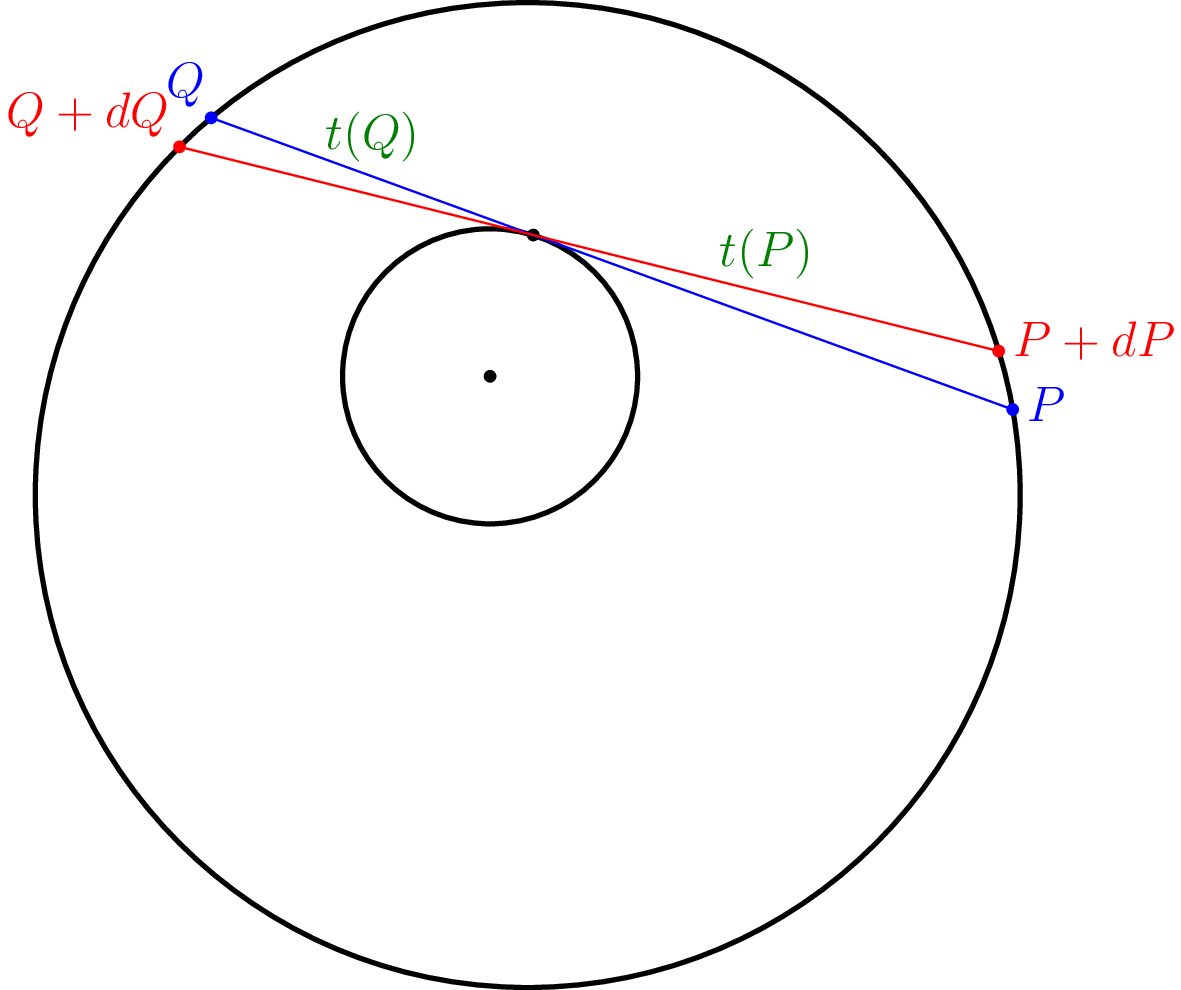
Let P be a point on the outer circle,
and let Q be the point you get when you take the counterclockwise tangent from P to the inner circle.
Consider what happens if we nudge the point P by a small increment dP.
Figure for Poncelet porism proof.
The similar triangles in power of a point then give us the approximation
Okay. Imagine you’re, like, trying to make glazed carrots or something.
Maybe a really simplified recipe looks something like:
Cut your carrots into suitably sized pieces with a knife.
Use a measuring spoon to get the right amount of oil, sugar, salt, etc.
Throw the carrots and other ingredients into a frying pan.
Serve the carrots on a plate.
You’ll notice that there were a bunch of different tools you used.
The knife was used to cut the carrots into pieces.
The measuring spoon was used to get the right amounts of other ingredients.
And the plates are just there for the presentation of your dish.
All these tools are things you see in any kitchen,
but they do a single, completely unrelated thing.
Now imagine someone asks you:
I’m confused, why do people use a measuring spoon for cooking?
Why not just use …
The application and syllabus are pretty much going to be the same as in previous years;
here are some of the (mostly small) changes:
I deleted the question that used to ask about past contest results because I
never read the answers to it anyway.
The application problem set is one geometry problem shorter.
Problem C.1 had its description change from “Learn to code” to “Learn to code, please,
I implore you” to encourage more people to not skip the problem.
Reading Comprehension answers are now all nonnegative integers who sum is six
times a prime to make it harder for people to get the answers wrong when they submit a late application.
(For on-time application, the Google Form …
Where do all the smart, curious, earnest kids go these days?
One of my friends asked me this recently, and I wasn’t sure what to say.
In the last ten years, something has changed.
If I had to summarize my concerns in one sentence, I would say this:
kids these days no longer feel they’re allowed to work on what they’re
interested in or excited about.
Instead, they feel obligated to work on whatever happens to be considered
the most “important” (or “prestigious”) thing possible.It’s for this reason I consider ambition as a double-edged sword.
When ambition isn’t accompanied by excitement, earnestness, curiosity,
or interest, it doesn’t usually end well.
But let me do a bit of story-telling.
Hobbies
When I was kid, math contests were seen as a hobby, or sport, or game.
Those were the good old days.
Calling all high school juniors!
We’re proud to announce a new educational service to
accompany last year’s ⛵IS:
Evan’s Chen’s Elite Cutting-Edge College Essay Consulting & Editing Center!
Abbreviated (EC)⁵.
Why trust Evan?
Evan Chen is one of the leading names in admissions to elite American colleges.
Students that Evan has mentored have gone on to prestigious institutions
such as Harvard, Princeton, Stanford — and of course,
MIT, the home of the illuMInaTi.
Evan is so successful at securing spots at selective universities
that nearly 1 in e^pi incoming MIT first-years are
alums of Evan’s programs [[citation needed]][[original research?]].
This is a figure unrivaled in the college prep industry.
Now, for the first time, you can join the ranks of Evan’s superstar students:
(EC)⁵ is the first endeavor led by Evan that doesn’t require any
sort of application or past achievements …
About five years ago I wrote a blog post warning that I thought it
was a bad idea to design math olympiads to be completely untrainable,
because I think math olympiads should be about talent development rather
than just talent identification, yada yada yada.
So now I want to say the other direction: I also don’t want to design
math olympiads so that every problem is 100% required to lie in a
fixed, rigid, and arbitrary boundary prescribed by some
nonexistent syllabus.
From a coach’s perspective, I want to reward “good” studying,
and whatever “good” means, I think it should include more than
zero flexibility and capacity to deal with slight curveballs.
I was reminded of this because there was a recent contest problem
(I won’t say which one to avoid spoilers) that quoted Brianchon’s theorem.
Brianchon’s theorem, for those of you that don’t …
Sometimes I get asked broad advice questions on solving problems, for example
questions like:
How do I know when to switch or prioritize approaches I come up with?
How do I know which points or lines to add in geometry problems?
How can I tell if I’m making progress on a problem?
How can I guess the answer if “find all” or “find min/max” problems?
How can I tell whether a conjecture I made is true or not?
What should I do on a problem when I am stuck?
and so on.
I think all of these questions have a certain quality that, for lack of a better
name, I’ll dub as being “NP-hard”.
This is a bit of abuse of terminology borrowed from
complexity theory,
but let me explain why I think the name fits.
We know that solving math problems is generally difficult.
There’s …
Editorial note: this post was mostly written in February 2023. Any resemblance
to contests after that date is therefore coincidental.
Background
A long time ago, rubrics for the IMO and USAMO were fairly strict. Out of seven,
the overall meta-rubric looks like:
7: Problem solved
6: Tiny slip (and contestant could repair)
5: Small gap or mistake, but non-central
2: Lots of genuine progress
1: Significant non-trivial progress
0: “Busy work”, special cases, lots of writing
In particular, traditional rubrics were often sublinear.
You’d see problems where you could split it into two parts, and solving
either part would only give 2 points, whereas solving both was worth 7.
Increasingly, I’ve noticed this is less and less common.
Particularly, at the IMOAs far as I know, the IMO rubrics aren’t really available anywhere.
(On the other hand, I’ve never been told that rubrics
explicitly need …
Here’s a mix of several publicity-related things I’d like to broadcast.
AlphaGeometry
A lot of you have already heard the buzz about the
AlphaGeometry news
and Nature paper.
(I’ve known about this paper for a while now,
so I’m glad I can finally talk about it!)
I managed to snag a cameo in the DeepMind post where I wrote
AlphaGeometry’s output is impressive because it’s both verifiable and clean.
Past AI solutions to proof-based competition problems have sometimes been
hit-or-miss (outputs are only correct sometimes and need human checks).
AlphaGeometry doesn’t have this weakness: its solutions have
machine-verifiable structure. Yet despite this, its output is still
human-readable. One could have imagined a computer program that solved
geometry problems by brute-force coordinate systems: think pages and pages of
tedious algebra calculation. AlphaGeometry is not that. It uses classical
geometry rules with angles and similar …