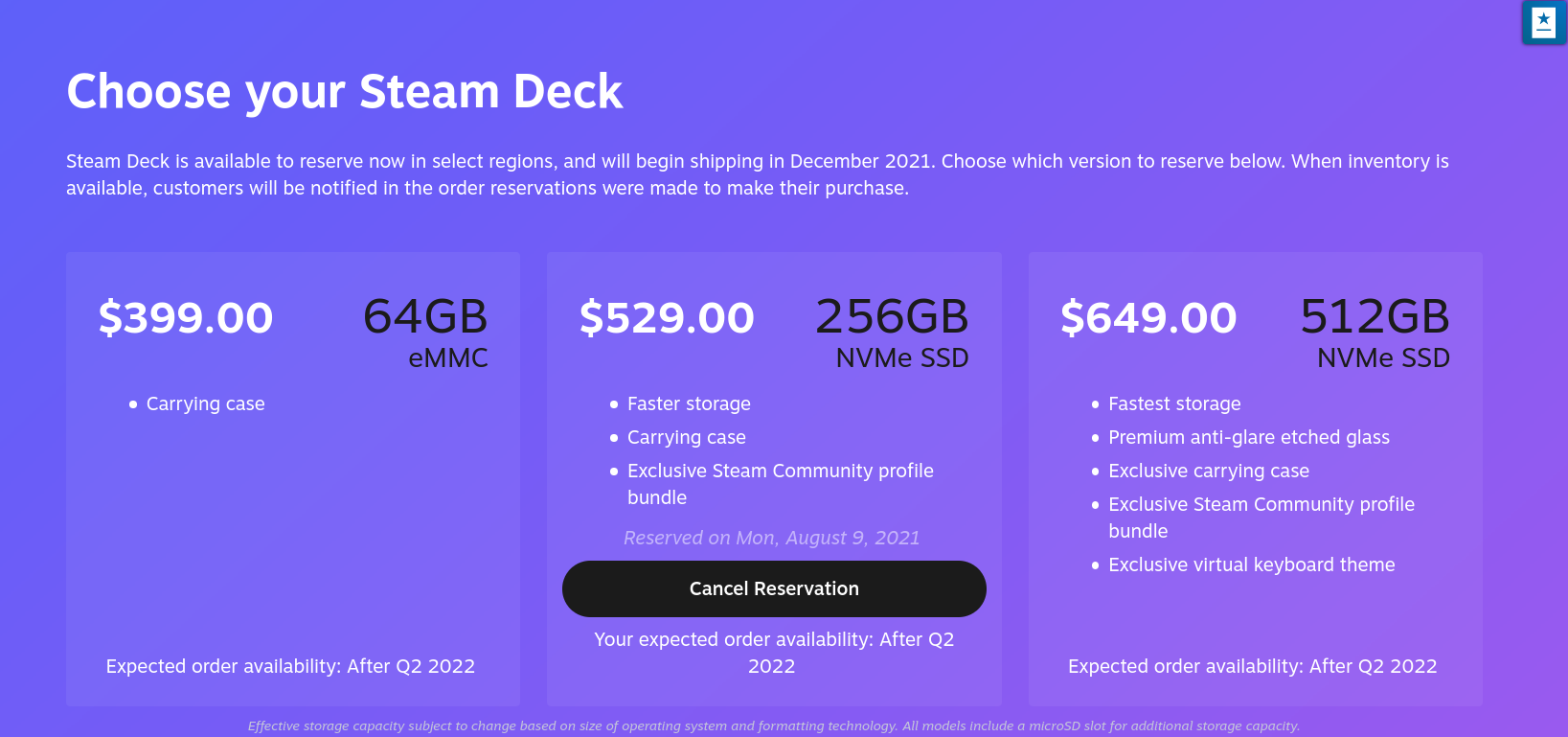
I might be going too far with this Arch Linux brand loyalty, but I am so psyched I don’t care.
💸
There’s three pieces of hardware that I’ve always kind of wanted but never been
willing to spend money on in isolation:
A handheld gaming console
A laptop with a touch screen
A laptop with enough power to play games on a Steam library (my laptop is a bit too old for this)
So when I heard the Steam Deck existed and it would be running an Arch Linux system beneath it,
I totally caved.
I’m just sad I didn’t hear about in time to be early enough in the queue to get it by Christmas. Ah well.
In unrelated news, careful readers might notice that the blog has been moved to blog.evanchen.cc.
I think the old URL usamo.wordpress.com will continue to …
Sometime this week the American Math Competitions released the following new policy:
For the IMO, EGMO, RMM, TSTSTs, and TSTs, and MOP, students must be US citizens or US permanent residents.
Visas are not a valid substitute.
(AMC Policies)
I want to make a rather brief statement on why I was opposed to this change.
To do this I want to draw an analogy.
In the American Math Competitions, students are asked what gender they identify with,
which is used to determine whether they are eligible for the
European Girl’s Math Olympiad and also for invitations to MOP.
This means that in theory, you could try to abuse the system by
deliberately misrepresenting your self-identified gender.
But in practice, nobody has attempted this.
So, we continue to allow students to self-identify their gender,
in order to make sure to be inclusive to students with gender dysphoria,
and trusting our …
I worked with a few friends on writing a mini one-round puzzle hunt for this year’s MOP students.
If you want to play, you can do so now at the following URL:
I’m not sure whether or not this is going to become a recurring tradition.
On the one hand, it was loads of fun to make
(including figuring out how to draw art on my iPad);
on the other hand, I definitely didn’t blow a couple hundred hours
of my life putting this together. ;)
Unrelated advertisement: the Carina Initiatives
is currently looking to hire a junior data scientist.
They’re a young philanthropic fund that’s interested in supporting initiatives
that build actual math problem solving (like, the problem-solving you’d see on this blog,
not the mainstream buzzword stuff).
I’ve had a lot of fun talking with them over the …
As a follow-up to the previous post,
I am recording here some details about the (numerous, varied, and deep)
revisions that a bunch of my puzzles went through during the production process.
These puzzles are in chronological order of when I wrote the puzzle.
Spoiler warning:
Unlike the last post, these will completely spoil all of the puzzles below.
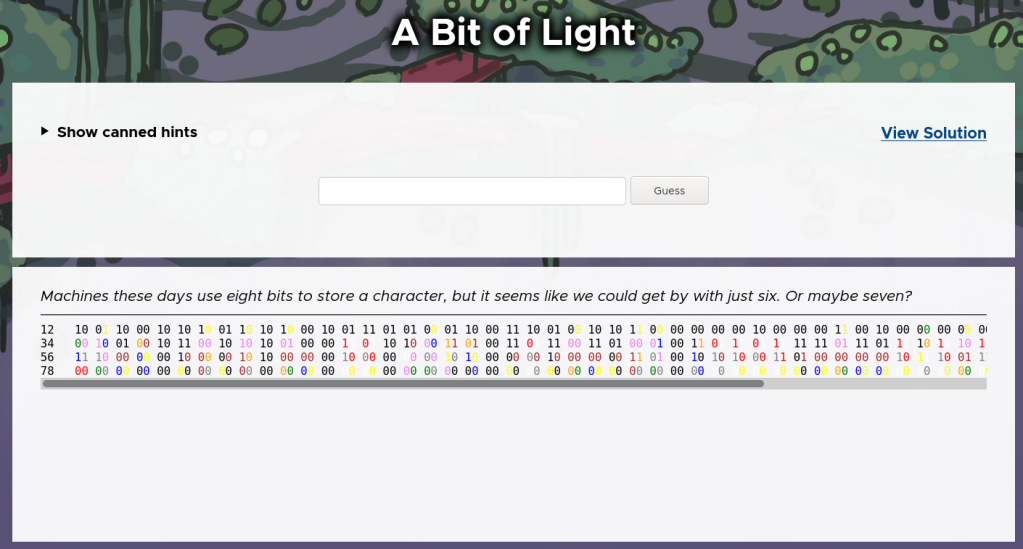
Surprisingly, the gist of the puzzle mostly survived revisions:
the idea of an encoding-based puzzle with the
key step to look at seven-segment displays between the Braille and resistor color encoding.
One issue I ran into while constructing was that
ABCDEF6 is actually too big in base 16 to store in an eight-bit number,
which is part of why I ended up 1337-ing the seven-segment display bits.
The final presentation of the “A Bit of Light” puzzle;
it looked pretty much like this at the start …
The 2021 Mystery Hunt
concluded a while ago, and wow, what an experience.
I was lucky enough to be on the organizing team,
and I am so proud right now to be able to say I am a ✈️✈️✈️ Galactic Trensdetter ✈️✈️✈️.
(If you don’t know what a puzzle hunt is,
betaveros has a great introduction.)
I came in to the MIT Mystery Hunt with no writing experience at all,
and ended up being listed as the author of a few.
It was a trial by fire, to say the least.
In this post I want to say a bit about the parts
of the puzzle-writing process that surprised me the most,
in the hopes that maybe it would be helpful to future authors.
A nice introduction is given by e.g.
David Wilson,
which I read many times before I actually attempted to write my first puzzle.
Most of what …
In this post I’m hoping to say a bit about the process that’s used for the
problem selection of the recent USEMO:
how one goes from a pool of problem proposals to a six-problem test.
(How to write problems is an entirely different story, and deserves its own post.)
I choose USEMO for concreteness here,
but I imagine a similar procedure could be used for many other contests.
I hope this might be of interest to students preparing for contests
to see a bit of the behind-the-scenes,
and maybe helpful for other organizers of olympiads.
The overview of the entire timeline is:
Submission period for authors (5-10 weeks)
Creating the packet
Reviewing period where volunteers try out the proposed problems (6-12 weeks)
A lot of people have been asking me how team selection is going to work for the USA this year.
This information was sent out to the contestants a while ago,
but I understand that there’s a lot of people outside of MOP 2020
who are interested in seeing the TST problems :)
so this is a quick overview of how things are going down this year.
This year there are six tests leading to the IMO 2021 team:
USA TSTST Day 1: November 12, 2020 (3 problems, 4.5 hours)
USA TSTST Day 2: December 10, 2020 (3 problems, 4.5 hours)
USA TSTST Day 3: January 21, 2021 (3 problems, 4.5 hours)
RMM Day 1: February 2021 (3 problems, 4.5 hours)
APMO: March 2021 (5 problems, 4 hours)
USAMO: April 2021 (2 days, each with 3 problems and 4.5 hours)
Finally, if you attempt to read this without working through a significant
number of exercises (see §0.0.1), I will come to your house and pummel you
with [Gr-EGA] until you beg for mercy. It is important to not just have a
vague sense of what is true, but to be able to actually get your hands dirty.
As Mark Kisin has said, “You can wave your hands all you want, but it still
won’t make you fly.”
When people learn new areas in higher math,
they are usually required to do some exercises.
I think no one really disputes this: you have to actually do math to make any progress.
However, from the teacher’s side,
I want to make the case that there is some art to picking exercises, too.
In the process of writing my Napkin …
I’m happy to announce that sign-ups for my new olympiad style contest,
the United States Ersatz Math Olympiad (USEMO), are open now!
The webpage for the USEMO is https://web.evanchen.cc/usemo.html (where sign-ups are posted).
Logo for USEMO.
The US Ersatz Math Olympiad is a proof-based competition open to all US middle and high school students.
Like many competitions, its goals are to develop interest and ability in mathematics (rather than measure it).
However, it is one of few proof-based contests open to all US middle and high school students.
You can see more about the goals of this contest in the
mission statement.
The contest will run over Memorial day weekend:
Day 1 is Saturday May 23 2020, from 12:30pm ET – 5:00pm ET.
Day 2 is Sunday May 24 2020, from 12:30pm ET – 5:00pm ET.
This post will mostly be focused on construction-type problems
in which you’re asked to construct something satisfying property P.
Minor spoilers for USAMO 2011/4, IMO 2014/5.
1. What is a leap of faith?
Usually, a good thing to do whenever you can is to make “safe moves”
which are implied by the property P.
Here’s a simple example.
Example 1(USAMO 2011)
Find an integer n such that the remainder when 2n is divided by n is odd.
It is easy to see, for example, that n itself must be odd for this to be true,
and so we can make our life easier without incurring any worries by restricting our search to odd n.
You might therefore call this an “optimization”:
a kind of move that makes the …