I’m now going to say something explicitly that I
hinted at in June:
I don’t think a student deserves to make MOP more because they had a higher score than another student.
I think it’s easy to get this impression because the selection for MOP is done
by score cutoffs. So it sure looks that way.
But I don’t think MOP admissions (or contests in general) are meant to be a form
of judgment. My primary agenda is to run a summer program that is good for its
participants, and we get funding for N of them. For that, it’s not important
which N students make it, as long as they are enthusiastic and adequately
prepared. (Admittedly, for a camp like MOP, “adequately prepared” is a tall
order). If anything, what I would hope to select for is the people who would get
the most …
There’s a new addition to my olympiad problems and solutions archive:
I created an index of many past IMO/USAMO/USA TST(ST) problems by what my opinions on their difficulties are.
You can grab the direct link to the file below:
In short, the scale runs from 0M to 50M in increments of 5M,
and every USAMO / IMO problem on my archive now has a rating too.
My hope is that this can be useful in a couple ways.
One is that I hope it’s a nice reference for students,
so that they can better make choices about what practice problems
would be most useful for them to work on.
The other is that the hardness scale contains a very long discussion
about how I judge the difficulty of problems.
While this is my own personal opinion,
obviously, I hope it …
Math must be presented for System 1 to absorb and only incidentally for System 2 to verify.
I finally have a sort-of formalizable guideline for teaching and writing math,
and what it means to “understand” math.
I’ve been unconsciously following this for years
and only now managed to write down explicitly what it is that I’ve been doing.
(This post is written from a math-centric perspective,
because that’s the domain where my concrete object-level examples from.
But I suspect much of it applies to communicating hard ideas in general.)
S1 is the part of the brain characterized by fast, intuitive, automatic,
instinctive, emotional responses, For example, when you read the text “2+2=?”,
S1 tells you (without …
Up to now I always felt a little saddened when I see people drop out of the IMO or EGMO team selection.
But actually, really I should be asking myself what I (as a coach) could do better
to make sure the students know we value their effort,
even if they ultimately don’t make the team.
Because we sure do an awful job of being supportive of the students,
or, well, really doing anything at all.
There’s no practice material, no encouragement,
or actually no form of contact whatsoever.
Just three unreasonably hard problems each month,
followed by a score report about a week later,
starting in December and dragging in to April.
One of a teacher’s important jobs is to encourage their students.
And even though we get the best students in the USA,
probably we shouldn’t skip that step entirely,
especially given the level …
Here is my commentary for the 2019 International Math Olympiad,
consisting of pictures and some political statements about the problem.
Summary
This year’s USA delegation consisted of leader Po-Shen Loh and deputy leader Yang Liu.
The USA scored 227 points, tying for first place with China.
For context, that is missing a total of four problems across all students, which is actually kind of insane.
All six students got gold medals, and two have perfect scores.
Vincent Huang 7 7 3 7 7 7
Luke Robitaille 7 6 2 7 7 6
Colin Shanmo Tang 7 7 7 7 7 7
Edward Wan 7 6 0 7 7 7
Brandon Wang 7 7 7 7 7 1
Daniel Zhu 7 7 7 7 7 7
Korea was 3rd place with 226 points, just one point shy of first,
but way ahead of the 4th place score (with 187 points …
While making preparations for this year’s MOP,
I imagined to myself what I would say on orientation night if I was director of the camp,
and came up with the following speech.
I thought it might be nice to share on this blog.
Of course, it represents my own views, not the actual views of MOP or MAA.
And since I am not actually director of MOP, the speech was never given.
People sometimes ask me, why do we have international students at MOP?
Doesn’t that mean we’re training teams from other countries?
So I want to make this clear now: the purpose of MOP is not to train and select future IMO teams.
I know it might seem that way, because we invite by score and grade.
But I really think the purpose of MOP is to give each one of you
the experience of working …
In yet another contest-based post,
I want to distinguish between two types of thinking:
things that could help you solve a problem,
and things that could help you understand the problem better.
Then I’ll talk a little about how you can use the latter.
(I’ve talked about this in my own classes for a while by now,
but only recently realized I’ve never gotten the whole thing in writing. So here goes.)
1. More silly terminology
As usual, to make these things easier to talk about, I’m going to introduce some words to describe these two.
Taking a page from martial arts, I’m going to run with hard and soft techniques.
A hard technique is something you try in the hopes it will prove something
— ideally, solve the problem, but at least give you some intermediate lemma.
Perhaps a better definition is “things that will …
People often complain to me about how olympiad geometry
is just about knowing a bunch of configurations or theorems.
But it recently occurred to me that when you actually get down to its core,
the amount of specific knowledge that you need to do well in olympiad geometry is very little.
In fact I’m going to come out and say:
I think all the theory of mainstream IMO geometry would not last even a one-semester college course.
So to stake my claim, and celebrate April Fool’s Day,
I decided to actually do it.
What would olympiad geometry look like if it was taught at a typical college?
To find out, I present to you the course notes for:
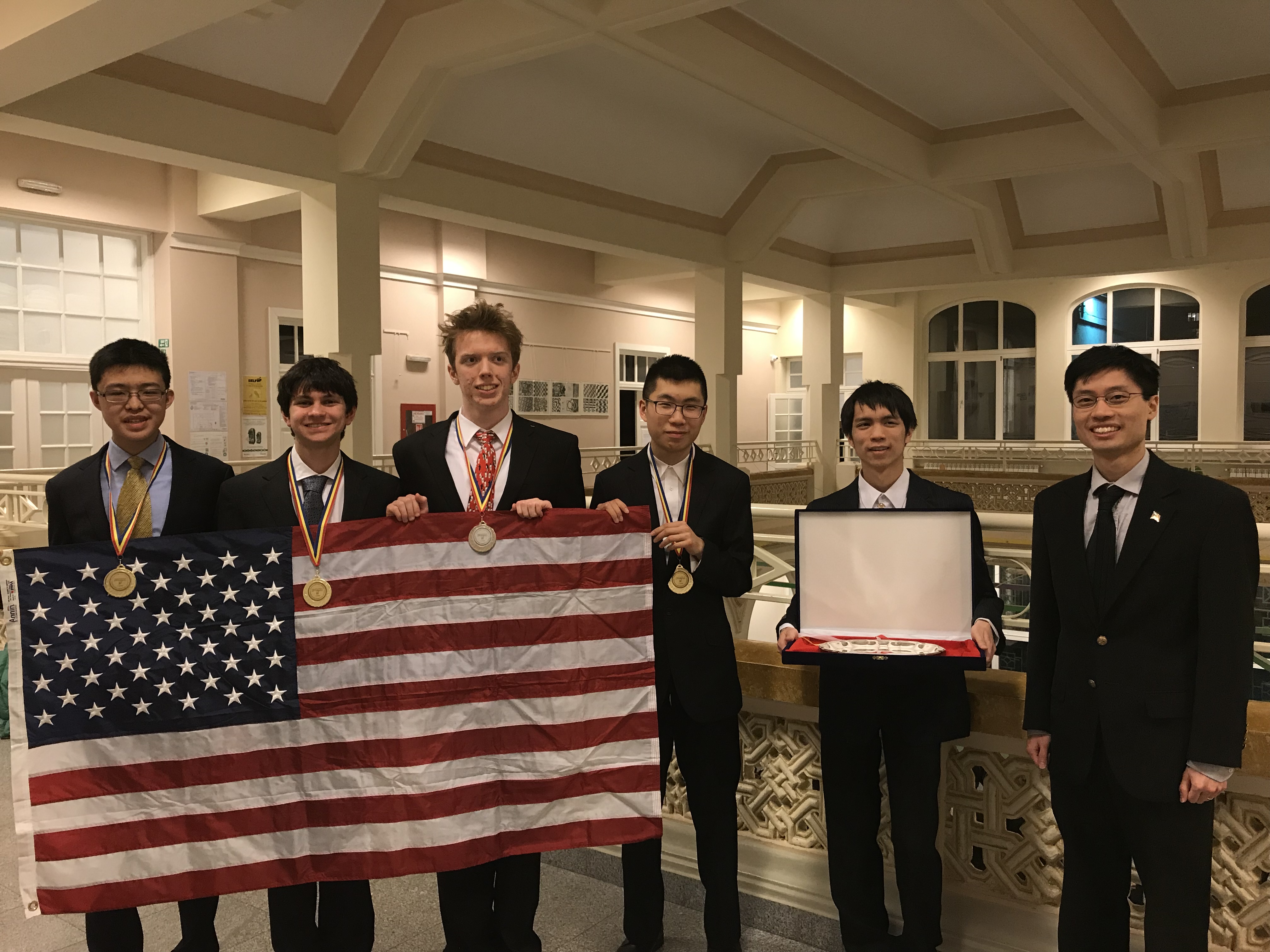
Po-Shen Loh and I spent the last week in Bucharest with the United States team for the 11th RMM.
The USA usually sends four students who have not attended a previous IMO or RMM before.
This year’s four students did breathtakingly well:
Benjamin Qi — gold (rank 2nd)
Luke Robitaille — silver (rank 10th)
Carl Schildkraut — gold (rank 8th)
Daniel Zhu — gold (rank 4th)
(Yes, there are only nine gold medals this year!)
The team score is obtained by summing the three highest scores of the four team members.
The USA won the team component by a lofty margin, making it the first time we’ve won back to back.
I’m very proud of the team.
Pictures
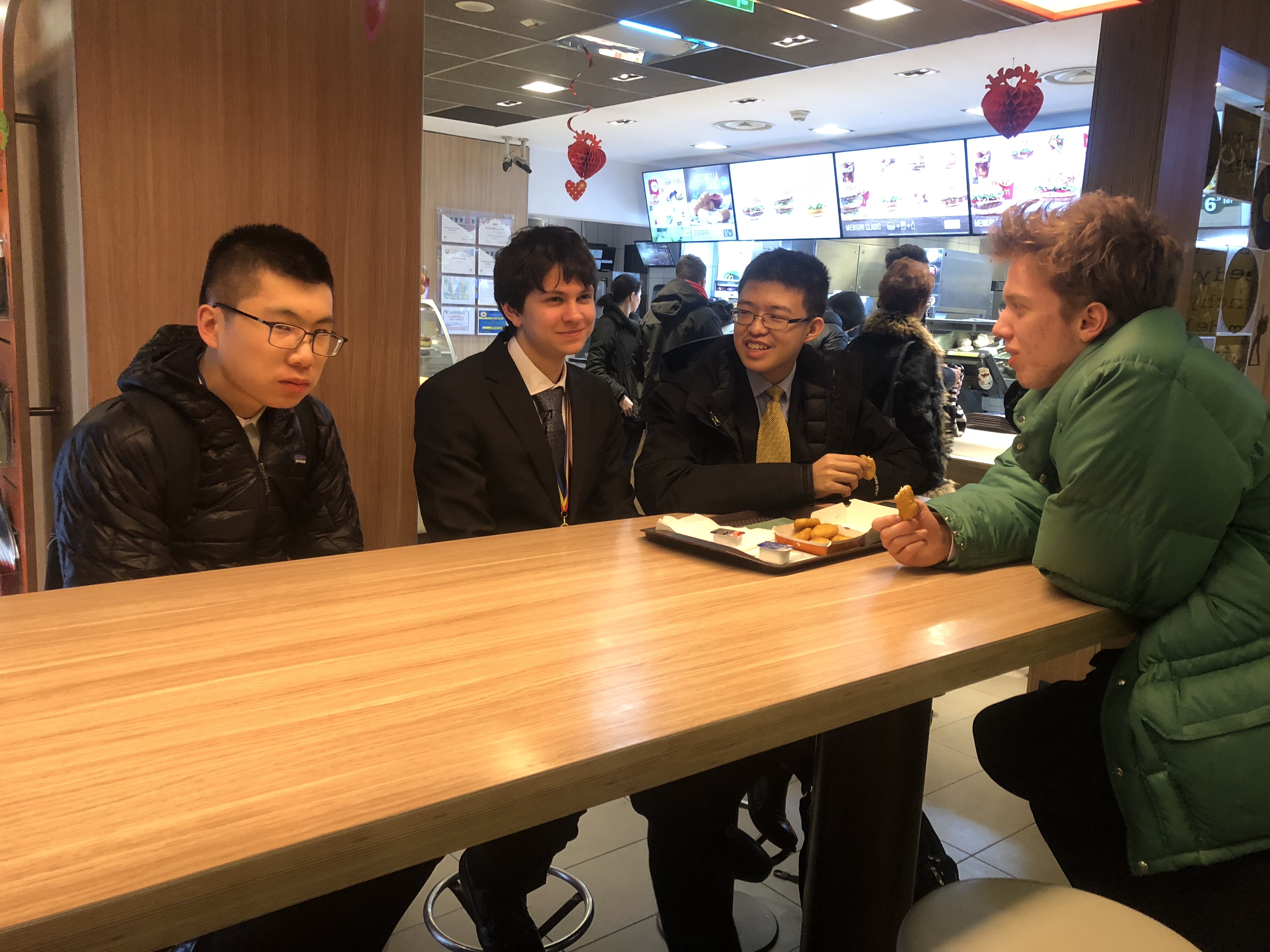
RMM 2019 team after the competition (taken by Daniel Zhu’s
dad)McDonald’s …
Careful readers of my blog might have heard about plans to
have a second edition of Napkin out by the end of February.
As it turns out I was overly ambitious, and
(seeing that I am spending the next week in
Romania)
I am not going to make my self-imposed goal.
Nonetheless, since I did finish a decent chunk of what I hoped to do,
I decided the perfect is the enemy of the good and that I should at least put up what I have so far.
So since this is someplace between version 1 and the (hopefully eventually) version 2,
it seems appropriate to call it version 1.5.
The biggest changes include a complete rewrite of the algebraic geometry chapters,
new parts on real analysis and measure theory,
and a reorganization of many of the earlier chapters
like group theory and topology, with more examples and problems …