This is a draft of an appendix chapter for my Napkin project.
In the world of olympiad math, there’s a famous functional equation that goes as follows:
f:R→Rf(x+y)=f(x)+f(y).
Everyone knows what its solutions are! There’s an obvious family of solutions f(x)=cx.
Then there’s also this family of… uh…
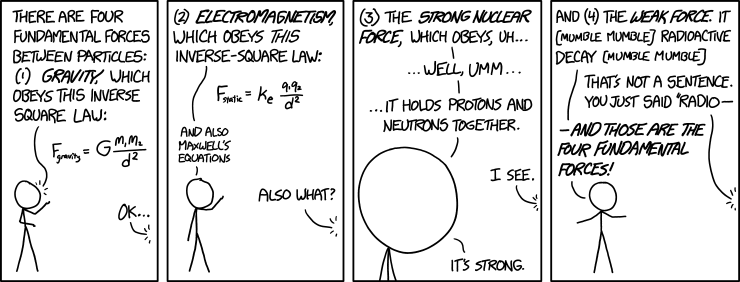
noncontinuous solutions (mumble grumble) pathological (mumble mumble) Axiom of Choice (grumble).
Don’t worry, I know what I’m doing!
There’s also this thing called Zorn’s Lemma.
It sounds terrifying, because it’s equivalent to the Axiom of Choice,
which is also terrifying because why not.
In the last week of December I got a position as the morning instructor for the
A* USAMO winter camp.
Having long lost interest in coaching for short-answer contests,
I’d been looking forward to an opportunity to teach an olympiad class for ages,
and so I was absolutely psyched for that week.
In this post I’ll talk about some of the thoughts I had while teaching, in no particular order.
1. Class format
Here were the constraints I was working with.
After removing guest lectures, exams, and so on I had four days of teaching time,
one for each of the four olympiad subjects (algebra, geometry, combinatorics, number theory).
I taught the morning session, meaning I had a three-hour block each day (with a 15-minute break).
I had a wonderfully small class – just five students.
Here’s the format I used for the class, which seemed to work …
In this post I’ll cover three properties of isogonal conjugates which were only recently made known to me.
These properties are generalization of some well-known lemmas,
such as the incenter/excenter lemma and the nine-point circle.
1. Definitions
Let ABC be a triangle with incenterI,
and let P be any point in the interior of ABC. Then we obtain three lines AP, BP, CP.
Then the reflections of these lines across lines AI, BI,
CI always concur at a point Q which is called the isogonal conjugate of P.
(The proof of this concurrence follows from readily from Trig
Ceva.) When P …
Updated version of generic advice post:
Platitudes v3.
I think this is an important question to answer,
not the least of reasons being that understanding how to learn is extremely
useful both for teaching and learning.The least of reasons is that people ask me this all the time and I should
properly prepare a single generic response.
It looks like the main point of my post a year ago was mainly to debunk the idea
that specific resources are important. Someone else phrased this pretty well in the replies to the thread
I always wondered whether I could generate olympiad geometry problems by simply
drawing lines and circles at random until three lines looked concurrent, four points looked concyclic,
et cetera. From extensive experience you certainly get the feeling that this
ought to be the case – there are tons and tons of problems out there but most
of them have relatively simple statements, not involving more than a handful of points.
Often I think, “I bet I could have stumbled upon this result just by drawing things at random”.
So one night, I decided to join the tangency point of A-mixtilinear circle with
the orthocenter of a triangle ABC. You can guess about how well that went.
Nothing came up after two hours of messing around randomly.
Surprisingly, though, I found almost by accident that the following modification has had significant success: