(This is a bit of a follow-up to the solution reading post last month.
Spoiler warnings: USAMO 2014/6, USAMO 2012/2, TSTST 2016/4, and hints for ELMO 2013/1, IMO 2016/2.)
I want to say a little about the process which I use to design my olympiad
handouts and classes these days (and thus by extension the way I personally think about problems).
The short summary is that my teaching style is centered around
showing connections and recurring themes between problems.
Now let me explain this in more detail.
1. Main ideas
Solutions to olympiad problems can look quite different from one another at a surface level,
but typically they center around one or two main ideas,
as I describe in my post on reading solutions.
Because details are easy to work out once you have the main idea,
as far as learning is concerned you can …
(Ed Note: This was earlier posted under the incorrect title “On Designing Olympiad Training”.
How I managed to mess that up is a long story involving some incompetence with Python scripts,
but this is fixed now.)
Spoiler warnings: USAMO 2014/1, and hints for Putnam 2014 A4 and B2.
You may want to work on these problems yourself before reading this post.
1. An Apology
At last year’s USA IMO training camp, I prepared a handout on writing/style for the students at MOP.
One of the things I talked about was the “ocean-crossing point”,
which for our purposes you can think of as the discrete jump from a problem
being “essentially not solved” (0+) to “essentially solved” (7−).
The name comes from a Scott Aaronson post:
Suppose your friend in Boston blindfolded you, drove you around for twenty minutes,
then took the blindfold off …
Epistemic status: highly dubious.
I found almost no literature doing anything quite like what follows,
which unsettles me because it makes it likely that I’m overcomplicating things significantly.
Let S be a nonempty set of positive integers.
We say that a positive integer n is clean if it has a unique representation
as a sum of an odd number of distinct elements from S.
Prove that there exist infinitely many positive integers that are not clean.
Proceeding by contradiction, one can prove (try it!) that in fact all
sufficiently large integers have exactly one representation as a sum of an even subset of S.
Then, the problem reduces to …
For olympiad students: I have now published some
new algebra handouts. They are:
Introduction to Functional Equations,
which cover the basic techniques and theory for FE’s typically appearing on olympiads like USA(J)MO.
Monsters, an advanced handout which covers functional equations that have pathological solutions.
It covers in detail the solutions to Cauchy functional equation.
Summation, which is a compilation of various types of olympiad-style sums
like generating functions and multiplicative number theory.
I have also uploaded:
English, notes on proof-writing that I used at the 2016 MOP (Mathematical Olympiad Summer Program).
You can download all these (and other handouts) from my MIT
website. Enjoy!
There’s a Mantra that you often hear in math contest discussions:
“math olympiads are very different from math research”.
(For known instances, see O’Neil,
Tao,
and others.
More neutral stances: Monks,
Xu.)
It’s true. And I wish people would stop saying it.
Every time I’ve heard the Mantra, it set off a little red siren in my head: something felt wrong.
And I could never figure out quite why until last July.
There was some (silly) forum discussion about how
Allen Liu had done
extraordinarily on math contests over the past year. Then someone says:
A: Darn, what math problem can he not do?!
B: I’ll go out on a limb and say that the answer to this is “most of the
problems worth asking.” We’ll see where this stands in two years,
at which point the answer will almost certainly change, but research …
Occasionally I am approached by parents who ask me if I am available to teach their child in olympiad math.
This is flattering enough that I’ve even said yes a few times,
but I’m always confused why the question is “can you tutor my child?” instead of
“do you think tutoring would help, and if so, can you tutor my child?”.
Here are my thoughts on the latter question.
Charging by Salt
I’m going to start by clearing up the big misconception which inspired the title of this post.
The way tutoring works is very roughly like the following: I meet with the student once every week,
with custom-made materials. Then I give them some practice problems to work on (“homework”),
which I also grade. I throw in some mock olympiads.
I strongly encourage my students to email me with questions as they come up. Rinse and …
I know some friends who are fantastic at synthetic geometry.
I can give them any problem and they’ll come up with an incredibly impressive synthetic solution.
I also have some friends who are very bad at synthetic geometry,
but have such good fortitude at computations that they can get away with using
Cartesian coordinates for everything.
I don’t consider myself either of these types; I don’t have much ingenuity when it comes to my solutions,
and I’m actually quite clumsy when it comes to long calculations.
But nonetheless I have a high success rate with olympiad geometry problems.
Not only that, but my solutions are often very algorithmic,
in the sense that any well-trained student should be able to come up with this solution.
In this article I try to describe how I come up which such solutions.
(EDIT: These solutions earned me a slot in N1, top 16.)
I solved eight problems on the Putnam last Saturday.
Here were the solutions I found during the exam,
plus my repaired solution to B3 (the solution to B3 I submitted originally had a mistake).
Some comments about the test.
I thought that the A test had easy problems: problems A1, A3, A4 were all routine,
and problem A5 is a little long-winded but nothing magical.
Problem A2 was tricky, and took me well over half the A session.
I don’t know anything about A6, but it seems to be very hard.
The B session, on the other hand, was completely bizarre.
In my opinion, the difficulty of the problems I did attempt was
B4≪B1≪B5<B3 …
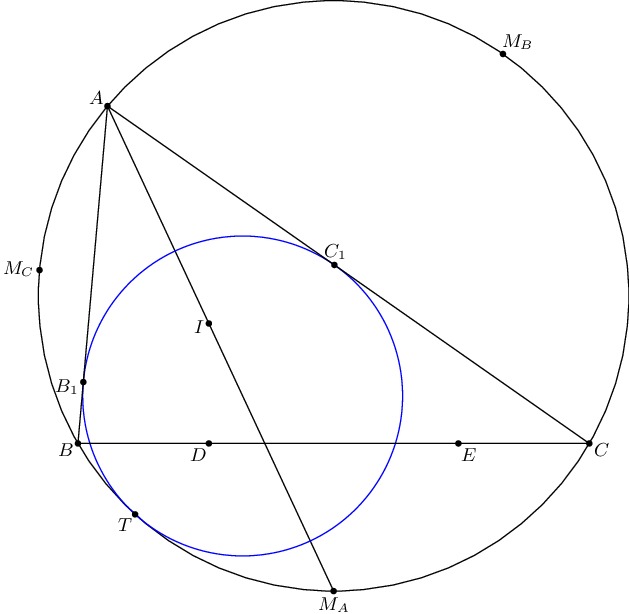
My favorite circle associated to a triangle is the A-mixtilinear incircle.
While it rarely shows up on olympiads, it is one of the richest configurations I have seen,
with many unexpected coincidences showing up,
and I would be overjoyed if they become fashionable within the coming years.
Here’s the picture:
The A-mixtilinear incircle.
The points D and E are the contact points of the incircle and A-excircle on the side BC.
Points MA, MB, MC are the midpoints of the arcs.
As a challenge to my recent USAMO class
(I taught at A* Summer Camp this year),
I asked them to find as many “coincidences” in the picture as I could …