Sometimes my OTIS students suggest features or things for the OTIS website, and
I reply “submit a pull request”.
I’m usually half-joking when I say this, because I acknowledge that I’m
essentially saying “please do the work for me”.
But part of me isn’t joking. Because, one of the things I’ve grown to most
value in gifted education is developing self-agency for my students.
If you’re reading this blog post, you’re likely to have good thinking abilities.
You have the capacity to go from point A to point B, to teach yourself geometry
from online resources (or a certain print textbook, I suppose), to put two and
two together unsupervised, and so on. This gift is rarer than you think.
So let me tell you a secret:
if you don’t know how to submit a pull request, you can teach yourself.
I often gripe about how standard K-12 education is overly
focused on specific knowledge (how to solve a quadratic,
memorizing dates for history, etc.)
rather than general skills (e.g. “how to figure out how to solve a quadratic”).
On the other hand, I understand why;
teaching general skills is much more difficult than preparing a cookbook.
So now I will instead gripe about specific things that should be taught
and aren’t.
Any amount of programming or computing literacy
To me the following are all comparable:
Refusing to learn how to use Google Docs,
and shrugging it off by saying “I’m not planning to be a writer”.
Refusing to learn how to use a spreadsheet,
and shrugging it off by saying “I’m not planning to be an accountant”.
Refusing to learn how to use a shell or git,
and shrugging it off by saying “I’m not …
Sometimes people ask me how many of my students made the IMO, and if I’m in a
bad mood I often give the super snarky reply, “I lost track”.The good-mood answer is “a lot”.
That’s actually a white lie. The real answer is “I deliberately don’t keep
track”. And in this post I want to explain why.
It’s definitely human nature to be happy when your students succeed, the same
way it’s human nature to be happy when your selfies get hearts.
In moderation, that seems fine.
I think it’s unlikely I ever reach a point where I never brag about OTIS at all.
But there is a fine line between the following two implications:
“I’m super proud of my kids, look what they did.”
“I’m super proud of myself, look what my kids did.”
I don’t know why I thought to write this,
but it’s been bugging me for a year or two now that I’ve never seen the answer
to “what is a proof” written out quite this way. So here you go.
It’s a bit weird for me to be writing an article that contains “you can stop
reading here” as the second sentence, but first time for everything, I guess.
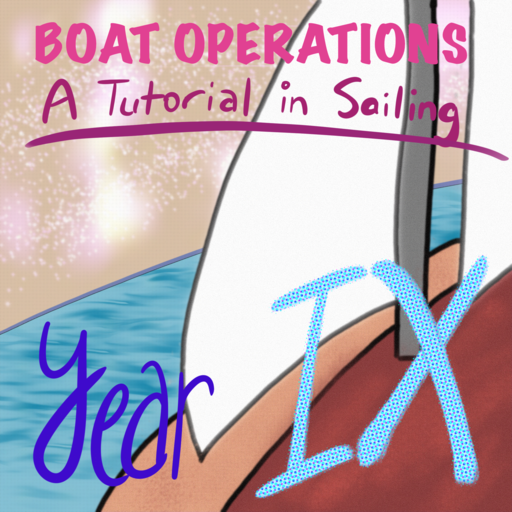
It’s with a sense of both sadness and excitement that I am writing to announce
that year IX of my math olympiad training program, OTIS, is cancelled.
Instead, it will be replaced by a new program that I am starting, named
Boat Operations: A Tutorial In Sailing, or ⛵IS for short.
This was a hard decision for me to make, but it’s been with me forever.
I’ve been staring at the edge of the water long as I can remember,
never really knowing why, and now it’s time to answer that calling.
Why sailing instead of math?
Sailing is a more active and physical experience: Sailing involves being out on
the water, feeling the wind and the waves, and physically maneuvering the boat.
This can be a more engaging and immersive experience compared to sitting at a
desk and working on math …
For me the biggest difference between undergraduate math and PhD life
has been something I’ve never seen anyone else talk about:
it’s the feeling like I could no longer see the ground.
To explain what this means, imagine that mathematics is this wide tower,
where you start with certain axioms as a foundation,
and then you build upwards on it.
At first learning math felt like slowly climbing up this tower.
When I reached a landmark, it felt like I was on the balcony
of the 30th or 50th or 100th floor, enjoying the view,
with an appreciation of the floors I had ascended to get here.
In theory, proofs in math can be formalized as a
long sequence of logical steps from the axioms that could be
computer-verified.
This turns out to way too cumbersome to actually do in practice given
the current state of technology (though …
The Carina Initiatives (https://carina.fund) is a friend of the math education
community which has supported organizations like Art of Problem Solving, BEAM, Athemath,
and others.
They’re starting a math talent search organization in the United States and are
looking to hire a full-time leader (salary $200K-$250K).
Passing this along in case anyone in this space might be interested in applying
or knows someone who might be. The link to apply is:
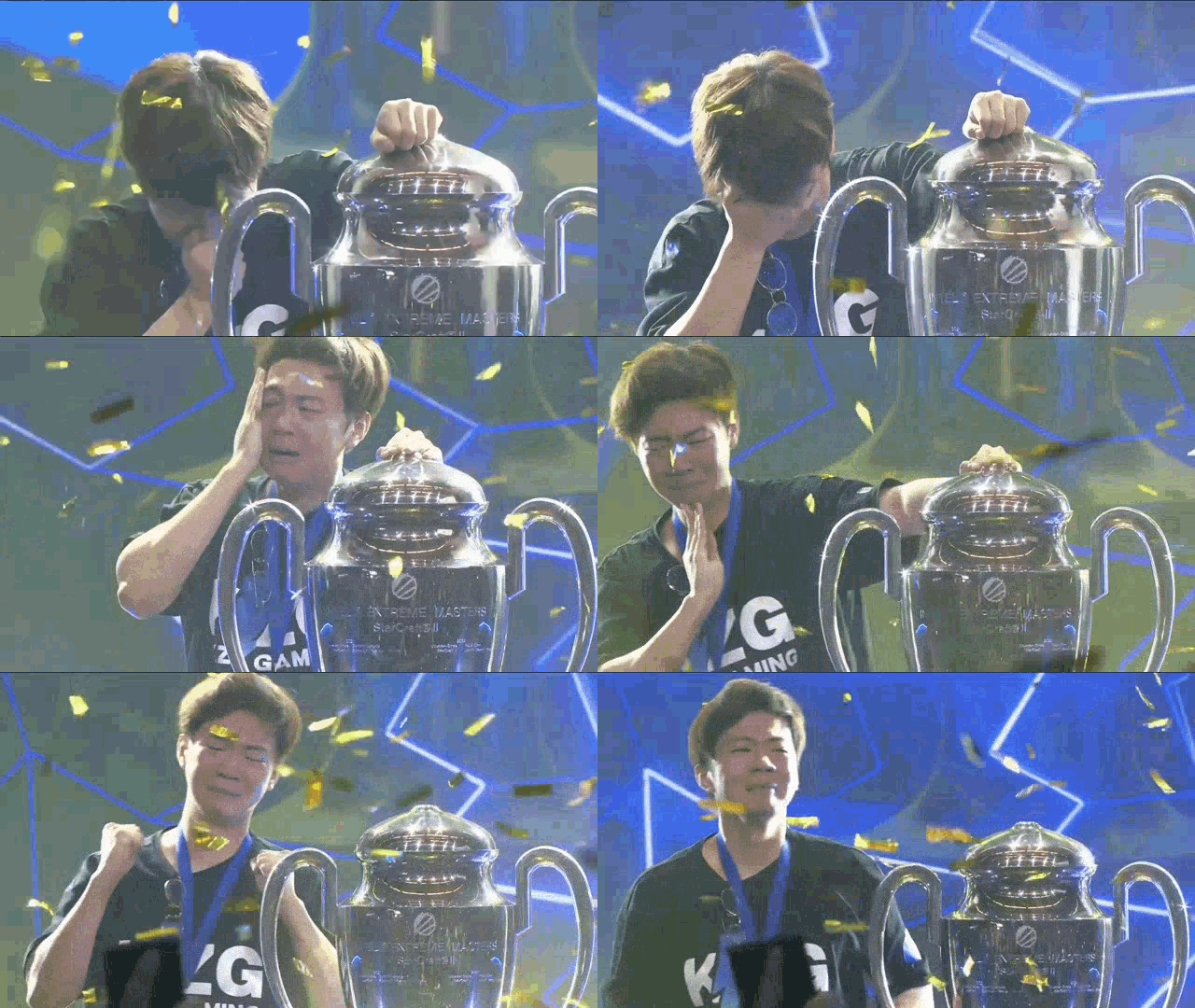
Last weekend in StarCraft, the world championship at IEM Katowice 2023
saw a so-good-it-must-be-scripted Cinderella story,
where Oliveira won the world championship in a totally unexpected way.
It was a whole roller-coaster of upset after upset from Oliveira,
and up until the grand finals we were all still asking,
“this can’t be, is this really happening?”.
Some context: StarCraft has one of the lowest upset rates
of any competitive game out there, and Oliveira (formerly known as TIME)
was ranked something like #21 coming in.
Last November at DreamHack Atlanta (which I was at!),
he didn’t win a single map. And just a month before IEM 2023,
Blizzard had shut down its Chinese servers.
But he’d been practicing 12 to 15 hours a day lately, and it showed.
The final winner interview
was so emotional not only did Oliveira start crying,
the host also started crying …
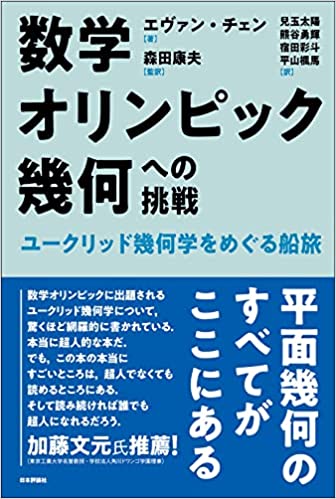
I’m happy to thank 日本評論社 and their team (Fuma Hirayama, Yuki Kumagae, Taiyo Kodama, Ayato Shukuta,
among others) for making the Japanese translation a reality.
As well as tripling the length of the errata PDF :)
This marks the second translation of the EGMO textbook (a Chinese translation
was published a while ago as well by Harbin Institute of Technology). Both linked below:
Japanese translation at nippyo.co.jp and amazon.co.jp.
ISBN-10: 4535789789 / ISBN-13: 978-4535789784.
Chinese translation at abebooks
and amazon.
ISBN-10: 7560395880 / ISBN-13: 978-7560395883.
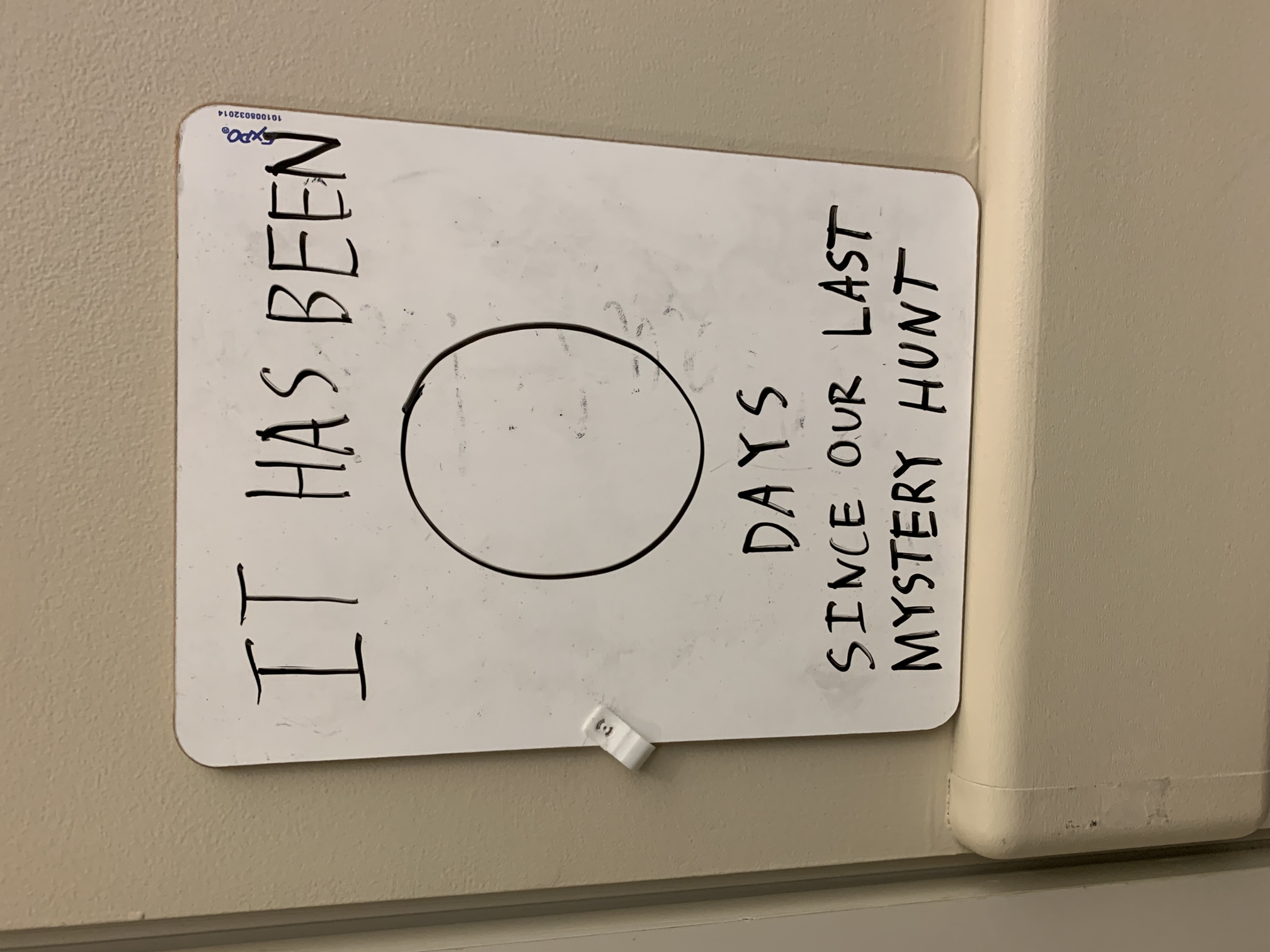
This is a retro-post for the Mystery Hunt 2023,
for which I played a somewhat minor role on the organizing team (teammate).
You can play at interestingthings.museum.
Office décor.
There is an ongoing list of write-ups about the hunt being kept at
puzzles.wiki,
and you may also be interested in the
reddit AMA from teammate.