When I finally open my eyes and look at the clock, it is 8am.
It doesn’t feel like it’s only been eight hours, though.
I’ve just had a long and complicated dream that I can’t remember much of anymore,
except that I think I was running a lot, and trying to not die, so I somehow feel sore.
That NyQuil stuff really works, I think to myself, and crawl out of bed.
(Even though it’s like trying to drink mouthwash.) I haven’t slept that soundly all week.
Or maybe I’m finally slowly recovering from my cold, and that’s why that night was better?
All I know is that I’m glad I didn’t spend another night coughing my lungs out
and struggling to get some shut-eye.
I drag my sorry butt out of bed and head over to my nearby computer …
I think it would be nice if every few years I updated my generic answer to “how
do I get better at math contests?”. So here is the 2019 version.
Unlike previous instances, I’m going to be a little less olympiad-focused than I usually am,
since these days I get a lot of people asking for help on the AMC and AIME too.
With Christmas Day, here are some announcements about my work that will possibly
interest readers of this blog.
OTIS V Applications
Applications for OTIS V are open now,
so if you are an olympiad contestant interested in working with me during the 2019-2020 school year,
here is your chance. I’m hoping to find 20-40 students for the next school year.
Note that the application has math problems in it, unlike previous years, so you have to start early.
OTIS Lecture Series
At the same time, I realize that I will never be able to take everyone for OTIS.
So I am planning to post a substantial fraction of OTIS materials for public consumption,
hopefully by late January, but no promises.
Napkin 2nd edition
The Napkin is getting a second edition which, if all goes well,
should come out by the end of February (but that is a big “if …
There’s a recent working paper by economists Ruchir
Agarwal
and Patrick Gaule which
I think would be of much interest to this readership:
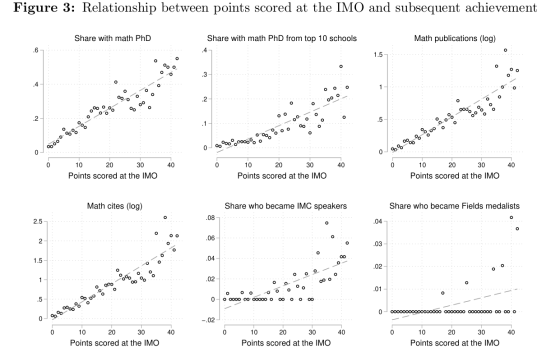
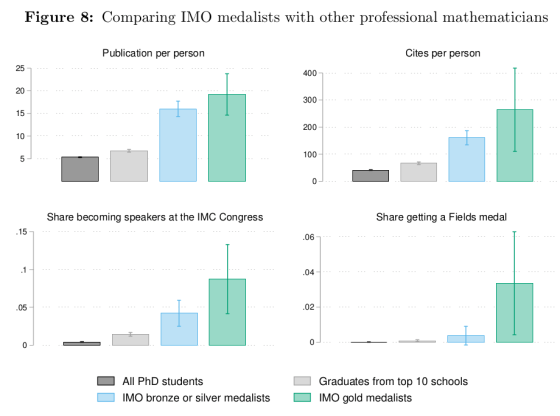
a systematic study of IMO performance versus success as a mathematician later on.
Despite the click-baity title and dreamy introduction about the Millennium Prizes,
the rest of the paper is fascinating, and the figures section is a gold mine.
Here are two that stood out to me:
Points scored at IMO vs subsequent achievements.IMO medalist outcomes.
There’s also one really nice idea they had,
which was to investigate the effect of getting one point less than a gold medal,
versus getting exactly a gold medal.
This is a pretty clever way to account for the effect of the prestige of the IMO,
since “IMO gold” sounds so much better on a CV than “IMO silver” even …
In the previous post we defined p-adic numbers.
This post will state (mostly without proof) some more surprising results about
continuous functions f:Zp→Qp.
Then we give the famous proof of the Skolem-Mahler-Lech theorem using p-adic analysis.
1. Digression on Cp
Before I go on, I want to mention that Qp is not algebraically closed.
So, we can take its algebraic closure Qp — but this
field is now no longer complete (in the topological sense).
However, we can then take the completion of this space to obtain Cp.
In general, completing an algebraically closed field remains algebraically closed,
and so there is a larger space
I think this post is more than two years late in coming, but anywhow…
This post introduces the p-adic integers Zp, and the p-adic numbers Qp.
The one-sentence description is that these are “integers/rationals carrying full
mod pe information” (and only that information).
The first four sections will cover the founding definitions culminating in a
short solution to a USA TST problem.
In this whole post, p is always a prime.
Much of this is based off of Chapter 3A from Straight from the Book.
1. Motivation
Before really telling you what Zp and Qp are,
let me tell you what you might expect them to do.
In elementary/olympiad number theory, we’re already well-familiar …
Some thoughts about some modern trends in mathematical olympiads that may be concerning.
I. The story of the barycentric coordinates
I worry about my geometry book. To explain why, let me tell you a story.
When I was in high school about six years ago,
barycentric coordinates were nearly unknown as an olympiad technique.
I only heard about it from whispers in the wind from friends who had heard of
the technique and thought it might be usable.
But at the time, there were nowhere where everything was written down explicitly.
I had a handful of formulas online, a few helpful friends I can reach out to,
and a couple example posts littered across some forums.
Seduced by the possibility of arcane power, I didn’t let this stop me.
Over the spring of 2012, spring break settled in,
and I spent that entire week developing the entire theory of …
It’s not uncommon for technical books to include an admonition from the author
that readers must do the exercises and problems. I always feel a little peculiar when I read such warnings.
Will something bad happen to me if I don’t do the exercises and problems? Of course not.
I’ll gain some time, but at the expense of depth of understanding. Sometimes that’s worth it.
Sometimes it’s not.
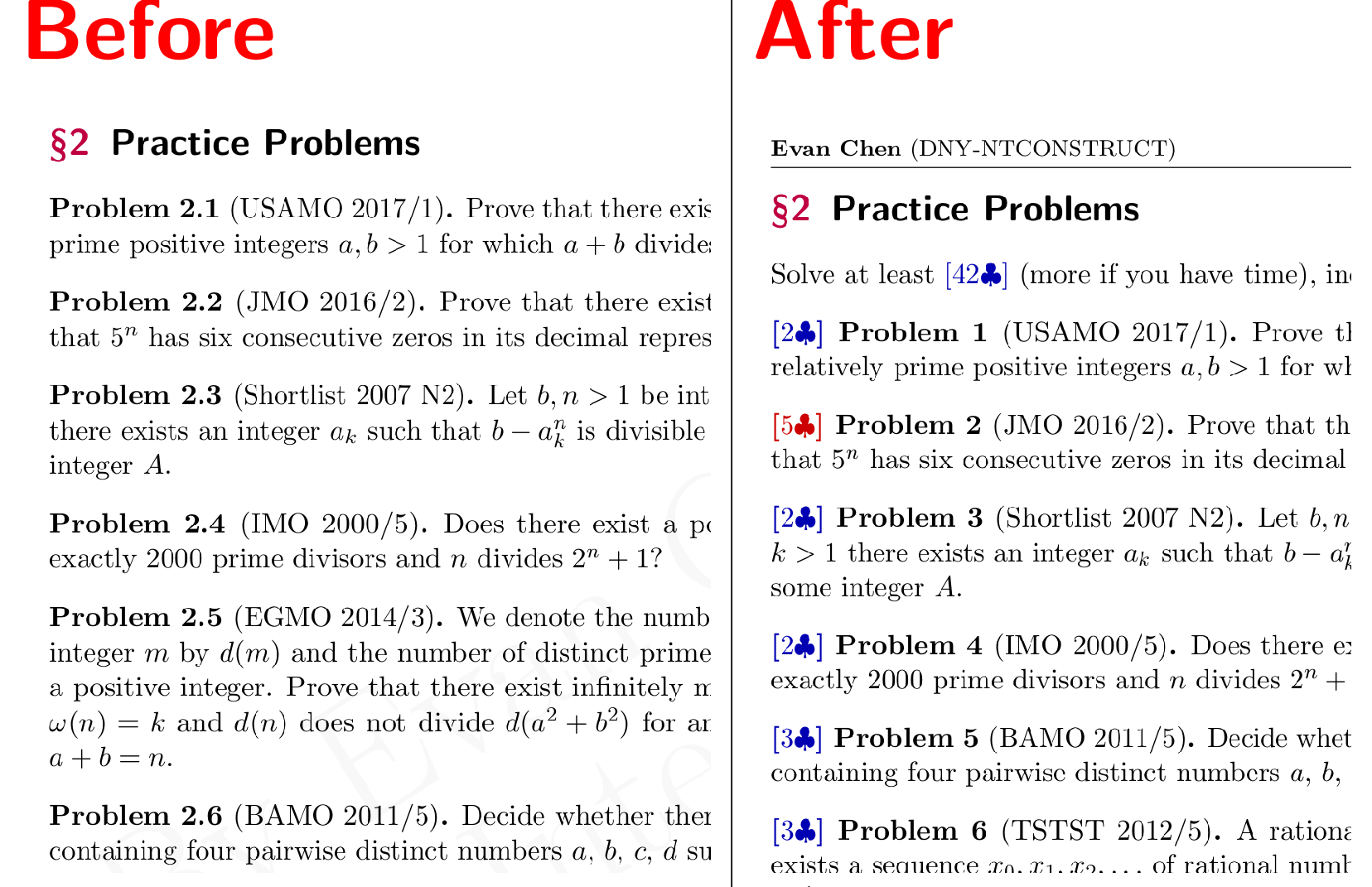
I spent the first few days of my recent winter vacation transitioning all the
problem sets for my students from a
“traditional” format to a “point-based” format. Here’s a before and after.
OTIS problem sets: before and after.
Technical specification:
The traditional problem sets used to consist of a list of 6-9 olympiad problems of varying difficulty,
for which you were expected to solve all problems over …
One of the major headaches of using complex numbers in olympiad geometry
problems is dealing with square roots.
In particular, it is nontrivial to express the incenter of a triangle inscribed
in the unit circle in terms of its vertices.
The following lemma is the standard way to set up the arc midpoints of a triangle.
It appears for example as part (a) of Lemma 6.23.
Theorem 1(Arc midpoint setup for a triangle)
Let ABC be a triangle with circumcircle Γ and let MA, MB, MC
denote the arc midpoints of BC opposite A, CA opposite B,
AB opposite C.